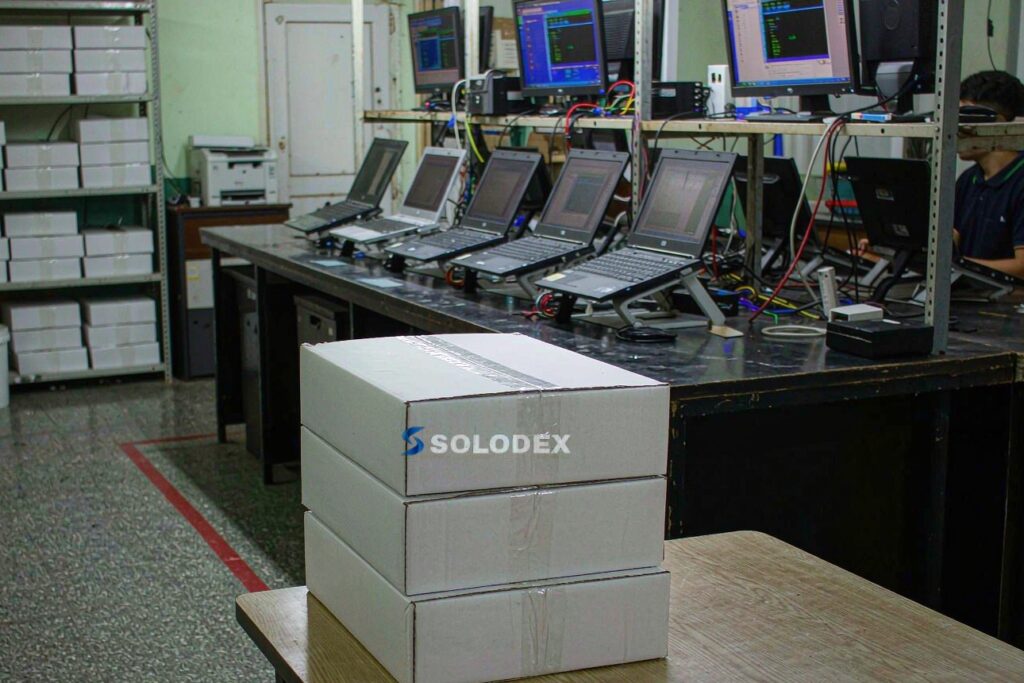
The container was declared as refurbished laptops, three hundred units, second-hand goods for reuse. At the destination the officer opened the doors, walked twenty metres down the aisle, and stopped counting power supplies at nine.
No adapters, no test sheets, four different models mixed in the same cartons, and a visible crack across one screen in five. The declaration said reuse. What was in the container was a consignment of equipment that could not be switched on, and in the importing country that is not a quality problem. It is a different legal category, with a different permission, and the permission had not been applied for.
The goods were returned at the shipper’s cost. The freight was more than the cargo was worth, which is the ordinary ending of this story.
The first question is not what it is worth
Every other category in this batch begins with a property of the goods: a gas, a pressure, an acid. This one begins with a question that has nothing to do with the object and everything to do with its future.
Is this equipment destined for direct reuse, or is it destined to be repaired, dismantled or recovered? If it is going to be used, it is goods. If it is going to be opened up, it is waste – and waste crosses borders under a separate international regime, with a separate permission, granted consignment by consignment.
That regime exists because a great deal of what is described as second-hand equipment is, in practice, a way of moving disposal costs from one country to another. It is the same structure as the clothing trade: a trade in used goods where the honest version and the disguised-dumping version travel in identical containers, and the difference is decided by evidence rather than by description.
“Refurbished” is a process, not a status
This is the sentence that costs people containers, and it is the same trap as a used machine that is old enough to be a different product: the word describes an intention, and the border asks for a condition. Refurbished describes what somebody did in a workshop. It does not describe the legal condition of the goods at the border, and no authority is obliged to accept it as an answer.
What the authority is looking for is narrower and more physical: is this unit fit for its intended use, complete, and destined for a user. Three tests, all of which a functioning shipment passes easily and a marginal one fails visibly.
Fit for use means it powers on and performs its function. Not “mostly works” – a laptop with a dead battery and a cracked panel is not fit for its intended use as a portable computer, and no test sheet changes what the officer can see.
Complete means the accessories that make it usable travel with it. A laptop without its power supply is, at the border, an incomplete unit – and incomplete units are the classic signature of a load that is going to be stripped rather than sold.
Destined for a user means there is a named buyer, a purchase order and an end use. Equipment sent speculatively, to a trader, with no identified customer, has no destination in the sense the rules mean.
Which is why the paperwork that matters here is not an invoice. It is a test record per serial number, and a packing list that lists the serial numbers those records cover.
Two flows that look identical and are not
There is a legitimate, entirely normal movement of broken equipment across borders: it goes to a workshop, it is repaired, and it comes back. That flow is not a waste shipment, because the goods are not entering the destination’s economy – they are visiting it.
It works because the paperwork says so: a repair declaration identifying the owner, the units and the expected return, sometimes a carnet, and a paper trail that closes when the goods come back. The distinguishing feature is not the condition of the goods. It is that the same units are expected to leave again.
The moment the units are sold in the destination instead of returned, the shipment changes character retrospectively, and the declaration that made it simple becomes a false statement. Which is why forwarders in this trade ask an awkward question before booking: is this repair-and-return, or is this a sale with a cosmetic repair attached.
What survives a physical inspection
This is the practical heart of it. Whatever the documents say, somebody at the destination may open the container, and the decision will be made on what they see. So the shipment has to be built for that moment.
Uniformity. One model per carton, or at least one model per pallet. Mixed models in a carton read as sorted scrap, because that is what sorted scrap looks like.
Accessories travelling with the unit. Power supply, cable, and where relevant the dock or the stylus, packed with the unit rather than in a separate carton that may or may not arrive.
The test record inside the carton. This is evidence made before it is needed, and it has the same property as a loading survey: it is worth nothing unless it exists at the moment somebody asks. A printed sheet with the serial number, the date, the functions tested and the result, in the box with the unit it describes. Not a folder in the office, not a PDF that nobody at the port can open.
Serial numbers on the packing list. If the list says three hundred units and the records cover three hundred serials, the consignment has an identity. If it says “assorted laptops”, it has a description.
Nothing that looks like removal. Units with the hard drive pulled, the battery missing or the RAM stripped look exactly like units being harvested – because that is the first thing a dismantler does.
Two sub-problems that make goods look like waste
The battery. A modern laptop contains a lithium battery, and a consignment of used laptops therefore contains hundreds of them, at unknown states of health. That is a dangerous goods question in its own right – one that hides inside a product nobody thinks of as dangerous – and it gets worse with age: a swollen pack is a damaged battery, which is a different and stricter category than a working one. Removing the batteries to simplify the transport, though, produces units that cannot be tested – which undermines the very evidence the shipment depends on.
The data. A wiped drive is the right thing to do, and it creates a machine that will not boot to a desktop in front of an inspector. So the test record has to describe what was tested after the wipe – power, display, ports, keyboard, charging – rather than an operating system that is no longer installed. A refurbisher who documents “boots to BIOS and passes diagnostics” is describing a reusable machine. One who documents nothing has a container of unverifiable electronics.
The charity route, again
Donated computers attract the same treatment as donated clothing, for the same reason: the exemption is real, narrow, and heavily used. Goods given to a registered organisation, for distribution rather than sale, with a named beneficiary, can move on a different footing from commercial stock.
The tell is identical too. Charity equipment is not graded, not serial-listed for resale, and not packed in matched cartons with test sheets. A consignment that arrives sorted, tested and priced, addressed to a company, is a commercial shipment wearing a donation letter – and in this category the consequence is not a delay but a reclassification into waste, with everything that follows.
Four containers of the same laptops
| What is in the container | How it is treated | What decides | The usual mistake |
|---|---|---|---|
| Tested units, complete, with serials on the list | Second-hand goods for direct reuse | The per-serial test record and the accessories in the box | Doing the testing but keeping the records in the office |
| Untested or incomplete units for resale | Assessed as waste on inspection | What the officer can see when the doors open | Believing “refurbished” on the invoice settles the question |
| Units sent abroad for repair and return | Not a waste shipment, if the return is documented | The repair declaration and the closed loop | Selling them at the destination instead of returning them |
| Donated equipment for a registered beneficiary | Possible under an exemption, with conditions | Whether it is genuinely unsorted and given away | Sorting, testing and pricing it, which turns it back into stock |
The second row is where most of the money is lost, and the reason is structural: the decision is taken by somebody looking at the goods, while the argument is prepared by somebody looking at the invoice. Those two people never meet, and the container is the only place their conclusions are compared.
What to establish before the container is packed
Which flow is this – reuse, repair-and-return, or recovery? Answered in writing, by the importer, before anything is tested. It determines which permission applies, and there is no version of this where the answer can be adjusted later.
Is every unit complete and functional? Per serial, with the accessory count matching. One missing adapter per unit is a thousand missing adapters.
Do the records travel with the goods? Inside the carton, in the language of the destination if that is required, referring to the serial on the unit.
Do the batteries create a separate problem? Age, swelling, state of charge – and whether the transport can be done with them installed rather than removed.
Is the buyer named? A purchase order and an end user, not a trader who will find one.
Would a refund of the freight be cheaper than a return? Asked at the quotation stage, because in this category the answer is frequently yes, and it changes how much testing is worth paying for.
Decided by a look
Every other category in this batch has a number you can read: a charge in grams, a date on a shoulder, an acid in a case. This one has no such number, which is exactly why it is the hardest to argue and the easiest to lose.
The whole shipment resolves into a single moment – a person opening a container and forming a judgement in about ninety seconds – and everything the shipper does either prepares for that moment or does not. Testing without records, records without accessories, accessories in a separate carton, a charity letter over a priced pallet: each of them is a way of doing the work and then losing the argument anyway.
Which makes the discipline unusually simple to state. Pack the container as though an inspector will open it, because in this trade the inspector is not a risk to be managed. The inspector is the reader the whole shipment is written for.
And the same lifecycle question appears one step earlier: a product banned by category never becomes second-hand goods at all.
And for used parts the material is harder to establish than the age: “stripped from vehicles” describes origin, not composition.
The same question arrives at the other end of life: a detector off a ceiling is a source, not electronic waste.
Used goods may need an extra inspection that quietly consumes the slack left in a peak-season plan; the rule is in refurbished electronics and Basel.


