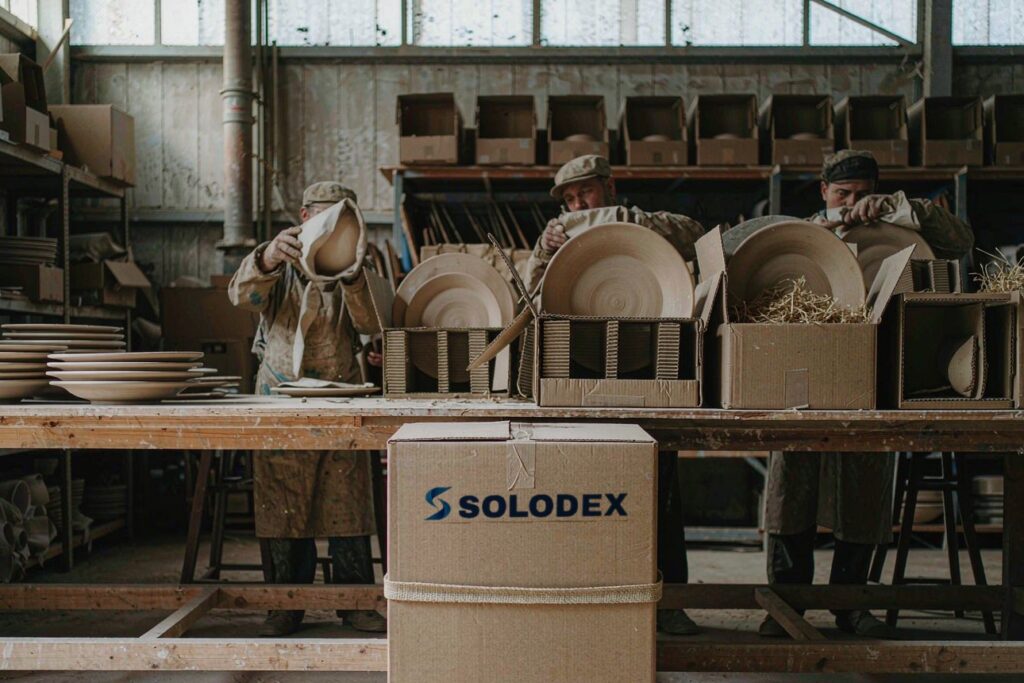
Two products left the same workshop in the same week, made from the same clay body and dipped in the same glaze. One was a mug. One was a vase. Both were invoiced as ceramic ware, both were packed in the same carton, and only one of them needed a test that costs more than the goods.
The difference is not quality, price or finish. It is a single question that decides which set of papers the shipment needs, and it is asked of the product rather than of the shipment: does it touch food?
One line, two regimes
Ceramics and glass sit in the same customs chapter and, very often, under the same tariff line. But the compliance regime splits them cleanly at the point of contact with food.
A plate, a mug, a bowl, a storage jar, a cooking dish — anything intended to hold or serve food — is a food-contact article. That brings it into a regulatory category with its own testing, its own documentation and its own liability, in every major market.
A vase, a figurine, a lamp base, a decorative bowl too large and too porous to serve from — is not. It has to meet rules about what it is made of and how it is labelled, but it does not have to demonstrate that it does not put metal into food.
Which means two objects that look identical on a shelf can require completely different paperwork. And it means the first decision in the whole shipment is not packing, routing or price. It is: which of these is which, and does the invoice say so.
The test measures migration, not content
This is the part that surprises manufacturers, because it inverts the intuition. The laboratory is not asked how much lead is in the glaze. It is asked how much lead comes out of the glaze into food.
The method is a simulation. The article is filled, or its surface is covered, with a dilute acetic acid solution — the standard stand-in for food — and left for a defined period at a defined temperature. Then the liquid is analysed, and the result is expressed as an amount per unit of surface area or per volume.
Two consequences follow. A glaze formulated with lead can pass, if it is fired properly and the metal is locked into the glassy matrix. And a glaze with almost no lead can fail, if it is under-fired, over-decorated or applied too thickly, because what matters is the finish, not the recipe.
That is why the report describes a process as much as a product, and why a factory that changes its firing curve for a busy season can invalidate a test it passed in spring.
The report covers a family, not a model number
Testing is expensive enough that nobody tests every SKU, so the system runs on product families: a shape, a body, a glaze and a decoration, treated as one qualified item. Add a colour and you may still be inside the family. Change the glaze, add a metallic decal, or move the decoration onto the food-contact surface, and you are outside it.
This is where shipments fail after the sample passed. The sample was the white version with a clear glaze; the order includes a red version with a gold rim; the gold rim is a metal decoration on a surface that touches the lip. The report covers the first and not the second, and the certificate presented at the border describes a product that is not in the container.
The rule that follows is unglamorous and worth writing into the purchase order: every variation that reaches the food-contact surface needs to be inside the scope of the report, or it needs its own report. Colour on the outside is usually fine. Anything on the inside is not a variation, it is a different product.
The same factory, two sets of papers
A workshop that makes both mugs and vases has to keep the two apart at every step, and the place where they get mixed up is not the kiln. It is the invoice.
One line reading “ceramic ware, 12,000 pcs” tells the broker nothing about which items are food-contact, which have reports, and which do not. The entry then gets built on an assumption, and the assumption is usually that everything is the same — which produces either a needless hold on the decorative goods or, worse, a food-contact article moving without the paperwork it needed.
The fix is a column, not a paragraph: a description that names the article, a separate line for the food-contact items, and the report reference against the line it covers. Then the certificate that arrives can be matched to a line rather than to a shipment, which is the difference between a check that takes a minute and a query that takes a week.
Dense, brittle, and allergic to free fall
Ceramics and glass are heavy for their volume — around two tonnes per cubic metre for a packed carton of stoneware — which decides the transport before anything else does. They go by sea, in full containers, because the air freight bill on a dense fragile article is a multiple of its value.
That puts them in a container for four to six weeks, on a floor that vibrates, in a stack that settles, with a humidity cycle that softens carton board. Breakage in that environment is not caused by a single impact. It is caused by thousands of small movements in which two hard surfaces touch.
| The failure | What causes it | What actually fixes it |
|---|---|---|
| Rim and handle breakage | Point loading inside the carton; the handle takes the stack above it | Dividers that carry load on the body, not on the handle; orientation so that no handle is under another piece |
| Surface chipping and glaze scratching | Piece-to-piece contact during vibration | Interleaving or individual wrapping, and a carton that is filled to the top rather than left with a gap |
| Layer collapse in the container | The bottom carton’s board softening over weeks of humidity | Carton grade chosen for the stack height and the voyage, and a stacking plan that does not assume the box is stronger than it is |
Read the middle column against the right one. Almost every breakage complaint is answered with more packaging material, and almost none of them is caused by too little material. They are caused by the load path — where the weight goes when the container moves — and the load path is decided by the divider design, not by the amount of bubble wrap.
Design decides the rate before packing does
Three features account for most ceramic breakage, and all three are drawn before anything is packed.
The handle is the classic. It is a thin section attached at two points, it protrudes, and it is exactly where a stack wants to put load. A handle designed to be flush, or a carton designed so that handles face inward and cannot take weight, changes the failure rate without changing the packaging budget.
The rim is the second. A thin rim chips on contact and is the first thing a customer inspects. The foot is the third: a small foot ring concentrates the entire weight of the piece on a hard circle, which is fine on a table and not fine in a stack.
Which is why the honest conversation about breakage happens with the product designer, not with the packing supplier — and why the evidence that decides a claim is the photograph taken before the carton was closed, not the one taken after it was opened.
Glass fails differently, for the same reasons
Glass is the denser cousin and behaves differently in transit. A ceramic piece tolerates compression and fails on impact; a glass bottle tolerates impact better than it tolerates the wrong load, and it fails at the neck, which is the thinnest section and the one every divider seems designed around rather than for.
Which means the packaging question changes shape. Bottles want moulded pulp or dividers that hold the body and leave the neck free, a full carton so nothing can move, and a layer arrangement where no bottle stands on another bottle’s shoulder. Cases that are packed loose in a carton and then stacked four high are the classic source of a claim, and the damage is always at the top third.
The rest is shared: the container vibrates, the board softens, the stack settles, and whatever was going to move moves. Glass just gives less warning before it does.
What the freight actually charges for
Because the goods are dense, the container fills by weight long before it fills by volume. A twenty-foot container of packed stoneware reaches its payload limit with space left over, which means the freight cost per piece is driven by kilograms and the empty space is free.
That has one useful consequence for a buyer comparing quotes: for this category, the rate per cubic metre is close to meaningless. What matters is the rate per tonne and whether the loading plan uses the payload properly. It also means that over-packaging — extra material to solve a breakage problem — costs twice, once in material and once in the kilos it adds to a container that was already full.
Five things to settle before the order is placed
Which items in this order touch food? Named individually, not by category. A “decorative” item that a customer will reasonably serve olives from is a food-contact item in most markets.
Does the report cover this shape, this glaze and this decoration? If the answer is “the report covers our ceramics”, the report covers nothing.
Is the invoice written so a broker can tell the two apart? Separate lines, with the report reference against the line it belongs to.
Is the carton graded for the stack it will be in, on that voyage? Not for a one-metre drop in a laboratory.
Where does the load path run? Through the body of the piece, or through the handle and the rim. That single decision is worth more than any change of packing material.
None of these is a freight question, and all of them change what the freight costs — the same way a used machine’s admissibility is decided before anybody measures it against a container. For ceramics, the gate is narrower and simpler: it is a question about a mouth.
The cup, not the vase
A shipment of ceramics is not one product. It is a set of objects of which some will be eaten from and some will not, and the border treats those two groups as different things with different evidence requirements.
Getting that wrong is expensive in both directions: a food-contact article without a report is a hold, a recall risk and a liability; a decorative article tested as if it were a plate is money spent for nothing.
The question is short enough to ask at the sample stage, and asking it there is the whole trick. Everything downstream — the invoice lines, the test scope, the carton design, the loading plan — is easier once somebody has said out loud which of these is going to be drunk from.
The gate changes with the goods. Where ceramics are decided by whether they meet a mouth, seed is decided by whether it is alive.
Where ceramics are judged by what they touch, a tyre is judged by when it was made — and the two categories sit at opposite ends of the freight arithmetic as well.
Glass is the shared burden: a case of wine is mostly packaging and water, which is why the freight maths looks like ceramics rather than like a luxury good.
Ceramics and glassware need packaging that survives handling and vibration; outside the box, the column of containers is checked for transverse racking, longitudinal sliding and vertical lift as three separate margins.


