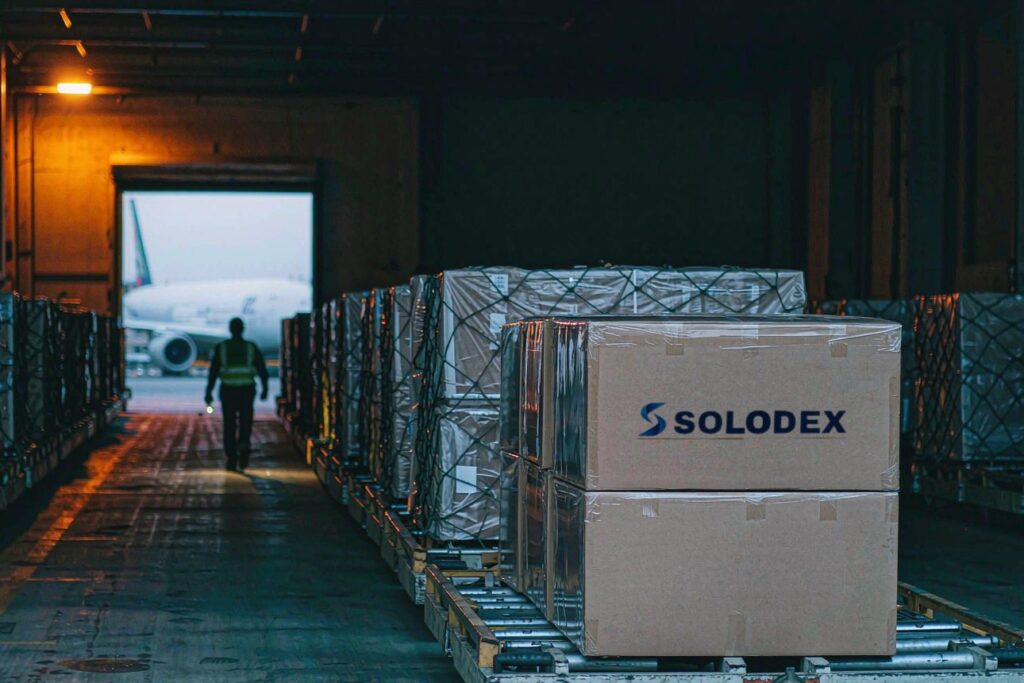
The flight took twelve hours. The shipment took six days. It landed on a Tuesday at 07:20 with a clean entry, and it was signed for on Friday afternoon at 15:40 — which means that of the hundred and fifty hours between the wheels leaving Shenzhen and a pallet going through a warehouse door in Rotterdam, roughly eight per cent were spent in the air.
Nobody was negligent. Every party did its part within its own hours. What happened is what always happens: the flight is the only segment of an air shipment that has a published duration and cannot be slowed down by a queue, which is exactly why it is not where the time goes.
Understanding where it does go changes what you buy.
The flight is the part nobody can hold up
Aircraft depart on schedule because the schedule is the product. A freighter does not wait for one more pallet, and it does not run late because the terminal was busy — it runs late because it arrived late, which is an airline problem and a rare one.
Everything around the flight, by contrast, is a queue with opening hours. A truck that arrives after the receiving window waits until morning. A screening line that closes at ten leaves the pallet for the next shift. A customs system that wants one more document does not process anything until somebody types it. A warehouse that works Monday to Friday turns a Friday arrival into a Tuesday delivery.
So the useful way to model an air shipment is not as a flight with ground handling attached. It is as a sequence of gates, one of which happens to be an aircraft.
Seven segments, and only one of them flies
| Segment | Typical time on a main lane | Who holds it | What releases it |
|---|---|---|---|
| Collection from the shipper | Half a day to a day, more if the factory is inland | The trucker’s route and the shipper’s readiness | Goods packed, documents issued, vehicle booked |
| Acceptance and screening | Two hours to a day | The approved facility’s queue | A security status and a weight |
| Build-up and cut-off | Two to six hours, before a fixed cut-off | The handler’s build plan and the aircraft’s contour | A pallet that fits the flight |
| The flight | Three hours to a day, by route | The airline | Nothing — it is the one fixed block |
| Breakdown at destination | Two to eight hours | The destination handler’s shift pattern | A pallet position in the shed |
| Entry and release | Four hours to three days | The broker, the importer and the customs system | A complete declaration and the duty paid |
| Delivery | Half a day to two days | The receiver’s dock and calendar | A booking and somebody who can sign |
Add the columns up and the shape of the problem appears. The two segments a shipper worries about — the flight and the freight rate — are the ones with the least variance. The variance sits in the four segments that happen on the ground at each end, and every one of them is governed by somebody else’s working day.
There are two cut-offs, and only one is published
The origin cut-off is a known number. It is printed in the booking confirmation, it is enforced, and it is the reason a shipment that arrives ninety minutes late does not fly.
The destination has a cut-off too, and nobody publishes it. It is the moment on the day of arrival after which the entry will not be processed until tomorrow, and it is set by the broker’s workload, the customs system’s hours, and whether the duty has been funded. Miss it and the cargo sits in a shed for a day — with storage running and nobody particularly concerned, because from the carrier’s point of view the goods have arrived.
This asymmetry explains the most common misunderstanding in air freight: shippers measure the flight, and the industry measures arrival. A consignment that lands on time and releases two days later is, by every operational KPI in the chain, on time.
The weekend is a segment
Most of the chain works five days a week, and the parts that work seven are the expensive ones. A Friday afternoon arrival therefore does not become a Saturday delivery; it becomes a Monday or Tuesday delivery, and the two days in between are not a delay anybody will admit to causing.
The same arithmetic applies to public holidays, and it compounds when the two ends do not share a calendar. A shipment leaving before a week-long holiday at origin and arriving before a long weekend at destination can lose four working days without a single thing going wrong.
Which is why the honest transit time quoted by an experienced forwarder is not the sum of the segments. It is the sum of the segments plus the days that the calendar will eat, and the second part is why two forwarders with identical routings quote five days and seven.
Arrival to release is the number nobody measures
Ask a shipper how long their air freight takes and they will quote the transit time from the booking. Ask what happened between landing and the truck arriving and most cannot answer, because that interval is not in any report they receive.
It is, however, where the recoverable days are. Three causes account for most of it. The declaration is incomplete — a value that does not match the invoice, a description that the tariff cannot resolve, a certificate that exists but has not been sent. The broker has not been instructed, which happens when the arrival notice goes to an inbox that nobody owns. Or the duty has not been paid, which is a treasury question that surfaces as a logistics delay.
None of these is a transport problem, and all of them are counted against transport. The fix is unglamorous: put the arrival date and the release date on the same report, and look at the gap. A company that measures that gap once usually discovers it is losing more days there than in any routing decision it has ever argued about.
What “express” actually buys
The premium services do not fly faster. A courier’s aircraft cruise at the same speed as a freighter’s, and the great circle distance does not care who is paying.
What express buys is position in the queues. A courier owns its aircraft, its hub, its sorting line and, crucially, its own brokerage — so the segments that are separate companies in ordinary air freight are departments inside one company with one service standard. That integration, not the aircraft, is what turns six days into three.
Which is also why express stops being competitive at a certain size. The integrated network is built for parcels and documents, priced per kilo with a minimum, and it degrades quickly when the shipment becomes a pallet that needs a contour, a security status and a formal entry. Above that line you are back to a built unit moving through somebody’s screening queue, and the integration advantage disappears.
The last mile is a booking, not a drive
Delivery is the segment shippers treat as automatic and the one that most often adds a day, because it depends on a party who has signed nothing with anyone in the chain. The receiver has to have a dock free, a person who can sign, and a slot in a calendar that was probably filled a week ago.
This is where a delivery fails for reasons that are nobody’s fault and everybody’s problem: the goods are at the destination, the entry is done, and the truck goes back because the bay is occupied. One day, sometimes three, added at the very end of a chain that was optimised from the front.
Where the promise is built
A quoted transit time is a sum of assumptions, and every assumption belongs to a different company. The forwarder assumes the goods are ready on the stated date, the handler assumes the pallet is at the terminal by cut-off, the airline assumes the flight operates, the broker assumes the documents are complete, and the receiver assumes nothing at all because nobody asked.
The weakest assumption is almost never the flight. It is whichever of the five has not been confirmed in writing, and finding out which one that is takes one conversation rather than a better rate.
There is also a structural point worth holding on to: air freight’s real competitor is not the sea. It is the next departure. For most cargo, the difference between five days and seven is not a reason to consider a container — but it is the difference between hitting a launch date and missing one, which is why the days on the ground matter more than the hours in the air.
Five questions that locate the days
What is the cut-off at origin, in local time? Not the flight time. The moment the cargo stops being able to board.
Which day does it land, and which days does the destination work? A Friday landing on a five-day week is a Monday or Tuesday delivery, and that should be in the quote rather than in the surprise.
Who is instructed to clear it, and by when? The arrival notice needs an owner, not an inbox.
What has to be true for the entry to be released on the day of arrival? Value, description, certificates, duty funding. Four items, all of them checkable before departure.
What is the receiver’s booking lead time? If the answer is measured in days, the delivery date is not the forwarder’s to promise.
None of these changes the rate. All of them change the date, and the date is what most air cargo is actually bought for. It is also the same logic that runs through the documents and through the waybill that carries them: the paperwork does not move the aircraft, it moves the cargo off the ground.
Ground time with a flight in the middle
The industry sells air freight as speed, and the speed is real — but it is bought on the ground. Every day saved between a factory door and an aircraft hold comes from somebody moving a queue: opening a screening line earlier, booking a truck the night before, getting a declaration right the first time, telling a receiver the goods are coming.
Which is why the two shippers on the same flight, with the same rate and the same routing, can be five days apart. One of them is measuring the flight. The other is measuring the gap between arrival and release, and has spent the last year closing it.
The aircraft was never the constraint. The queue was — and every queue has an owner who could have been asked.
Air freight time is spent in a chain of ground handling steps; on a ship, time at a middle call can be spent lifting a box off and back on with nothing delivered, which is why the load and discharge lists share a container number.


