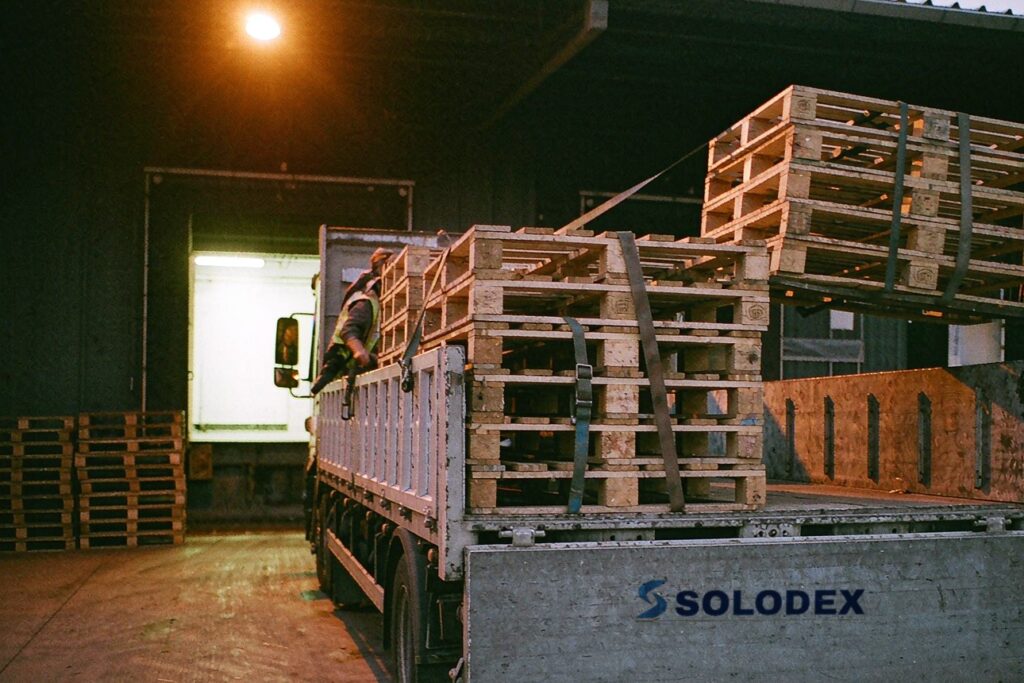
The pallet that was fine until it went on the rack
The pallet sat in the factory for three days with 700 kg on it and did not move. It went into the container, crossed an ocean, came out at the destination warehouse, and was lifted onto the second level of a rack. Two days later the deck was bowed and the cartons on it had started to lean.
The buyer’s question was reasonable: the pallet is rated at 1,500 kg, the load is 700. The answer is that the pallet has three ratings, and the one printed on the invoice is almost always the largest. On the ground, evenly loaded, it may well carry 1,500 kg. Being driven across a dock on a forklift, it carries less. Sitting on two steel beams with nothing underneath the middle, it carries less again.
That is the whole problem with pallets, and it is not a manufacturing defect. A pallet is a structure, and a structure is defined by how it is supported. Change the support and you have changed the pallet.
Three numbers, one of which gets quoted
Pallet ratings are usually given as a set, and the order never changes.
Static load is the pallet on a flat floor with the weight evenly distributed and nothing moving. It is the largest number, and it is the one that ends up in the quotation because it is the most flattering.
Dynamic load is the same pallet being moved — lifted, set down, driven over a dock plate, braked. Impact and deflection mean the safe figure drops, typically to something like two thirds of static.
Racking load is the pallet resting on two beams with the centre unsupported. The deck now has to span a gap, and the figure falls again, often to about a third of static. This is the number that matters if your cargo is going into a distribution centre rather than onto a shop floor, and it is the number almost nobody asks for.
So “rated at 1,500 kg” is not wrong. It is one of three sentences, and the one you were not told is the one your warehouse will test.
The load path runs through the corners
Look at where the weight actually goes. The cartons press on the deck boards; the deck boards press on the stringers or the blocks; the stringers press on the forklift’s forks or the rack’s beams. Every one of those is a different kind of stress: the boards bend, the stringers take compression and bending, the blocks take pure compression.
Two consequences follow, and both are visible in the first hour of any loading bay.
The corners carry the stack. When pallets are stacked, the weight of the upper pallet lands on the four corner blocks of the one below, not evenly across its deck. A pallet whose corners are chipped, damp or made of short grain has lost most of its capacity even though the deck looks fine. This is why a stack can look perfect at the top and be collapsing at the bottom.
A forklift is not a floor. The forks enter from one side and lift. For a moment the load is carried on two narrow strips, with the centre of gravity outside the wheelbase, and the pallet is being asked to act as a beam in a direction it was not designed for. Most pallet failures that get blamed on the load happened at this moment, in front of witnesses who describe it as “it just folded”.
Five centimetres of overhang is a different pallet
Overhang is when the cargo is wider than the pallet. It is extremely common, because the carton size is set by the product and the pallet size is set by whatever the supplier has, and a few centimetres is easy to ignore.
Mechanically it does three things at once. The load no longer sits over the stringers, so the deck boards are carrying it in bending rather than passing it down — and the fasteners are now in shear. The pallet’s own footprint is unchanged, so the stack above is still landing on the corners while the weight sits outside them. And in a container, the overhang eats the gap you needed between pallets, so the load that was going to be secured by friction is now touching its neighbour before the doors are closed.
None of this shows up in a photograph. A pallet with five centimetres of overhang looks like a pallet.
The film is a constraint, not packaging
Stretch wrap does one job: it holds the load together as one object. It does not make the pallet stronger, it does not protect the cartons from impact, and it does not compensate for a bad stack pattern.
What it does do is prevent the small movements that accumulate. A pallet that shifts two centimetres on every corner becomes a leaning pallet by the end of a voyage; the film’s job is to make those two centimetres impossible.
Which means the useful questions are about tension and coverage, not about how many turns. Film applied too loosely does nothing. Film applied too tightly compresses the bottom cartons and crushes the corners it was supposed to protect — a failure that looks exactly like a bad carton and is not one. The practical test is to lift one corner of the wrapped load: if the pallet comes up with it, the film is doing its job; if the load shifts inside the film, it is decoration.
Corner boards and a top cap are the parts that turn film from a wrapper into a constraint. They spread the force over the panel instead of concentrating it on one edge, and they are the first thing removed when someone is trying to save a few cents per pallet.
A pallet has an owner, and it is usually not you
Pallets are the only part of your shipment that is also somebody’s asset, moving around a pool and expected to come back.
One-way pallets are bought, used once and forgotten. They are cheap per unit, they arrive in whatever condition the supplier had, and nobody inspects them because nobody owns them.
Pool pallets — the standardised exchange pallets used across Europe and in many Asian pools — belong to a system. They are repaired, graded and reissued, and they come with an obligation: you receive twenty, you owe twenty. Keep them too long and a rental charge starts; lose them and you pay a replacement price that is well above the cost of a new one-way pallet.
This is where a shipping decision quietly becomes an accounting one. The pallet count has to appear on the packing list, the exchange has to be recorded at receipt, and somebody has to be responsible for the returns — otherwise the cost arrives six weeks later as a debit note that nobody recognises.
What the wood carries besides the load
A pallet is also a quantity of water. Kiln-dried hardwood sits somewhere around fifteen per cent moisture content and can be higher; a 40-foot container of twenty pallets is several hundred kilograms of timber, and over a cold night at sea it gives up some of that water into the air inside the box.
That water lands on whatever is coldest — usually the container roof — and drips. It is the mechanism behind most rusted machinery and collapsed cartons that arrive in an otherwise dry container, and it is treated properly in its own place. What matters here is the connection: the pallet that was cheapest, or the one that sat in the yard for a month before loading, is also the one carrying the most water.
And note what the ISPM 15 stamp does and does not do. It certifies that the wood has been treated against pests. It says nothing about moisture, strength, grade or whether the pallet will survive being racked.
Five ways a good pallet still loses the load
The table is the short version. The middle column is what you will actually see at the destination, and the right-hand column is the question that would have prevented it.
| The situation | What you see afterwards | The question that prevents it |
|---|---|---|
| Only the static rating was quoted | The deck bows on the rack, cartons lean | What is the racking load, and will it be racked? |
| Cargo overhangs the pallet | Deck boards split at the ends, fasteners pulled | Does the carton footprint fit inside the pallet, with no overhang? |
| Corner blocks damp or chipped | The stack sinks at one corner; nothing looks broken | Who inspects pallets before loading, and against what? |
| Film too tight, no corner boards | Bottom cartons crushed, corners rounded | Is the film tension specified, and are edge boards used? |
| Wet timber loaded | Rust, stained cartons, collapsed board | What is the moisture content, and how long has it been outside? |
The arithmetic of a pallet footprint
Pallet size is usually treated as a purchasing detail. It is a freight decision, and the arithmetic is short.
A 40-foot high cube is about 12 metres long and 2.35 metres wide inside. Pallets of 1,200 by 1,000 millimetres go two across and ten rows deep: twenty pallets, using 2.0 metres of the width and leaving 350 millimetres that will be filled with nothing. Pallets of 1,200 by 800 also go two across and ten rows deep: twenty pallets, using 1.6 metres of the width and leaving 750 millimetres of air.
Same container, same pallet count, twenty-five per cent less cargo in the second case — because each pallet carries 0.96 square metres instead of 1.2. If the destination pool only accepts the smaller size, that is the price of belonging to the pool, and it should be compared against the cost of re-palletising at destination rather than against the price of a pallet.
The same arithmetic decides how many pallets fit before the load plan runs out of height. A pallet 150 millimetres tall with 1.6 metres of cargo on it is 1.75 metres; two tiers is 3.5 metres, which does not fit under a 2.69-metre door. So the pallet height is not a trivial number either — it decides whether the second tier exists at all.
The long pole is the load plan
Every decision in this article is made before the first carton is placed: the pallet type, the rating that matters, the footprint, the stack height, the film specification, the exchange arrangement. After that, the load is what it is, and the only remaining actors are a forklift driver and gravity.
Which is why the useful conversation happens at the loading plan, with three numbers on the table: the racking load if the cargo will be racked, the footprint with zero overhang, and the moisture content of the timber. None of them costs anything to ask. All of them are cheaper than the alternative, which is a container of leaning pallets and a claim that has to prove the pallet was adequate — a proof that starts with a specification nobody wrote down.
And the reason it is worth being precise here rather than at the carton is that the pallet is the last thing in the chain that is still a choice. The carton strength was fixed at the sample stage; the pallet can still be changed the week before loading. It is the cheapest place left to buy margin.
Even a sound pallet has to be held down: straps, bags and braces are what stop it walking across the container in a seaway.
The pallet is also the largest single source of water in a container — around thirty kilograms in a forty-foot load, released into the air and onto the cargo above.
A pallet is stable when its load stays inside its own footprint; a deck stack is checked as a whole column, where the lightest box in the middle may carry the largest corner load.


