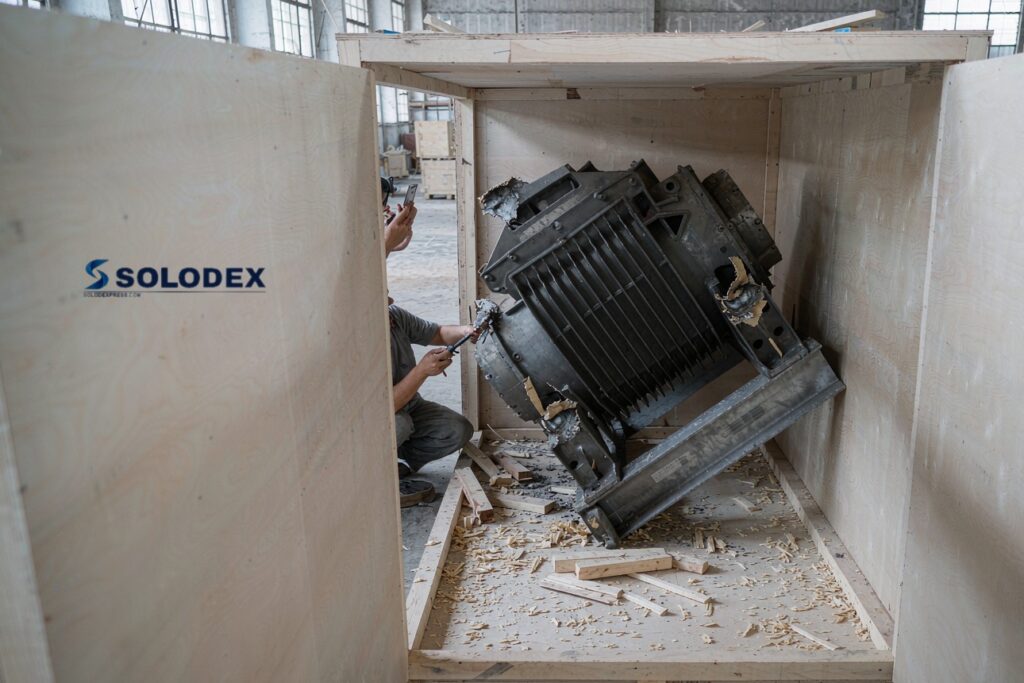
The crate is fine. That is the first thing the receiving team notices, and it is the reason nobody takes a photograph.
It is a wooden case, banded, with a stencil on the side and no dents anywhere. It comes off the truck, gets signed for, and sits in the bay for three days because the machine inside is not needed until the line changeover. When it is finally opened, the internal steel frame that holds the unit has sheared at two of its four mounting points, and the alignment of the spindle is out by something visible to the naked eye.
Nothing fell over. Nothing was dropped. And the claim that follows has a problem that has nothing to do with the damage and everything to do with the sequence: it arrives at the carrier, three days late, describing a loss the carrier’s own document says was not there.
Hidden means “not reasonably visible”, not “not looked at”
The distinction matters more than any other in this article. Damage that could have been seen at delivery is visible damage, whether or not anybody looked. Damage that a reasonable inspection would not have revealed is hidden, and hidden damage sits outside the scope of a clean signature — which is exactly what the words “apparent good order” were written to exclude.
So the question the surveyor will ask is not “did you inspect” but “could you have found this”. A carton with a crushed corner, visible before the pallet wrap came off, is not hidden. A machine whose internal frame has sheared inside an undamaged case is as hidden as damage gets, because finding it required opening the case, and opening the case was not part of taking delivery.
This is genuinely good news, and it is why the phrase “you signed clean” is not the end of the conversation. What it does mean is that the burden shifts in an uncomfortable way: you now have to establish not only that the goods were damaged, but that the damage existed before the truck left, using evidence that does not include the one document everybody points at.
Four combinations, four different claims
Hidden damage is not one problem. The state of the packaging relative to the state of the goods splits it into four cases, and each one points at a different party with a different evidentiary standard.
| Packaging | Contents | What it usually means | Who the claim is against |
|---|---|---|---|
| Crushed, torn, deformed | Damaged | Impact in transit | The carrier — with the note as evidence, not as an obstacle |
| Intact, undamaged | Damaged, shifted or deformed | Insufficient packing or securing for the journey | The seller, under the contract of sale, not the carrier |
| Intact outside, wet inside | Rust, mould, water staining | Condensation, or water entering through the container roof | The carrier or the container operator, depending on where the water came from |
| Intact, sealed | Fewer units than the documents | Never loaded, or removed before sealing | The seller — and the count at the dock is the only evidence that will exist |
The second row is the one that gets misfiled most often, and it is worth dwelling on because the intuition runs the wrong way: a perfect box containing a broken machine is evidence that the transport was fine. Packaging that absorbs a journey without a mark did its job. What failed is what was inside it.
The last row deserves a sentence of its own. Shortage is the only one of the four that can be settled by counting rather than by argument, and the only one where the evidence is a document you already hold: the packing list says how many should have been there, and a sealed container with fewer inside makes that document the whole case.
The perfect box with the broken machine
When the outer packaging shows no impact, the failure has to be one of three things: the goods were packed without enough restraint to survive normal transport, the internal bracing was designed for a static load rather than for a ship, or the unit was damaged before it was packed.
All three are the seller’s responsibility, and none of them is a carrier claim — which is why sending it to the carrier is not merely late, it is aimed at the wrong party. The carrier will point at its clean note, and it will be right, and the file will sit there while the real claim goes unpursued.
The evidence that supports this case is different from the evidence that supports a transport claim, and most of it is inside the box: photographs of the internal packing as it was found, before anything was lifted out; the position of the unit relative to its restraints; whether the restraints failed or were never adequate; whether the load was secured to the container floor with any planned arrangement or simply placed and closed up.
Which is why the photograph has to be taken before the unpacking proceeds. Once the unit is out of the case and on the floor, “it was restrained like this” becomes your recollection against the seller’s specification sheet.
Wet is its own category
Water damage deserves separate treatment because the source decides the claim, and the source is readable if you look at the right surfaces.
Condensation — container rain — falls from the ceiling. It leaves staining on the tops of cartons, drip marks on the upper surfaces of the load, and corrosion on the highest metal parts. It happens because a container loaded warm in a humid climate and shipped into a cold one condenses on the underside of the roof, and it is nobody’s negligence in particular, which is why it is usually handled by insurance rather than by argument.
Ingress comes from outside. It stains the floor and the lower tiers, it leaves a tide line, and it is often accompanied by a damaged roof panel or a failed door seal. Ingress is a carrier or equipment matter, and the container’s own condition record becomes relevant.
The distinction is visible in a photograph taken in the first hour and invisible in a photograph taken after the load has been restacked in a dry warehouse. If the goods are wet, photograph the ceiling of the container before anything else — that single frame decides which of the two cases you have.
The window for hidden damage is measured in days
Notice periods for damage that was not apparent at delivery are short, and they run from delivery. Under the maritime regimes the written notice is due within three days of delivery; road conventions give about seven; air cargo about fourteen. Each of those is a condition of the claim, not a formality, and satisfying it does not require a lawyer — it requires a message describing what was found, when, and where the goods are now.
That is the same message the claim itself will be built on, and the same reason it should be sent before the survey rather than after. A notice sent on day two, followed by a survey on day nine, is a strong file. A survey on day nine with no notice is a file that will be argued about on the timing alone.
There is one further trap in the timing, and it is administrative rather than legal. Internal routing takes days: the person who opens the case is in operations, the person who owns the carrier relationship is in logistics, and the person who owns the insurance policy is in finance. By the time all three have seen the same email, the window that started on the day of delivery may already be half gone. The only reliable fix is to make “opening a case” a trigger that produces a message on the same day, rather than a task that produces one when somebody gets to it.
The survey is where the argument becomes a number
Sooner or later somebody has to write down what the damage is, why it happened and what it costs. That document decides the claim more than any photograph, and it has three parts that are not equally reliable.
The facts are the easy part: what was found, where, in what condition. Photographs support this section and surveys rarely disagree about it.
The opinion on cause is where claims are won and lost, and it is the section most often left thin. A report that says “unit deformed, cause unknown” describes the damage and assigns no responsibility, which means the reader — the carrier, the insurer, the seller — will assign one, and it will be the one that suits them. A report that says the internal restraints failed under normal transport loads is a different document entirely, and getting that sentence in requires the surveyor to have seen the restraints in place.
The number is the repair estimate or the replacement value, and it is worth knowing which one you are claiming before anybody asks. Repair cost is what most policies and most carrier limits respond to; replacement value is what a total loss claim needs; and the gap between them is the argument that takes longest.
Two procedural points make the difference in practice. Ask for a joint survey — the carrier’s surveyor and yours, examining together. It costs a day and removes the most common defence, which is that your surveyor was not independent. And if the carrier declines to attend, put the refusal in writing on the day and proceed with your own surveyor: a documented refusal is far better than waiting for an attendance that never comes.
One practical caveat, because it is easy to forget in the heat of the moment: on small losses the survey can cost more than the damage. If the repair is a few hundred dollars and the survey is a few hundred more, the arithmetic points at the insurance excess rather than at a claim, and the honest answer is to say so early rather than to spend six weeks proving a point.
What to photograph before you touch anything
The sequence is the whole method, and it takes about ten minutes.
Outside first, including the seal. The container as it stands, the doors closed, the seal number legible. This is the frame that establishes the boundary between the carrier’s responsibility and yours.
The load as found. Doors open, nothing moved. Where the pallets sit, whether anything has shifted, whether the dunnage and straps are intact or broken. A load that has moved is a load that took an impact, and the direction it moved in tells you what kind.
The packaging, before opening it. All four faces of the case or carton, at a distance where the whole thing is visible, then close enough to read any marks. Repeat for the internal packaging once opened, before the goods come out.
The goods in place. The damaged part in the position it was found, with its restraints visible. Photograph the failure, not the damage: a sheared bracket tells a story that a bent panel does not.
The reference. One photograph that ties the whole set together — a label, a serial number, or the marking on the case, in the same frame as the damage. Without it, a set of photographs is a set of photographs of something.
None of this requires a surveyor on site. It requires somebody to stop for ten minutes at the point where the natural instinct is to get the machine onto the floor and see whether it works, which is the exact moment at which the evidence stops being available.
And it is worth remembering what all of this is for. The delivery itself takes forty minutes and is decided weeks earlier; the unpacking takes ten minutes and is decided by whoever is holding the phone. Between them, they determine whether a damaged machine becomes a recovered cost or a written-off one — and the second outcome almost never has anything to do with who was actually at fault. Nor does any of it survive a warehouse that shelves the pallet without deciding what it is, which is where the next seventy-two hours go.
Whether the box was ever strong enough for the stack is usually settled by the specification, not by the photographs taken at delivery — the arithmetic happens at the sample stage.
Rust and mould usually appear days after delivery, which makes them hard to attribute: the water that caused them was loaded at origin, not admitted in transit.
Whether hidden damage is arguable depends on what the file can show: four photographs in the right order and a seal number do more than a mailbox of close-ups.
Damage you find after the driver leaves is a problem of evidence; a missing carton is a problem of status, because the unit was signed for in full.


