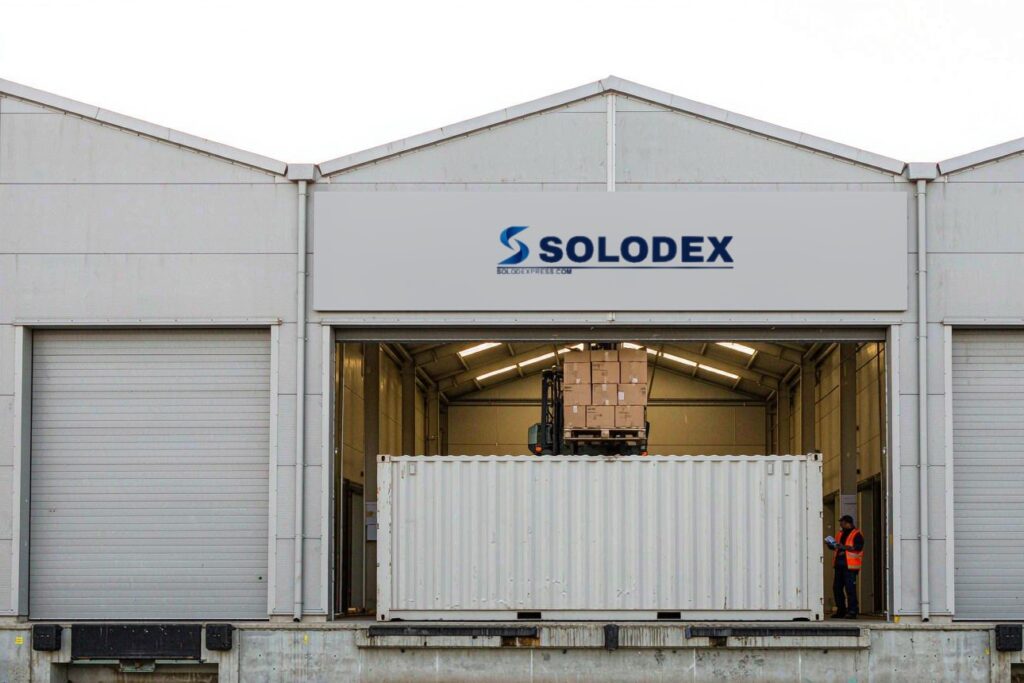
The driver arrives at 08:40 with a forty-foot high cube. Your dock is a standard concrete platform, one point two metres off the yard. The container floor, sitting on a chassis, is one point five metres off the ground. Three hundred millimetres of daylight between the two surfaces, and no leveller in the door.
The forklift cannot bridge it. Nobody on site can lift twenty-one pallets by hand. The driver has another collection at eleven and leaves at 10:50, which is two hours and ten minutes after arrival — just past the free window. He comes back the next afternoon. The waiting charge is six hundred dollars, and the second attempt costs the same again because the leveller was never the problem anybody fixed.
Nothing in that sequence was a mistake in the usual sense. The container was booked correctly, cleared correctly, delivered to the right address on the right day. What failed is the one handover in the entire chain that has no standard format: the forty minutes at the dock, which two companies negotiate verbally, and which one driver executes alone.
Thirty centimetres is the whole problem
Standard loading docks are built around road trailers. A trailer bed sits at roughly one point two metres, and warehouses have been built to match that number for fifty years. A container on a chassis is taller, because the chassis adds a frame and a fifth wheel between the road and the box: about one point five metres to the container floor, and an internal height of two point six nine on a high cube.
That gap is normal, expected and solvable. It is solved by a dock leveller — the steel plate in the doorway that rises and falls through roughly three hundred millimetres — or by a ramp, or by taking the container off the chassis and putting it on the ground. What it is not solved by is a forklift, a pallet truck, or manpower.
The failure is therefore not technical. It is that the gap only becomes visible when a truck is already in the yard, at which point the only available options are expensive and slow. Before the truck arrives, the same gap is a question with a five-minute answer.
Who is actually supposed to unload
This is where a surprising number of deliveries go wrong before anyone touches the doors. Under DAP the seller delivers the goods at the named place, ready for unloading — ready for, not unloaded. Under DDP the seller adds import clearance and duty, and unloading still sits with the buyer unless the contract says otherwise. Neither term moves a pallet.
The carrier’s position is even simpler: a driver’s job is to drive. Linehaul and full-truckload terms do not include unloading, and a driver who helps is doing a favour that can void his own insurance if something is dropped. The receiving site supplies the labour and the equipment; that is the assumption every carrier prices into the rate.
Which means the practical question is not “will they unload it” but “who did we assume would”. On a delivery to a warehouse with a dock, the answer is obvious and nobody writes it down. On a delivery to a site without one — a shop, a construction compound, a factory with a yard but no platform — the assumption is usually wrong, and it is discovered in the worst possible way.
If the goods are going somewhere without a dock, the delivery has to be re-specified before booking: a tail-lift vehicle, a container on the ground with a reach stacker to place it, or a transload at a facility that has a platform. Each of those is cheap to arrange in advance and effectively unavailable on the day.
The clock starts when the driver arrives, not when you are ready
Free time on a full-truckload delivery is typically two hours from arrival, measured at the gate rather than at the dock. After that the charge runs by the hour or half hour, commonly sixty to a hundred dollars, and it accrues whether or not anyone is unloading. A single overrun of three hours is a three-hundred-dollar afternoon, and it is one of the few line items on a freight invoice that the receiver caused personally.
Two things make it worse than the rate suggests. The first is that the driver’s next appointment is real: he leaves, and the container comes back on another day, which means the charge is paid twice for one delivery. The second is that repeated overruns follow the account, not the shipment. A site that habitually holds drivers becomes a site carriers price up, or decline to serve at preferred rates.
The fix is unglamorous and works: give the carrier a window the site can actually meet, have the labour on the dock before the window opens, and tell the driver in advance which door. Most overruns are not caused by slow unloading. They are caused by a warehouse that was told nine o’clock and starts at nine thirty.
How the container was loaded decides how long it takes
Two identical forty-foot containers can take forty minutes or six hours to empty, and the difference was decided at origin, weeks earlier, by whoever wrote the loading plan.
Palletised cargo comes out with a forklift at roughly one pallet a minute. A high cube holds twenty to twenty-one standard pallets, or rather more of the smaller European footprint, so the physical work is under an hour and the dock is clear before free time expires.
Floor-loaded cargo — cartons stacked to the roof, often to save the volume that pallets waste — has to be handled piece by piece. For a full high cube that is several thousand cartons and, with two people, a working day. The saving at origin was real: roughly ten per cent more cargo in the same box. The cost at destination is a crew, a lost afternoon, and often a waiting charge, and it lands on the party who had no say in the decision.
This is worth stating plainly because it is the clearest case in the whole chain of a decision being made by one party and paid for by another. If you are the buyer, ask how the container will be loaded before it is loaded, not after it arrives — and on what, since the pallets themselves have to clear the border under a rule of their own.
Three ways a container comes off a truck
Which one applies is a property of your site, not a preference, and it has to be settled before the booking.
| Method | What the site needs | Works when | Fails when |
|---|---|---|---|
| Dock to container | A platform at trailer height, with a leveller or ramp | There is a real loading dock and a forklift that fits through the container doors | The dock has no leveller, or the forklift is too tall or too wide for the door opening |
| Tail lift | A vehicle equipped with a lift platform and a driver who operates it | Small volumes, no dock, ground-level access, cargo already on pallets | The load is heavier than the lift rating, or the vehicle was booked as a standard trailer |
| On the ground | Space to set the box down, and equipment to place and later remove it | No dock at all and enough yard, or cargo that will be unpacked over several days | No reach stacker available, or the ground cannot take the point load |
The third option deserves a note because it looks like the flexible one. A container set on the ground cannot be repositioned without lifting equipment, so the site is committed to unloading where it stands, in whatever weather arrives, and the chassis goes back to the pool immediately — which is good for equipment availability and bad if you later discover the goods need to move.
The container is not yours to keep
There is a tempting assumption at the end of a long delivery day: the box is on our yard, we will empty it tomorrow. Three things start running the moment the driver hands over, and none of them pause overnight.
The equipment clock. A chassis and a container sitting at a receiver are both out of circulation, and both are billed — the container to whoever holds it, the chassis to whoever took it from the pool. A day’s delay is a small invoice. A week’s delay is a large one, and it is the same week in which the carrier’s equipment shortage becomes your problem rather than theirs.
The risk transfer. This is the part that surprises people. Once the goods are delivered to the agreed place, the carrier’s liability for them is essentially finished; what happens on your yard is covered by your own cargo insurance, if it is still running. A container broken into on your site overnight is not a carrier claim. It is a police report and an insurance claim, and the second one depends on the first.
The evidence window. A closed container on a yard is a sealed box. Whatever state the cargo is in, that state is now unattested, and every hour it stays closed makes it easier for someone to argue that whatever is found inside happened after delivery rather than before.
None of which means a container must be emptied the day it arrives. It means the decision to leave it costs money and moves risk, and that the decision is usually taken by whoever is tired at six in the evening rather than by whoever owns the goods.
What to fix before the next delivery
Five things, all cheap now and none available on the day.
Measure the dock. Height, leveller travel, door width, and the height of the tallest forklift that will pass through a container opening of two point five eight metres. If any of those numbers is unknown, it is the number that will fail.
Write the unloading responsibility into the purchase order. Not into the Incoterm — into the order, in one sentence. DAP and DDP both leave the pallets where they are, and a sentence costs nothing.
Match the delivery mode to the site. Dock, tail lift or ground, decided at booking. A standard trailer sent to a site with no platform is not a carrier error; it is an instruction error.
Give a window the site can meet, and staff it. Two hours of free time disappears quickly when the receiving clerk is also doing the morning count.
Count before you sign. The dock is where evidence is created, and the signature at the end of the unload decides what can be proven afterwards — the point at which a damage claim becomes possible or impossible. A pallet count against the packing list takes ten minutes while the driver is still there and is worth considerably more than ten minutes.
None of this is complicated, which is exactly why it gets skipped. Every other handover in the chain has a document that forces the conversation: a bill of lading for the ocean leg, a declaration for the border, a terminal release for the quay. The dock has a signature on a delivery note, and by the time anyone reads it, the truck is gone and the argument is about what the paper meant.
Most receiving failures are planned against a dock; a small parcel has no dock, and the failure happens at a door with a card and a deposit scan.


