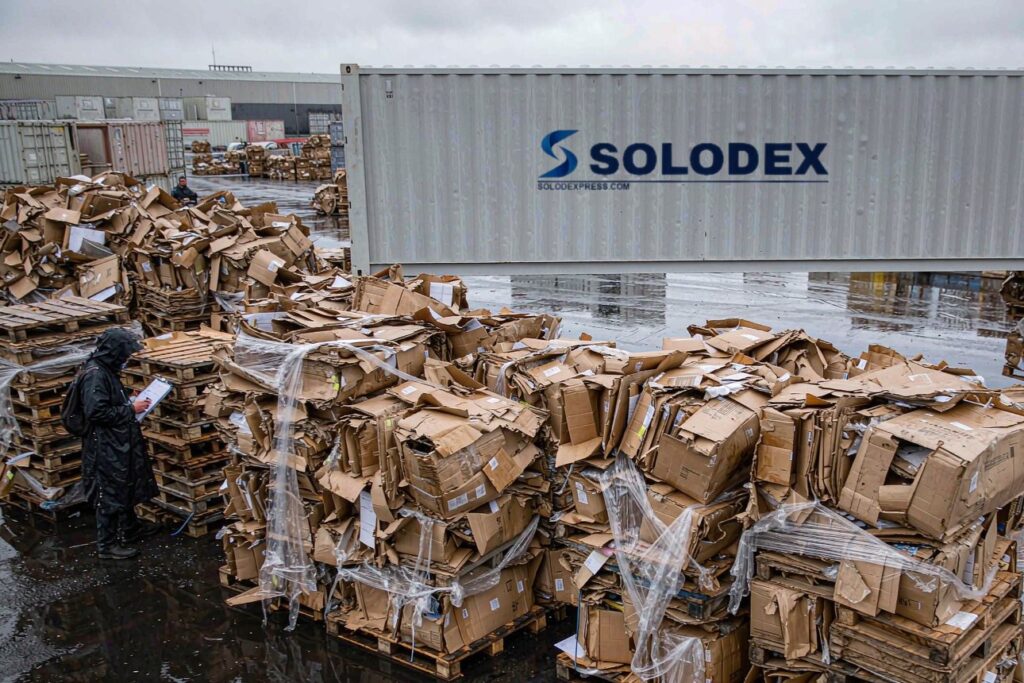
A pallet of returns sits in a warehouse outside Rotterdam: forty cartons, two and a half cubic metres, four hundred and fifty kilos, invoice value eight thousand dollars. Sending it back to Shenzhen costs about thirteen hundred dollars and takes eight to ten weeks. Destroying it, with a certificate, costs four hundred and fifty and takes nine days. Selling it to a clearance buyer recovers perhaps two thousand.
Three options, three completely different outcomes, and the instinctive choice — send it back, it is our product — is frequently the worst of the three. What follows is the arithmetic that decides it, because in returns the arithmetic is the whole decision.
A return is not a reverse shipment
The mental model most people carry is that a return is the outbound journey played backwards. It is not. It is a new export from the country where the goods now sit, followed by a new import into China, and both of those events have their own paperwork, their own duty treatment and their own failure modes.
Three consequences follow immediately, and each one adds cost that the outbound leg never had.
Before any of them apply, one earlier question must be settled: whether the goods are defective, damaged, or simply unwanted. The three lead to different recoveries — a damage claim against a carrier or insurer is a separate pot of money from a return — and the claim window is short. Companies that ship goods back before assessing the claim forfeit the claim in the process.
First, the goods have to leave the country they are in, which means an export declaration there, filed by whoever is the importer of record — usually you, not the Chinese supplier. Second, they have to be re-imported into China, which is a customs event with a specific regime, not a return to sender. Third, the original import duty and tax you paid on entry are a separate question from the shipping, and most companies never ask it.
Neither leg is hard in isolation. The cost comes from the fact that there are two of them, that they are sequential, and that the goods are worth less at the end than they were at the start — because whatever made them returnable has not been fixed by moving them. And before either leg begins, the goods have already been through a discharge and delivery chain that generated its own charges, some of which are still running.
Three numbers decide it
Every disposition decision reduces to three figures, and companies that get this wrong usually get it wrong by comparing the first two and ignoring the third.
| Number | What it is | Where people go wrong |
|---|---|---|
| Value as returned | What the goods are worth in their current condition | Using the original invoice value |
| Cost to return | Both clearances, freight, handling, time | Counting only the freight |
| Recoverable value | What you can sell them for after repair, relabelling or repacking | Assuming repair will restore full price |
The decision rule is blunt: if the recoverable value, minus the cost to return, minus the cost to make them sellable again, is not clearly positive, the goods should not travel. Not “should maybe not” — should not. Because a return that breaks even on paper consumes management time, warehouse space and cash for three months, and produces nothing.
Run the Rotterdam pallet through it. Eight thousand dollars of goods, damaged in transit, worth perhaps thirty percent in their current state — twenty-four hundred. Repair and repack would cost eleven hundred and restore them to maybe seventy percent of value, fifty-six hundred. Return costs thirteen hundred. So: 5,600 − 1,300 − 1,100 = 3,200. Positive, and worth doing.
Now change one number. Suppose the goods are seasonal, and by the time they arrive back in China the season is over. Recoverable value drops to fifteen hundred. The same arithmetic gives a negative number, and the same pallet should be destroyed in Rotterdam rather than shipped anywhere.
What a return actually costs, line by line
The freight is the line everyone budgets, and it is rarely the largest one.
| Line | Typical range | Notes |
|---|---|---|
| Export declaration at origin | $150–400 | Filed by you as importer of record |
| Freight back to China | $80–200 per CBM by LCL | Minimum charge often one or two CBM |
| Chinese import clearance | $300–600 | Returned-goods regime, not a normal entry |
| Port and warehouse handling | $150–400 | Both ends, plus inspection if selected |
| Repair or repack | 10–40% of value | Often omitted from the business case |
| Time | 6–12 weeks | The cost that never appears in a spreadsheet |
The Chinese clearance line deserves attention because it is not a normal import. Returned goods enter under a specific regime that requires the goods to be in the state they left in, and requires the original export documentation to prove it. If the goods have been used, altered or repaired abroad, they may no longer qualify — which is the most common reason a return that was costed correctly becomes more expensive on arrival, and it is the subject of the two clearances a return actually goes through.
Five ways to end a return, compared
Once the three numbers are known, the choice is usually obvious. What is not obvious is that there are five options rather than three, and that two of them are frequently cheaper than the one everyone thinks of first.
| Disposition | Typical cost | Time | What you recover | Main risk |
|---|---|---|---|---|
| Return to China | 15–40% of value | 6–12 weeks | Repaired goods, less repair cost | Loses eligibility if altered abroad |
| Destroy with certificate | $300–800 | 1–2 weeks | Nothing, but a clean insurance claim | Uncertified destruction leaves stock on the books |
| Sell to a clearance buyer | 60–85% discount | 1–3 weeks | 15–40% of value | Brand exposure and local compliance |
| Repair in place | 10–30% of value | 2–6 weeks | 60–80% of value, back in the same channel | Repair quality becomes your warranty |
| Abandon | Storage, then a bill | Months | Nothing | The charges follow the consignee |
Two rows deserve comment. Selling to a clearance buyer is often the highest-value option per unit of effort, and it is rejected for reasons of brand control rather than economics — a legitimate reason, but a decision that should be made deliberately rather than by default. And repairing in place is the only option that returns goods to the same channel, which matters when the alternative is losing a customer relationship rather than a consignment.
The duty you already paid
Here is the line almost nobody claims, and in some jurisdictions it is the largest single number in the whole calculation.
When the goods were imported, duty and import VAT were paid. When they are subsequently exported again — whether back to China or to a third country — a portion of that duty may be recoverable. The United States runs a formal drawback system allowing recovery of the great majority of duty paid on goods that are later exported, within a window measured in years. The European Union provides for repayment or remission where goods are re-exported in defined circumstances. China has its own rules for returned goods and for the corresponding adjustment of any export refund previously claimed.
Each scheme has conditions: the goods must be identifiable, the export must happen within a stated period, the application must be made with evidence, and it is never automatic. The point is not that the money always comes back. The point is that the money is often there and the application is rarely made, because the person handling the return is in logistics and the person who knows about drawback is in finance, and nobody puts them in the same conversation.
There is a second trap in the same area. Goods presented for re-export are still subject to examination at the border, and a returned consignment is a category that attracts attention — because it is where people try to move things under the wrong description. The exam that follows costs the same whether the goods are genuinely returned or merely misdescribed, and it arrives at the worst possible moment in a return file.
For a returns programme with any volume at all, this is worth a standing process rather than a case-by-case scramble. The sums are large enough that a single recovered year can pay for the administration of several more.
Where the returned goods end up is a separate decision
The four remaining questions in this series are all about the second half of the problem — what to do with goods that are not going back into the same channel.
Repair is a different customs status from return, not a variant of it, and it has its own regime for temporary admission and for re-export after processing. Destruction is legal in every major market, but only counts if it is supervised and certificated; an unsupported destruction leaves the goods on your books. Abandonment — simply not collecting them — is the default that costs the most, because storage accrues, the goods are eventually sold or destroyed by someone else, and the invoice still follows the consignee. And selling where they landed avoids both clearances but creates a tax event and a compliance question in the destination market, not a saving.
All four are cheaper than a badly planned return, and all four are worse than a well-planned one. Which is why the decision belongs at the point of failure — the moment the goods are known to be unsaleable in their current state — and not three weeks later when the container is already moving.
The first forty-eight hours
- Stop the clock. Whether the goods are in a terminal, a 3PL or your own warehouse, storage is accruing. The two clocks at the port do not pause for a commercial decision.
- Value them as they are, not as they were invoiced. Get a realistic number for the damaged or unsaleable condition, because every later calculation depends on it.
- Price all three options — return, destroy, sell in place — before choosing one. The instinctive option is not the cheap one often enough to skip the comparison.
- Check the drawback window in the country where the goods sit, and diary the deadline. It is usually years, but it is never indefinite.
- Decide who owns the decision. A returns file with three owners has none, and the goods will still be where they are in six weeks.
None of this is exotic logistics. It is ordinary arithmetic applied at a moment when everyone would rather be doing something else — which is precisely why it is skipped, and why the same company can handle a thousand outbound shipments flawlessly and lose money on forty cartons coming back.
The outbound chain is engineered, measured and negotiated. The return is usually improvised on the day it happens, by whoever answers the email. That asymmetry, more than any freight rate, is where the money goes.
A return is not the outbound leg reversed, and when nobody collects the parcel the return starts its own clock under a new reference.


