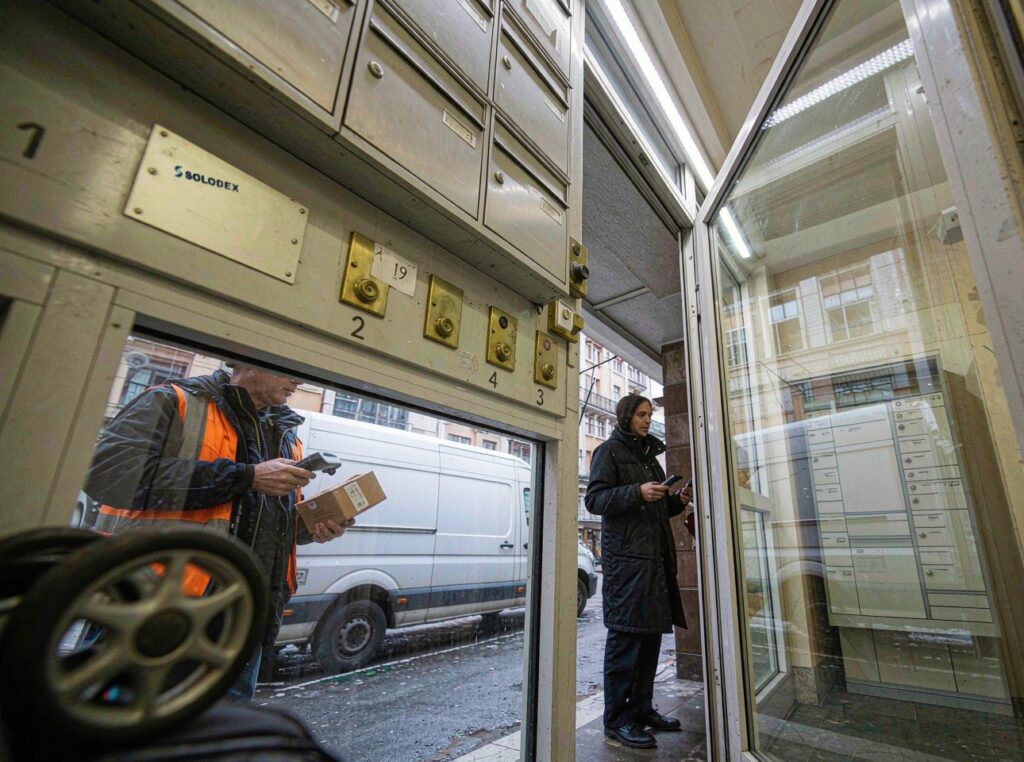
A parcel addressed to Elena Petrov clears customs on a Tuesday. The entry carries an importer code owned by the carrier, a value under the relief threshold and a declarant whose name Elena has never seen. On Thursday a card through her door says a parcel is waiting. To collect it she shows a phone number and the last four digits of a code sent to her handset. Two systems have now processed the same box, and neither one asked the other who she is.
This is not a loophole and it is not a mistake. It is how small parcels are built. The customs record answers one question — who is accountable for this import — and the delivery record answers a different one — who is allowed to take possession of this box. When the goods are a company’s stock the two answers are often the same entity, and the seam is invisible. When the receiver is a person with no tax number, the seam is the whole story. The registrations and the choice of sales model are covered in the marketplace versus own-store comparison and in the foreign-company test; this article starts after the parcel has already been cleared without either of them.
The tax number question was answered on the other side
Most advice about an individual receiver starts with the wrong fear. It asks whether a person needs a VAT number, an EORI, an importer code, a local registration. For goods moving to a business in its own name, those questions decide the whole shipment, and they are argued at length in the importer-of-record analysis and in the DDP and DDU comparison. For a parcel moving to a person, the carrier has usually already solved the problem by putting a different party on the entry.
That party is the operator of a simplified procedure: a consolidated clearance under a code the carrier holds, with the individual parcels listed beneath it rather than declared one by one. The receiver never becomes an importer in the legal sense. She does not sign an entry, does not hold a registration and does not receive a customs debt. From her point of view the tax number question never arose, because the question was directed at somebody else.
What did not disappear was the field on the waybill. Every carrier still needs a name and a phone number to hand over a box, and those are the only identifiers the delivery network has ever used. The person who cannot supply a VAT number is perfectly able to supply a mobile number. The two facts are unrelated, but they are stored next to each other on the same label, which is why people assume they belong to the same system. They do not.
Two records, one name, no join
A small parcel generates two sets of records that share a consignment number but not a person record. On the customs side there is a declarant, an importer code, a tariff line, a value and a country of origin. On the delivery side there is a consignee name, an address, a phone number, a scan history and a proof of delivery. The name may appear in both. Nothing in either system requires the names to refer to the same legal person, and no field exists to say that they do.
The absence of a join is not carelessness. The two systems have different lifetimes. The customs record is closed at import and kept for audit; the delivery record is closed at handover and deleted or archived on a much shorter cycle. They are also operated by different firms: a broker or a carrier’s clearance arm on one side, a local delivery contractor on the other. A field that linked them would have to survive both handovers, and nobody is paid to maintain it.
| Question | Customs record | Delivery record | Field used | Where they differ |
|---|---|---|---|---|
| Who is accountable for the import | Importer under a simplified code | Not recorded | Broker’s code | Only one side has an answer |
| Who may take the box | Not recorded | Named consignee plus phone | Phone and access code | Only one side has an answer |
| What is inside | Tariff line and declared value | Nothing beyond the outer label | Outer waybill label | Different descriptions of one object |
| When the process ends | At import clearance | At handover or deposit | Two separate scans | Two different closing events |
The same name spelled two ways
A seam becomes visible in the smallest details. The name on a customs declaration is often transcribed from an invoice in one form — surname first, middle name included, accents preserved — and the name on a delivery label is typed into a different system by somebody reading the order confirmation. Both are reasonable. Neither system compares them, so nobody discovers that they differ until a document check is requested and the two records fail to match.
The mismatch is harmless while the parcel moves, because movement only requires the consignment number. It becomes expensive at the two moments when a human reads the records: a customs query asking the receiver to confirm the entry, and a loss claim asking the receiver to prove that the box was addressed to them. In both cases the person is asked to explain a difference that was created by data entry, in a field that no process ever cross-checked.
Identity numbers behave the same way. A passport number or a national identifier accepted for a customs query in one country is not a field the delivery contractor can read, and the last four digits of a phone number that unlocks a locker are not something a broker would accept as proof of import. Each identifier is correct inside its own system and useless outside it. The three candidates for importer are distinguished by which number they can supply; the individual receiver is distinguished by a number from a completely different list.
Why the relief makes the seam wider
Reliefs for low-value parcels are defined around private senders and private receivers, so the clearer a parcel looks as a gift between individuals, the less it looks like a commercial import with a traceable buyer. The rules on what a gift declaration actually does explain the duty side of that choice. The side effect is that the customs record becomes thinner exactly where the delivery record becomes more important.
A commercial import carries a purchaser, an invoice, a company name and often a repeating account. A relieved parcel carries a description, a value and a person’s name on a label. When something goes wrong — the box is opened, the wrong person collects it, the contents are disputed — the commercial import has a chain to follow and the relieved parcel has a phone number. The identity that was sufficient to clear the goods was never designed to prove who owned them.
This is why a declaration that is perfectly correct at the border can be useless two days later. The clearance model decides who files and when; it does not decide who can later demonstrate that a particular box was theirs. The seller who chose the simplest inbound route may have saved a registration and created an evidentiary gap, without either appearing on a cost sheet.
How the delivery side identifies a person
The delivery network does not verify identity in the way a bank or a border post does. It verifies access. A consignment is released to whoever can produce the code sent to the number on the label, or to whoever answers the name at the door. That is enough for a low-value parcel and it is deliberately cheap: no document check, no registry lookup, no signature against an identity card.
The consequence is that the consignee field is a contact point rather than a legal identity. Two people sharing a phone number, a flat shared by students, a parent ordering on a child’s behalf — all of these work perfectly in the delivery system and produce a clean proof of delivery. The scan says the parcel was handed to the consignee. What it means is that a code arrived on a device.
The same looseness is visible at the other end of the journey. A care package sent to a student abroad fails when the phone number belongs to a parent in another time zone, not when the contents are wrong. A consolidated parcel service succeeds partly because the local operator knows which codes and numbers it can actually reach. Neither outcome depends on the customs record at all.
What happens when the two sides disagree
Disputes appear at the seam, not inside either system. A receiver says the box was opened before delivery; the carrier produces a handover scan; the broker produces a closed entry showing the parcel passed customs intact. All three records are accurate. None of them describes the interval between the border and the door, because neither system was asked to record custody during that interval.
A second common case involves the wrong person collecting. The code was forwarded, or the name on the door was enough. The carrier’s obligation was to release against the identifier it held, and it did. The customs record still shows a lawful import under a valid code. The receiver’s loss is real, but there is no field in either record where it can be entered, because the two systems disagree about who the consignee was supposed to be.
This is the small-parcel version of a problem that appears in much larger form when cargo is held and eventually sold: the paperwork closes before the commercial question is settled. With a container there is a warehouse receipt and a survey. With a parcel there is a scan and a message. The smaller the shipment, the more the evidence depends on fields somebody thought were administrative.
Who carries the error when the code is wrong
A simplified clearance is convenient because the carrier’s code stands behind many parcels. It also means the error, when there is one, is attached to the code rather than to the individual box. A wrong value or description in one consignment is corrected against the operator’s entry, not against a person’s own import record, because the person never made an import record. The receiver may not even be told that a correction happened.
This changes where the cost lands. Under an import made in a buyer’s own name, an error is discovered by the buyer and disputed by the buyer. Under a consolidated code, the correction is handled between the carrier and the customs authority, and the receiver sees only the resulting parcel — delayed, released, or occasionally opened for inspection. The person who bears the delay is the person with the least visibility into the entry, which is the opposite of what a commercial importer would accept.
The practical question to ask a carrier is therefore not whether an individual needs a tax number. It is what happens to a parcel when the declaration under the shared code is queried, who may amend it, and how long the parcel waits while that happens. Those answers describe the real risk of shipping to a private receiver. The registration question has already been answered by the fact that the parcel cleared.
| If the declaration is queried | Import under own name | Simplified code |
|---|---|---|
| Who is contacted | The named importer | The carrier or broker |
| Who may amend it | The importer or their agent | The code holder |
| What the receiver sees | A request for documents | A delayed parcel or nothing |
Three practical consequences for the shipper
First, the name and number on the waybill are the only identity that will ever be used at the door. They should belong to the person who will actually be there, not to an office that places the order. A purchasing department ordering samples for a colleague in another country is creating a receiver who cannot receive.
Second, the value and description on the customs line should be consistent with what the receiver will later say the box contained. The two records do not talk to each other, but a human being will eventually read them side by side. A parcel cleared under a relief and described as something else at the door invites a question that neither record can answer on its own.
Third, the proof of delivery is evidence of access, not of identity and not of condition. A delivered waybill can close while cartons are missing, and a failed attempt can leave a parcel in storage with the same status field unchanged. The handover scan belongs to the delivery record, and the delivery record was never given the contents or the customs identity. Knowing that removes a great deal of confusion from the conversation afterwards.
The unit an individual actually provides
What the small consignee contributes is not a tax identity. It is a reachable identifier: a name that matches a door, a phone that reaches a hand, and a code that can be produced on request. The customs side runs on a different identifier held by somebody else, and the two never meet in a database. For the shipper the practical rule is simple: treat the delivery record as the only record that will identify the receiver after clearance, and put into it the person who will actually stand at the door.
The six steps that end at the border are described in the parcel shipping guide. This is the step the guide cannot show, because it happens inside two systems that were never integrated. An individual receiver without a tax number is not a problem to be solved at customs. It is a parcel for which the identity needed at the border and the identity needed at the door are supplied by two different parties, and no field in either system records that they are the same person.
A private receiver is identified by a name and a phone at the door; the parcel that reaches that door was priced from its outer dimensions. The carton is the freight unit on the invoice, not the contents described on the label.


