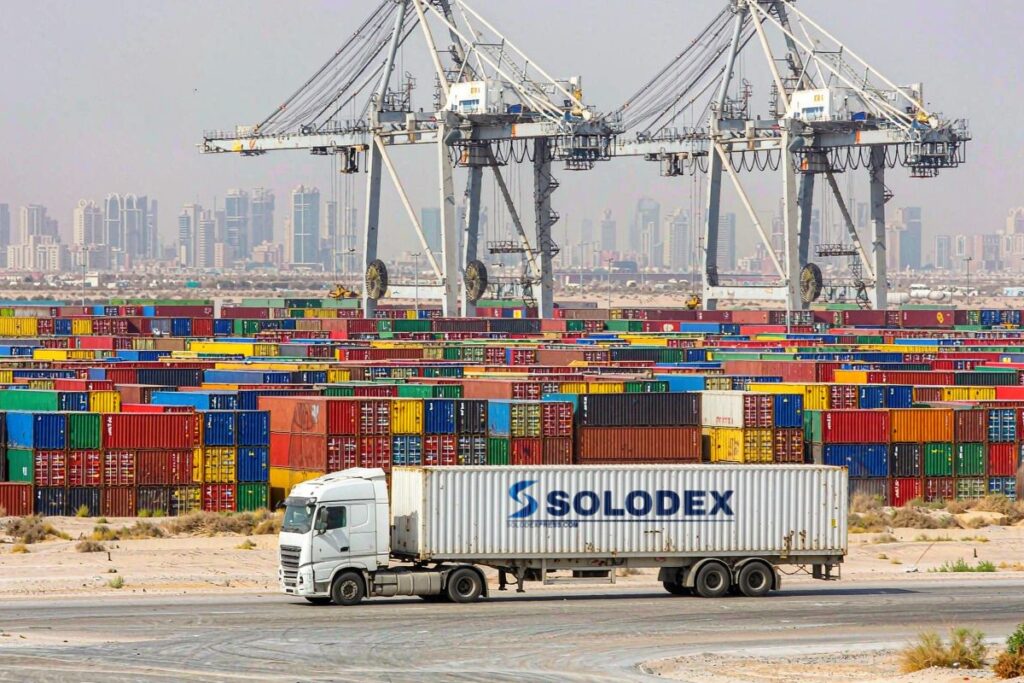
The container cleared the port. It did not clear customs.
Everything about it was ordinary: a forty-foot box of consumer goods, a clean commercial invoice, a certificate of origin stamped by the chamber in Shenzhen, a bill of lading that matched the manifest. What it did not have was a shipment certificate on the Saudi conformity platform, and without that single document the container was not a shipment with a paperwork problem. It was cargo that could not be declared at all — and the two outcomes available to it were re-export to origin or destruction, both at the importer’s cost.
The instinct from every other market is to look at the duty rate first. In the Gulf that instinct arrives in the wrong order, because the region runs three gates and they open in sequence: conformity, then declaration, then tax. Skip the first and the other two never happen. And the first gate is not one gate — Saudi Arabia and the United Arab Emirates ask genuinely different questions, despite sharing a customs union, a five per cent baseline duty and a single border regime on paper.
One customs union, two different questions
The GCC common tariff gives both countries the same starting point: five per cent on CIF for most goods, zero for GCC-origin goods moving between member states. Almost everything after that diverges, and the divergence is where shipments die.
| Saudi Arabia | United Arab Emirates | |
|---|---|---|
| Duty | 5% of CIF, higher bands of 12–20% on protected lines | 5% of CIF, higher on alcohol and tobacco |
| Import VAT | 15% on CIF + duty | 5% on CIF + duty |
| Tariff digits | 12-digit GCC integrated tariff (since January 2025) | 8-digit GCC unified tariff |
| Conformity | SABER — product certificate plus a shipment certificate for every import | ESMA / EIAC regimes by category; no single per-shipment platform |
| Declaration | Fasah, at least 48 hours before arrival | Mirsal 2 per emirate, e.g. Dubai Customs |
| Who may import | An entity registered in the Kingdom with a commercial registration and ZATCA file | Importer registration with the emirate’s customs authority |
| Low-value relief | No general parcel de minimis of the kind other markets publish | AED 1,000 duty relief on e-commerce imports into Dubai (from 3 August 2026) |
Two rows in that table account for most of the surprises. The VAT row triples the tax burden between the two countries on identical goods. The conformity row decides whether the goods can be declared at all.
In Saudi the certificate is per shipment, not per product
SABER sits inside SASO’s product safety programme and it issues two different things, which are routinely confused:
- A product certificate (PCoC) — the product model meets the relevant Saudi technical regulation. Valid one year. SABER charges SAR 500 before VAT, and the conformity body’s testing and audit fees sit on top.
- A shipment certificate (SCoC) — this particular consignment matches the certified product. Issued per shipment, in one to two working days, valid 90 days, SAR 350 before VAT.
The change that matters happened in late 2025 and is still catching people out. Since 1 October 2025, a shipment certificate is required for every commercial import, regulated or not. A product outside every technical regulation no longer slips through on an invoice — it goes through product registration, an importer self-declaration with a pledge, and then still needs its SCoC. Letters of undertaking, which used to paper over a missing certificate at the border, stopped being accepted at the start of 2025.
There is also a habit worth breaking early: the certificate has to exist before the goods move. Obtaining conformity documents after arrival is treated as a violation rather than a correction, and the practical consequence is the one in the opening paragraph — re-export or destruction, paid for by the importer. For a first shipment into Riyadh or Dammam, the conformity work is the critical path, not the freight booking.
One more detail with a date on it: from 1 October 2026, ten technical regulations require the supplier’s name and commercial registration number to appear on the product itself. Labels are now a conformity item, not a marketing one.
Who is actually allowed to be the importer
This is the structural constraint that decides distribution models before any price is discussed. The importer named on a Saudi declaration must be an entity registered in the Kingdom, with a commercial registration and a ZATCA file. A foreign supplier cannot be the importer of record. Someone inside Saudi Arabia has to own the declaration, the duty liability and the compliance record behind it.
Saudi commercial practice narrows it further: only Saudi nationals may import goods for resale and conduct direct marketing, with a carve-out for foreign industrial entities trading in the products they themselves manufacture. A Chinese exporter therefore has three structures — its own Saudi company, a Saudi buyer importing in its own name, or a Saudi entity appointed as importer of record — and the choice changes who carries the risk, not what the paperwork looks like.
Mechanically, the declaration runs through Fasah with a licensed broker, and it has to be in at least 48 hours before arrival; advance manifest submission has been mandatory for sea freight since late 2025. Get that right and ZATCA’s own target for a compliant declaration is clearance in under two hours. Get it wrong and the same container sits for a week while a certificate is requested that should have been requested a month earlier.
Dubai’s AED 1,000 is a duty relief, not a tax relief
In August 2026 Dubai raised the threshold that gets quoted most often and understood least. Dubai Customs Declaration No. 16 of 2026, effective 3 August 2026, exempts cross-border e-commerce goods valued at AED 1,000 or less from customs duty — up from the AED 300 that had applied before.
Read the sentence again, because three separate limits hide inside it.
It is a Dubai rule, not a federal one. The other six emirates are not covered by it, so a parcel routed through Sharjah or Abu Dhabi is not automatically inside the same relief.
It relieves duty, not VAT. The five per cent import VAT is a federal charge administered by the Federal Tax Authority and it is untouched. A AED 900 parcel pays no duty and still pays VAT. Sellers who treat the threshold as “tax free below a thousand” build a landed-cost model that is wrong by five per cent from the first unit.
It excludes categories regardless of value. Tobacco and its derivatives, electronic smoking devices and accessories, nicotine liquids, alcoholic drinks and food preparations containing alcohol stay outside the relief. And it applies to e-commerce personal imports moving through a company registered on the Dubai Customs e-commerce platform — the registration is a condition, not a formality.
The same notice adds something genuinely useful for apparel and electronics sellers: B2C goods returned within 60 days of export, where duty was demonstrably paid on the way out, are exempt from duty on the way back in. For a category with a double-digit return rate, that is worth more than the threshold itself.
And keep the traveller allowance separate: the AED 3,000 personal allowance for arriving passengers has nothing to do with parcels. Mixing the two is one of the more common ways to mis-predict a courier shipment.
Free zones suspend, they do not exempt
Jebel Ali, DAFZA, DMCC and the rest are a genuine cash-flow instrument and a frequent source of quiet errors. Goods entering a free zone have duty and VAT suspended for as long as they stay there, and goods re-exported directly usually attract no duty at all. That is a deferral on storage and transhipment, not a permanent exemption.
The moment goods move from the zone to the mainland, an FZ transit out declaration is filed through Mirsal 2 and the five per cent duty becomes payable. Customs will normally ask for a deposit or bank guarantee equal to the duty as security that the goods will not enter without declaration — a real working-capital line that belongs in the landed-cost sheet, not in a footnote. A seller who reads “free zone” as “duty free” discovers the difference on the first mainland delivery.
The third gate is a strait
None of the above governs when the container arrives, and this year that has been the harder problem. The Strait of Hormuz has been closed to normal commercial transit since February 2026, with transits running at a handful of vessels a week against roughly eighty-five a day before the closure. Gulf ports are on the wrong side of that.
The practical consequences are not evenly spread. Jebel Ali, which handles the largest container volume in the region, absorbs disruption through feeder re-routing and yard congestion; Saudi’s east coast ports face longer approach and more volatile berth windows. What a shipper experiences is not a single delay but a wider distribution: the same lane that ran on a reliable weekly rhythm now runs on a rhythm set by convoy schedules and naval escort windows, and the variance is the cost.
This is the same lesson as why transit times are not a fixed number, applied to a chokepoint that has not reopened. For Gulf destinations, quoting a transit time without stating the routing assumption is not optimism, it is a guess.
What has to exist before the container is sealed
Almost every avoidable delay at a Gulf port is something that should have been finished before the container was closed. The sequence is fixed, and it is shorter than most people expect.
| When | What exists | Who owns it | If it is missing |
|---|---|---|---|
| 4–6 weeks out | 12-digit classification; confirmation of whether a technical regulation applies | Importer, with the broker | Every downstream document is wrong, including the duty rate |
| 3–4 weeks out | PCoC on SABER, if regulated; product registration and self-declaration if not | Importer or manufacturer, via a SASO-accepted body | No SCoC can be requested, so nothing can be declared |
| 1 week out | SCoC issued per shipment (valid 90 days) | Importer or broker | Cargo cannot be declared at all — re-export or destruction |
| 48 hours out | Fasah declaration and advance manifest lodged | Licensed broker | Dwell, inspection, storage; the fastest release becomes the slowest |
| On arrival | Duty, VAT and the 0.15% service fee paid through SADAD | Importer of record | Release withheld; demurrage starts |
Two habits make the difference between a two-hour clearance and a two-week one. The first is treating classification as a document rather than a lookup: the twelve-digit line decides the duty rate, whether a technical regulation applies, and which regulator has to approve the shipment, so it is the first thing to fix and the most expensive thing to fix late. The second is confirming who the importer of record will be before quoting a DDP price — samples and small consignments can travel on a simplified basis, but a container sold DDP into Riyadh needs a Saudi entity that is legally able to own the declaration.
And one number worth keeping in view when comparing the two markets: the same goods, the same five per cent duty, and a tax bill three times higher in Riyadh than in Dubai. The identity-first logic of Korea and the layered arithmetic of a landed cost both apply here, but they apply in a different order — and in the Gulf, the order is the whole point.
The two documents behind that first gate have their own logic — what a product certificate binds, and what a split container does to a shipment certificate — set out in the SABER certificate explainer.
What happens when the certificate is genuine but the issuing body no longer exists is the UAE side of this file.
The Saudi version of that last step, in detail: a valid certificate and a container that no longer matches it.
Where clearance paperwork must be presented for each collection, the remaining cartons need their own file; the Gulf regimes are in Saudi and UAE import rules.


