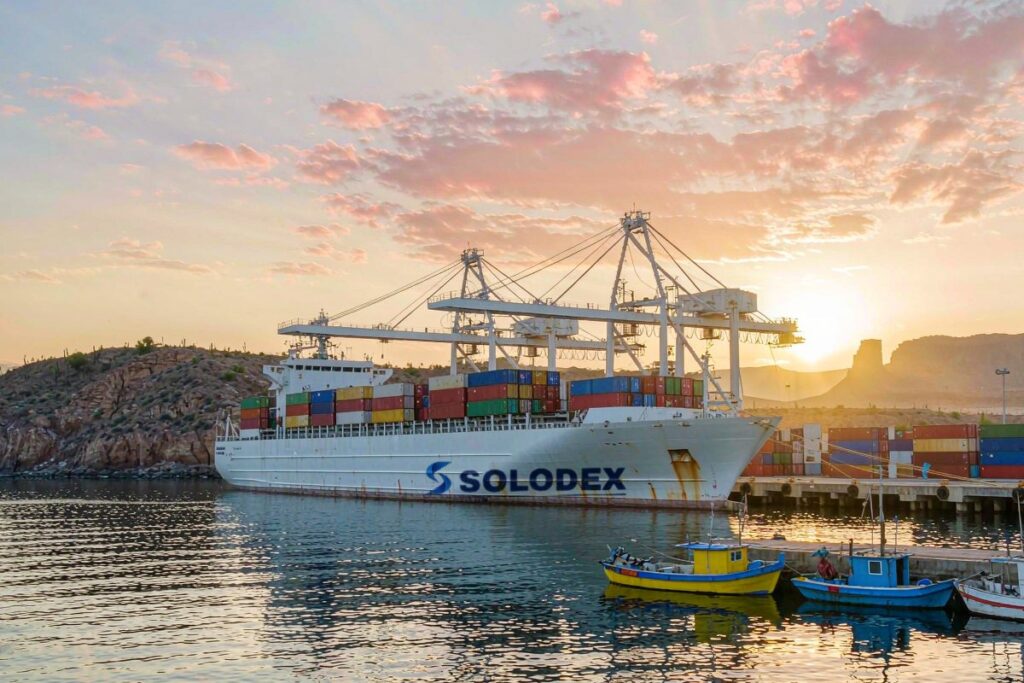
In December a carton cost what it cost. In January the same carton, from the same factory, in the same packaging, carried a different rate — not because the product changed, but because a decree did.
On 1 January 2026 Mexico raised tariffs on roughly 1,400 tariff lines arriving from countries it has no free trade agreement with. China is on that list, and so are Korea, India, Vietnam, Thailand, Indonesia, Brazil, Turkey, the UAE and South Africa. The bands run from 10 to 50 per cent, 316 lines that had been duty-free were taxed for the first time, and the most common single rate in the schedule is 35 per cent. The measure runs to 31 December 2026 and is extendable.
That single change reorders everything else about importing into Mexico. Until this year the practical question was what the product was; from this year it is where it comes from, and those are two different fields on the same declaration.
What the January decree actually covers
| Sector | Lines affected | Rate band |
|---|---|---|
| Textiles and apparel | 1,014 | 10–35% |
| Motor vehicles and parts | 235 | 20–50% |
| Iron and steel products | 249 | 15–50% |
| Plastics | — | 10–35% |
| Household appliances | — | 15–30% |
| Footwear, leather, furniture, toys, paper, glass, cosmetics, aluminium, motorcycles | — | 10–50% by line |
Read the second column before the third. Textiles alone account for more than a thousand lines, which means a single apparel shipment can straddle several different rates once it is broken down by garment type and fibre. The 35 per cent that most exporters now quote is a mode, not a rate — it is what the largest cluster of lines landed on, not what any particular product pays.
Two asymmetries decide who is exposed. The measure applies only to non-FTA origins, so goods of US, Canadian or EU origin continue to enter at preferential rates or zero. And it is a temporary instrument with a stated expiry, which means the calculation is stable enough to price against for a season and not stable enough to build a five-year model on.
Origin and provenance are two different fields
This is the distinction that produces the most expensive mistakes, and it is a one-word problem. Mexican customs rules refer to goods provenientes de — coming from — which is not the same as country of origin.
Take a Chinese-made item that ships out of a warehouse in California. Origin is China. Provenance is the United States. For a parcel under the courier regime, the difference between those two readings is the difference between the T-MEC global rates and the general one, which is 33.5 per cent. For a formal import, a certificate of origin is what settles it — and a Chinese good without a T-MEC certificate does not become American by being stored in Los Angeles.
The practical instruction is unglamorous: ask the carrier how it will declare the parcel before booking, and do not assume a US transhipment point changes the rate. It changes the routing and the transit time. The origin sits on the invoice and in the certificate, and it follows the goods.
Three lanes, and the lines between them are hard
Mexico runs parcels through a simplified courier procedure that is genuinely useful and narrowly bounded. The thresholds are per consignment and per consignee, and each band carries its own treatment.
| Value band | What is charged | Documents | Who clears |
|---|---|---|---|
| Up to US$50, shipped from the US or Canada | No IGI, no IVA — but a fixed DTA fee of MXN 378 | Waybill and invoice | Registered courier |
| US$50.01 to US$117 | A single global rate of 17%, replacing IGI and IVA | Waybill and invoice | Registered courier |
| US$117.01 to the consignee ceiling | Global rate of 19% | Waybill and invoice | Registered courier |
| Above the ceiling | IGI + 16% IVA + DTA + IEPS where applicable | Pedimento, B/L or AWB, invoice, permits | Agente aduanal |
Two notes sit outside the table. Parcels that do not come from the US or Canada pay the general global rate of 33.5 per cent, not 17 or 19 — which is why the same carton can cost materially more from Shenzhen than from a US warehouse, even though the freight may be cheaper. And the ceiling itself is where the lanes stop being interchangeable: the simplified procedure operates up to a per-consignee limit (US$2,500 under the 2026 rules, though some carriers apply a lower internal cap), above which a formal pedimento is unavoidable.
One detail that gets lost in the summary: the US$50 lane is not free of charges, it is free of the two taxes, and the fixed DTA fee is still collected. “Duty-free” and “nothing to pay” are different statements.
The two documents that make a formal import possible
Commercial volume cannot travel on the courier lane, and the formal route has an order of operations that cannot be reversed at the port.
First, the importer of record must be an entity registered in Mexico, with an active RFC tax identity and a fiscal domicile, enrolled in the Padrón de Importadores. For certain sectors — chemicals, textiles, footwear, steel — a sectoral registry is required as well. A foreign supplier cannot occupy that role; someone inside Mexico has to own the declaration and the liability behind it.
Second, only a licensed agente aduanal can file the pedimento, and it goes in electronically through VUCEM. The broker is not a convenience that can be replaced by good paperwork: the declaration carries the broker’s patent number and electronic signature, and the importer’s RFC, regime code and registered product data. Then the entry is charged on the customs value: IGI at the rate the tariff line and origin produce, 16 per cent IVA, and the DTA processing fee at roughly 0.8 per cent.
Which is where the January decree lands. The declaration asks for country of origin explicitly, and the rate follows from it. A supplier who quotes “35 per cent, that is what Mexico charges now” is describing a mode across a thousand lines, and the person who has to defend the number at the border is the importer named on the pedimento.
Permits sit alongside the declaration rather than behind it. Goods subject to a Mexican official standard need the NOM certificate or the label that proves compliance, and health, food and agricultural lines need clearance from COFEPRIS or SENASICA before the entry can be validated. A shipment that arrives with a correct pedimento and a missing NOM is not a shipment with a rate question; it is a shipment in detention, and detention in Mexico is measured in storage days rather than in a revised invoice.
Splitting a parcel does not work here either
Mexican rules name the practice. Fraccionamiento — breaking one operation into several to stay under a threshold — is prohibited, and the penalty route runs through the smuggling provisions rather than a simple adjustment. The thresholds are assessed per consignee and per day, so three parcels arriving together are one operation with a single value.
The arithmetic has also stopped working. Below US$50 there is nothing to save but the two taxes, and the fixed DTA fee applies to each parcel; between US$50 and the ceiling the global rate applies to the full value of each parcel, so splitting converts one taxable amount into three. Eight parcels of US$49 out of a US$400 order is exactly the pattern the courier rules say they will not accept.
The same reasoning appears in the general case against splitting: the fee structure is per shipment, so the saving is imaginary and the exposure is real.
The marketplace detail that decides the margin
For anyone selling into Mexico through a local marketplace rather than shipping to a consumer, the RFC stops being a customs document and becomes a commercial one. Amazon México requires RFC tax information from sellers shipping from Mexico or carrying Mexican indicators. Without it on file, withholding runs at 16 per cent IVA plus 20 per cent ISR — a combination that removes most of the margin on ordinary consumer goods before any duty is considered.
This is the point where the three lanes and the tax identity converge. A seller testing the market can send individual parcels through the courier route and never touch an RFC. A seller holding stock in Mexico cannot: the moment inventory sits in the country, there is an importer of record, and that importer needs an RFC, a padrón entry, and a broker relationship. The choice is not about paperwork preference; it is about whether the goods are stored in Mexico or shipped through it.
What to recheck before the next quote
- The tariff line and the origin together. Neither alone produces a rate any more. Ask for the specific fraction, not the sector average, and confirm whether the line is one of the 316 that moved from zero.
- Whether a certificate of origin exists. For non-FTA origins it will not change the rate; for US, Canadian or EU goods it is the only thing that keeps the preferential treatment. A US warehouse is not a certificate.
- Which lane the shipment actually fits. Value per consignee per day, not per parcel, and remember that the US$50 band is tax-free rather than charge-free.
- Who is the importer of record, and are they enrolled. Padrón registration, sectoral registration where relevant, and an agente aduanal engaged before the vessel sails — the same structural question as the Gulf’s importer-of-record rule, arriving with a different set of documents.
- Whether the quote is IVA-inclusive. IVA is 16 per cent of the customs value plus duty, it is not waived by any trade agreement, and it is the line most often left out of a DDP calculation — the failure mode described in building a landed cost.
None of this is more complex than Brazil’s cascade or Korea’s identity regime. What makes Mexico awkward this year is timing: the rate changed in January, the guidance most exporters rely on did not, and the difference is being discovered at the border rather than in the quotation.
The rules that decide whether a shipment actually earns the preference — the tariff-shift tests, the value calculation and the file behind the certification — are covered in the USMCA origin article.
Whether the product itself may be sold — the NOM certificate and the Spanish label — is a separate file, covered in the NOM article.
Whether the company named as importer is entitled to act at all — the register entry that sits behind the tax number — is a separate permission, checked before anything else on the file.
Where origin sets the rate, each house bill can be assessed differently even from one container; the mechanism is in Mexican customs rules.


