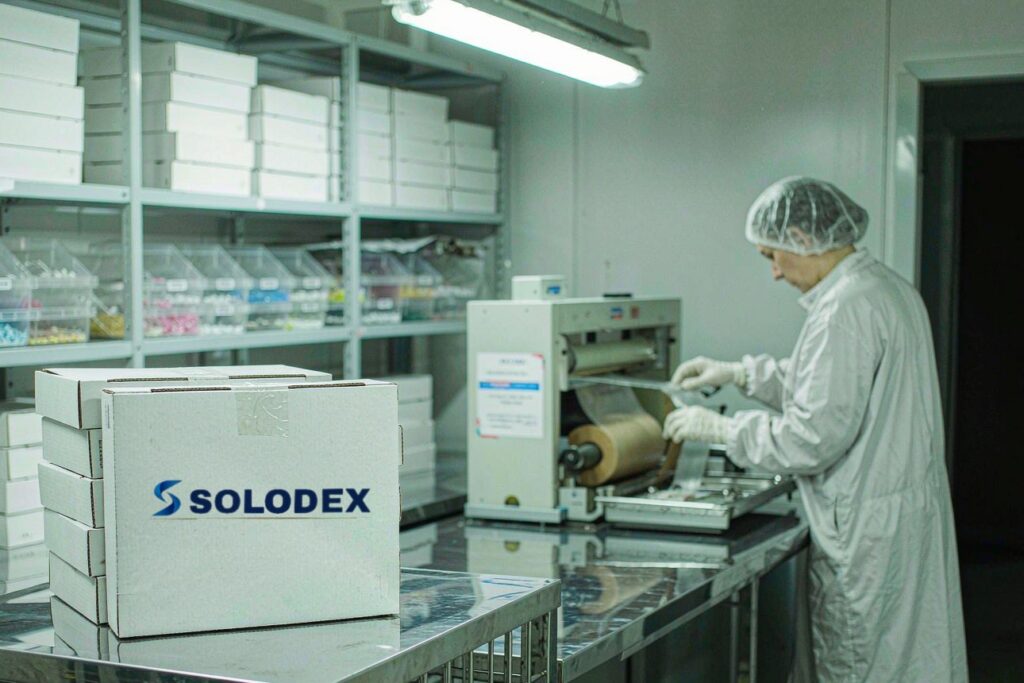
The pallet arrived with one carton crushed at a corner. Inside, forty pouches of sterile wound dressings sat in a neat stack, each one sealed, each one printed with a lot number and a use-by date. Nothing in the carton was broken. The hospital’s sterile services department rejected the entire carton the same afternoon.
The forwarder settled the claim at the value of the carton, because a carton was what had been damaged. The contents were worth eleven times that, and none of them could be used.
This is the difference that makes medical goods a separate problem from every other fragile cargo on this site. A scratched machine is a machine with a defect. A pouch that has been folded hard enough to break its seal is not a damaged pouch. It is a device that has stopped being sterile, and there is no repair for that.
Whether a product is a medical device at all is a question about language, argued in a sentence and settled before anything is packed – what the packaging claims decides which rulebook applies. This is the question that comes after that one, and it is asked by the people who already know what the product is.
Two packages in one carton
Every terminally sterilised device travels inside two packages that do two different jobs, and confusing them is where the argument starts.
The inner one is the sterile barrier system: the pouch, the blister, the tray with its lid. Its job is to keep microorganisms out while letting the sterilising agent in and out during manufacture, and then to let the contents be presented onto a sterile field without touching anything else. It is, functionally, part of the device.
The outer one is protective packaging: the carton, the dividers, the shipper, the pallet. Its job is to survive the journey so that the inner one never has to.
Damage to the second is a freight loss, priced in cartons. Damage to the first is a product loss, priced in devices, and it is not repaired by anything that happens after the factory gate. A crease that runs across a seal, a corner that took the impact, a pouch that was compressed between two heavier cartons for three weeks – all of them end the same way, and none of them look like much in a photograph.
The seal is proven by the process, not by looking
Nobody at the destination can tell you whether a pouch is still sterile. There is no test you can run on a sealed unit that answers the question without opening it, and opening it answers the question by destroying the subject.
What exists instead is a validated process. The seal strength, the peel behaviour, the integrity of the porous side are tested on samples taken from the production run – dye penetration, bubble emission, peel force – and the results stand behind every unit made in that run. This is the same logic as any other report that speaks for a batch rather than an item: what it certifies is the process that produced the sample, not the object in your hand. The unit itself carries three things you can read: the sterilisation date, the use-by date, and the lot number that ties it back to the run whose samples were tested.
Which gives the shipper one real defence and one false one. The real defence is that the process was validated and the records exist and the transit was designed so the packaging was never the load path. The false one is the colour-change square printed on the pouch. That indicator proves the package went through the sterilising cycle. It proves nothing about what happened to it afterwards, and it will look perfectly correct on a pouch whose seal failed in transit.
The enemy is vapour, not water
A sterile barrier has to breathe. Steam and ethylene oxide have to get in and out during the cycle, so the porous side of a pouch is designed to pass gas, and by extension it passes water vapour. This is not a defect; it is the mechanism.
The consequence is the counter-intuitive part: a carton that is bone dry on arrival can contain a compromised barrier, and a carton that is visibly wet is not necessarily the one that failed. What matters is the history of temperature and humidity across the journey, because that is what drives condensation inside a container – the same mechanics that put water inside a sealed steel box in the first place. A pallet loaded warm into a cold container, or a container crossing four climate zones, cycles the moisture in the air through the cartons and through the porous side of every pouch in them.
Paper-based and Tyvek-based barriers lose their integrity when they take on moisture, and they do not recover it when they dry out. The pouches look the same. The fibre structure is not.
Two dates on the same pouch, and only one of them is about the device
The sterilisation date and the use-by date are printed side by side, and it is natural to assume the second is the first plus however long the device lasts. It is not. The shelf life is set by the packaging: the manufacturer ages the packaged unit, tests the seals and the barrier after that ageing, and declares a period for which the whole assembly is still sterile.
Two things follow, and both of them cost money. Change the pouch – a different supplier, a different coating, a different size – and the shelf life has to be re-established, even though the device inside is identical and its own shelf life has not changed. And the date is not extendable. There is no test that re-certifies a pallet in a warehouse, no inspection that adds a year, and no reputable way to move a device from an expired pouch into a new one outside a validated facility. The device may be perfect. It is no longer a sterile device.
Four kinds of damage, four different outcomes
| What happened | Is the device still sterile? | What it becomes | Who pays |
|---|---|---|---|
| Carton crushed, pouches inside intact and uncreased | Yes, if the barrier was never the load path | A carton claim and a usable product | Cargo insurance, at carton value |
| Pouch creased across a seal, no visible opening | No – a flexed seal is a failed seal | Scrap, or a return to the manufacturer | Usually nobody, unless sterility was insured |
| Pouch visibly torn or opened | No | Scrap, and a documented destruction | Depends entirely on the policy wording |
| No visible damage, three weeks of humidity cycling | Unknown, and treated as no | Scrap, with no evidence to argue about | The most expensive row in the table |
The third column is the one that changes how a shipper behaves. A non-sterile device – a stethoscope, a scale, a stretcher – behaves like ordinary cargo: damage it, claim it, discount it, sell it on. A sterile device has no second market and no discount price, because the buyer is a hospital and the buyer’s own procedure forbids it. There is no conversation in which a clinician accepts a compromised pouch at a lower price.
What cannot be done at the destination
Every instinct in the freight chain says the problem can be fixed locally. Repack it, re-label it, put it in a new pouch, send it back out. For this category, all four are wrong.
Repacking a sterile device is manufacturing. It requires a validated process, a clean environment, a steriliser, and the packaging validation that goes with it, which means it can be done by the original manufacturer or by a facility licensed to reprocess – not by a warehouse, and not by a forwarder trying to be helpful. A device re-pouched in a warehouse is an unregistered device with an invented expiry date, and the paperwork that describes it is false.
So the realistic outcomes are two. Return it, under a formal authorisation from the manufacturer, which costs a second freight leg and usually a second set of import formalities. Or destroy it, under supervision, and obtain a certificate that says so – because a customs authority that has already assessed duty on a consignment will want to know why the goods no longer exist before it releases the duty. The certificate is a customs document, not a receipt from a waste contractor, and the difference is discovered at the refund stage.
What the claim actually pays for
Cargo insurance responds to physical loss or damage to the goods. A crushed carton is physical damage and is easy to agree. The pouches inside it are, in the ordinary sense of the word, undamaged – they are neither broken nor deformed, and a photograph of them proves nothing.
That gap is why policies covering this category need sterility to be addressed explicitly rather than assumed. Whether a breach of the sterile barrier counts as damage, and whether it is excluded as a loss that is not physical, is a question about the wording, not about the facts. The same shipment can be fully covered or entirely uncovered depending on a clause that nobody reads until a pallet is being condemned. It sits alongside the risks that neither the carrier nor the declared value covers, and it is the reason the shipper’s own records matter more than the surveyor’s opinion: the argument is not about what the pouches look like now, it is about what they went through.
Which is why the documents that decide these cases are made before the cargo moves. A temperature and humidity logger in the carton, a loading record with the container’s condition, photographs at the point of stuffing, and a specification that says what the packaging is expected to withstand – these are evidence assembled before the damage, and they are the only thing that turns an unwinnable argument into a routine one.
The third kind of sensitive cargo
Most goods on this site are stopped by a document, a duty rate, or a class. Medical devices are stopped by a physical property that leaves no trace: the barrier either held or it did not, and the difference is invisible from the outside in both directions.
Which is why the practical instruction is not about handling. It is about the load path. The sterile barrier must never carry weight, must never be the thing that absorbs an impact, and must never be the surface that takes a corner. A carton strong enough to do that job – and strong enough is a calculation, not a feeling – is what makes the rest of this category boring.
And it is why the sentence at the top of the file should not be “fragile”. It should be the one thing everybody in the chain needs to know before they touch the pallet: the product is not the device. The product is the device inside a package that has never been opened, and the package is the part that cannot be replaced.
Classification follows what a device is claimed to do; when such a product travels under a temperature instruction, the instruction is a target for the air and not a reading of the goods.


