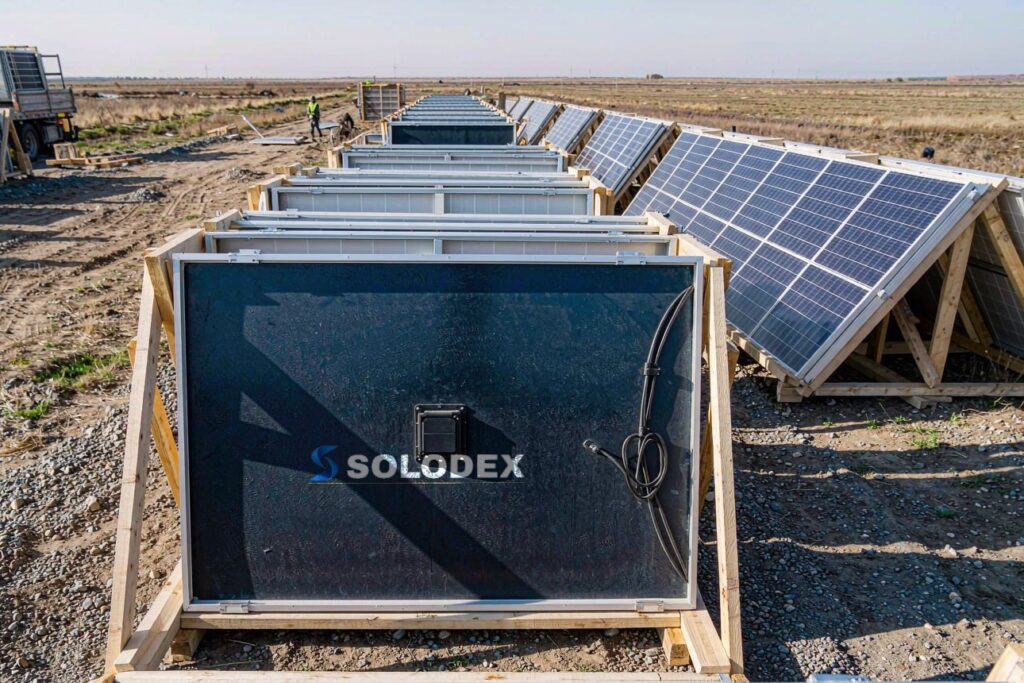
The invoice said photovoltaic modules, six hundred and twenty pieces, and every one of them was exactly what it claimed to be: glass, aluminium, silicon, a junction box. Not one component of a solar panel is dangerous goods.
The container was still stopped, because four cartons loaded at the door held hybrid inverters with lithium batteries inside, and nothing on the booking mentioned them. The modules were fine. The shipment was not.
This is the defining feature of the category, and it catches experienced exporters as often as new ones: the dangerous goods status of a solar shipment is not a property of the panels. It is a property of whatever else is in the box.
What a module is made of
A modern module is a sandwich: tempered glass on the front, an encapsulant, the cells, a backsheet, an aluminium frame, and a plastic junction box with cables and connectors on the back. There is no liquid, no gas, no flammable solvent, and no cell chemistry that behaves like a battery.
Which is why a container of modules, and nothing but modules, moves as ordinary cargo. It needs a proper description, a value and an origin, and it needs to survive the journey intact — but it does not need a dangerous goods declaration, and it does not need a UN number.
The description matters more than it sounds. “Solar panels” is a trade term, not a customs description; the entry needs the article, and the value needs to be the transaction value rather than a rounded estimate. A vague line is what makes an officer open the doors, and once the doors are open, everything in the container is being looked at.
What turns the container into dangerous goods
The accessories do. A residential system sold as a kit includes the modules, the mounting, the cabling, and increasingly a battery or a hybrid inverter with one built in. A portable power station sold alongside is a lithium battery in a plastic case. A “solar generator” is a battery with a panel attached.
Each of those is dangerous goods in its own right, usually Class 9, with a UN number, a state-of-charge limit for air, packaging instructions and a declaration. Loaded into a container with modules, they do not become less regulated because the main cargo is benign.
The consequence is a classification that runs the wrong way round: the container is described by its least dangerous majority and regulated by its most dangerous minority. This is the same arithmetic that turns one battery into a whole-load problem, and it is why the packing list, not the invoice headline, is the document that decides.
Four things that arrive in the same container
| What is in the box | Dangerous goods? | What decides | The usual mistake |
|---|---|---|---|
| Modules only | No | Nothing — ordinary cargo with a proper description | Assuming every solar shipment needs a declaration, and paying for one |
| Micro-inverters, DC optimisers | Usually no | No battery inside; capacitors are not a transport class | Declaring them as if they were, and delaying the booking |
| Hybrid inverter or all-in-one unit | Usually yes, Class 9 | The battery inside it, and its chemistry | Booking it as “inverter” because the battery is not a separate line |
| Portable power station, spare packs | Yes, Class 9 | Watt-hours per unit, state of charge, packing instruction | Treating a retail box as exempt because it looks like a consumer product |
Read the third column. In three of the four rows the answer depends on something that is not visible from the outside of the carton, and in the fourth it depends on a number that is printed on a label nobody photographs. That is why the useful control is a line-by-line review of the packing list against the battery rules, done before the container is booked rather than at the gate.
Glass that fails without breaking
A module is a sheet of tempered glass bonded to cells, and it can be destroyed without a crack. Micro-cracks form where the glass flexes or where a corner takes a knock, invisible to the eye and to a photograph, and they propagate over the first months of service until a cell string goes open and the module loses a fifth of its output.
Which is why the damage that matters in this category is measured, not seen. Electroluminescence imaging — a photograph of the module under an electrical load, in which cracks appear as dark lines — is the only way to know whether a pallet survived. A visual inspection at delivery will pass a module that fails an EL test.
Two practical consequences follow. The first is that the inspection at destination is not a satisfactory control, because the damage may be invisible and the claim window is short. The second is that the evidence has to be made before shipment: photographs of the crates, of the loading, and of the corner protection, taken by somebody who expects an argument later.
The serial number is the claim
Every module carries a serial number, laser-etched or on a label inside the frame, and the numbers run in a sequence that the factory records against the pallet. That sequence is what turns a pallet into a set of individually identifiable products — and it is what a claim needs.
A claim that says “forty modules arrived cracked” is a claim about a pallet, and it will be answered with a question about handling. A claim that lists forty serial numbers, with the pallet they came from and the position in the crate, is a claim about forty specific articles that can be checked against the factory’s own output record.
Which is why the packing list should carry the serial range per carton, and why somebody should photograph the labels at loading. It takes twenty minutes, and it is the difference between a replacement and an argument — the same reason evidence made before the damage decides these cases.
They travel standing up
Modules are shipped vertically, in A-frame racks or purpose-built crates, and the reason is structural. A module lying flat has its whole weight carried by the middle of the glass; a module standing on its long edge has its weight carried by the frame, which is what the frame is for.
The crate is therefore not packaging in the ordinary sense. It is a jig that keeps every module in the same plane and stops one from leaning on another, and its cost is a material part of the landed cost per watt. Reusing a crate designed for a different module size, or “reinforcing” one with extra timber, is how a shipment arrives with a stack that has settled by two centimetres and a row of micro-cracks along the bottom edge.
Two metres three, and how many fit
A mainstream module is roughly 2.3 metres by 1.1, which puts it in an awkward place: too long to lie two-deep across a container floor without waste, and short enough that the loading plan decides the freight. A forty-foot container takes a few hundred modules loose, more in a purpose-built rack, and the difference between a good and a bad plan is a double-digit percentage of the freight per unit.
The equipment at both ends matters as much as the plan. A module crate is long, heavy and awkward, and cargo that needs a specific handling method is cargo that can be refused at a site without the right crane or forklift attachment. The destination’s unloading capability belongs in the quotation, not in the delivery instructions.
The tariff can be the whole business case
Solar modules are one of the most contested products in international trade. Several major markets apply anti-dumping or countervailing duties, and the rate depends on the producer, the origin and sometimes the supply chain, which means two containers of identical panels can attract very different duty depending on whose factory made them and what documentation proves it.
That produces a failure mode that no amount of packing skill prevents: a shipment that is physically perfect and commercially dead, because the duty was assumed from a headline rate rather than confirmed for that producer and that destination. The question belongs in the quotation as a duty line, not in a footnote about “taxes at destination”.
It also raises the value of the origin documents. Rules of origin for solar products are detailed, and a certificate that simply states the country of export is not an answer — the question is where the cells were made, and whether the transformation that happened afterwards is enough.
Five things to settle before the container is booked
Is every line on the packing list a module, or is something else in there? The answer decides whether the booking needs a dangerous goods declaration, and it has to be answered line by line.
If there is a battery, what is its UN number, its watt-hours and its state of charge? For air, the state of charge is a hard limit; for sea, it is a packing instruction.
Is the crate rated for these modules, and is it the crate the factory designed? Not a similar one, and not a reinforced one.
What is the duty treatment for this producer and this destination? Confirmed, in writing, before the price is quoted to the buyer.
Can the destination unload a module crate? Length, weight and lifting points, checked against the receiver’s equipment rather than assumed.
None of these is a freight question, and each of them can stop a container — the same pattern as a machine that is inadmissible or a tyre that is too old. The category decides the gate; the gate is almost never the one the invoice is written for.
The panel is the easy part
A solar module is one of the few manufactured goods that is genuinely harmless to transport: inert, stable, and well understood by everybody in the chain. That is precisely why it makes a poor alibi. The container is not classified by the panels; it is classified by the accessories, priced by the duty, and judged by whether the glass arrived with its cells still connected.
Which is why the first question on a solar booking is not about freight at all. It is the one nobody puts on the form: what else is going in the box.
The accessory that reclassifies a container is, at scale, a cargo in its own right: a storage unit is thirty tonnes that no container wants.
Long fragile panels consume space and careful handling in the strip, a cost a flat per-bill share hides; the profile is in solar module shipping.


