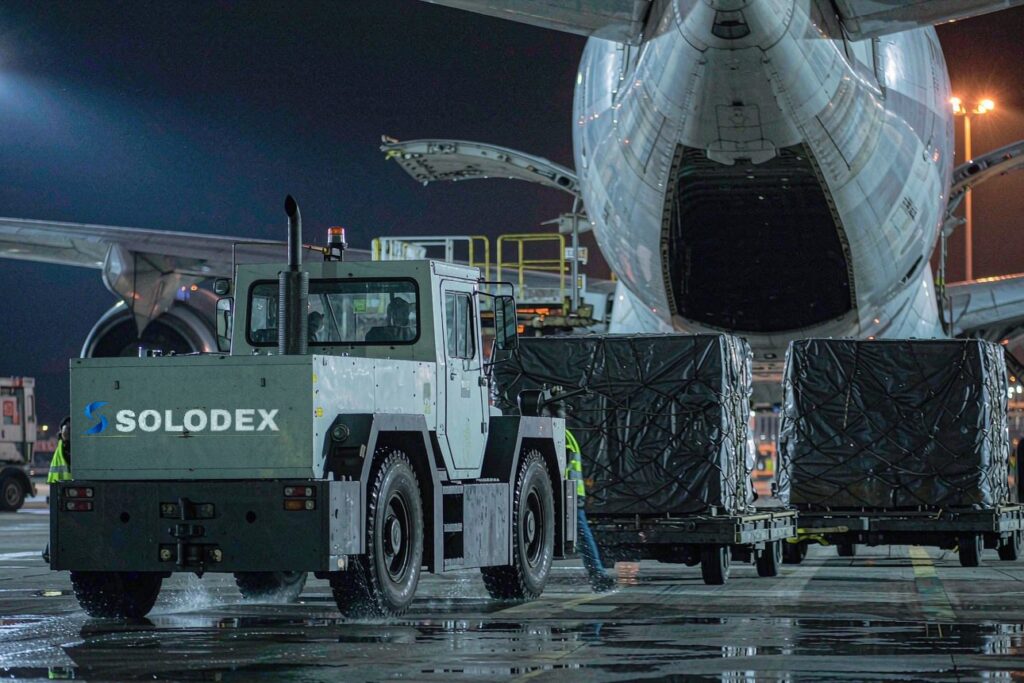
The booking was confirmed three weeks before departure, and at 22:40 the night before the flight the forwarder’s operations desk sent one line: rolled to tomorrow, space not available.
The shipper read it as the airline being full, which is what the forwarder said, and which is also true. But the airline never took the shipper’s booking. It took the forwarder’s — a block of space on that flight, agreed months earlier, of which this consignment was supposed to consume a part. When the flight came up short, somebody at the forwarder decided which of its customers would move and which would wait, and the decision was made against a contract the shipper has never seen.
That is the thing worth understanding about air capacity: it is not bought at the counter. It is rented, often sublet, and the order in which people get rolled follows ownership rather than loyalty.
A booking is not a seat
On a passenger flight, a confirmed ticket has a seat number behind it. On a freighter, a confirmed booking has nothing behind it except an understanding that the cargo will be accepted if it arrives before cutoff, at the weight and volume declared, and if the flight has room after everything else has been loaded.
There is no unit of space that is set aside with your name on it. What exists is a plan: this flight, this routing, this weight, this rate. The plan is executed at the cutoff, when somebody weighs what is actually on the floor and compares it with what the aircraft can carry.
Which is why “confirmed” in air freight means accepted, not reserved — and why a shipment can be confirmed for three weeks and still not fly.
Four layers, and only one of them answers the phone
Capacity on a given flight is held in layers, and each layer has a different relationship with the aircraft.
The airline owns the positions. It sells them through its own cargo organisation, and it commits blocks of them to parties who will pay for the commitment.
The block holder — usually a large consolidator or a forwarder with volume — has contracted for a fixed amount of capacity on a route, for a period, at an agreed rate. This is where most of the space on a busy freighter actually sits.
The forwarder you are talking to either holds a block of its own, or holds a smaller allocation inside somebody else’s, or has nothing and buys space per shipment.
You hold a booking, which is a request against whichever of the three above is actually carrying your consignment.
The practical consequence is uncomfortable and worth stating plainly: when you ask “can you get it on the flight”, the answer depends on whether the person you are asking owns space, rents space, or is queuing for space. Only the first of those can answer without calling somebody.
Hard block, soft block, and why the difference shows up in October
A hard block is capacity the forwarder pays for whether it uses it or not. A soft block is capacity it has first refusal on, which returns to the airline if it is not taken by a cutoff. Free sale is what is left, booked flight by flight.
In a soft market, the difference is invisible: space is plentiful, hard blocks look like a bad deal, and everybody sells cheaply. In a tight market the same three arrangements behave completely differently. The hard-block holder has space and a cost already sunk, so it protects its own customers and prices the rest at whatever the market will bear. The soft-block holder finds its allocation pulled back. The free-sale buyer is told the flight is full, because it is.
This is the capacity half of what happens to rates in the fourth quarter, and it explains an asymmetry shippers find baffling: the forwarder who was cheapest in March is not the one who can move the pallet in November.
Co-loading: your space may belong to a competitor
A forwarder without capacity on a route does not stop selling the route. It buys space from a forwarder that has it, and moves your cargo under that party’s arrangements. The trade calls it co-loading, and it is normal, legitimate, and invisible on your invoice.
Three things follow. Your consignment is now one layer further from the aircraft, so the answer to “what is happening” is second-hand. The margin of the party in the middle is inside your rate, which is fine as long as you know it is there. And if the flight is oversold, the roll order is decided by the party whose name is on the block — not by the party whose name is on your invoice.
There is no scandal in any of this. The problem is only that a shipper who believes it is dealing directly with an airline’s capacity will misread every subsequent message, and will keep asking a question that the party in front of it cannot answer.
When the flight is full, somebody decides
Overbooking is not an accident; it is a plan. Aircraft rarely depart at their maximum payload, because volume, fuel, weather and the balance of the load all intervene, so selling slightly more than the aircraft can carry is rational. What matters is who gets moved when the plan meets reality.
The order is set by contract, then by rate, then by relationship. A hard-block allocation is honoured because it has been paid for. A high-yield ad-hoc booking may be protected over a low-yield one on the same flight. A customer of fifteen years with no allocation has sentiment, which is worth something and is not a contract.
Which is why the useful question at booking is not “is it confirmed” but “what happens if the flight is full, and where am I in that order”. A forwarder that can answer that question has thought about it. One that cannot has probably not been in the situation with your cargo yet.
A block is measured in kilos; an aircraft is filled in cubic metres
Space is contracted in weight, because weight is what an airline can invoice and what a load sheet is built from. An aircraft, however, runs out of two things at once: payload and volume. On a route where most of the cargo is light, the flight fills up in cubic metres while the tonnage column still shows room.
So a forwarder can hold a block with 4,000 kilos unused and still be unable to take another pallet, because the positions are gone. And a shipper can be told “we have space on the block” and then be rolled, because the space that existed was a weight allowance, not a hole in the aircraft.
This is the same mismatch that makes a quote hard to read: a rate is quoted per chargeable kilo, and chargeable kilos mix weight and volume into one number that behaves like neither. The block is denominated in that number. The aircraft is not.
The last hour, when the decision is actually made
Cut-off is not the departure time. It is the moment the cargo stops being able to join the flight, and it is earlier than most shippers expect because everything downstream of it takes time: the pallet has to be built or broken, weighed, screened or its status verified, transported to the aircraft, and loaded in a sequence that keeps the aircraft balanced.
At the end of that process somebody produces a load plan and, if the numbers do not fit, an offload list. The names on the offload list are not chosen at that moment — they were chosen by the contracts described above, and the list is only where the choice becomes visible.
Which is why the message arrives at ten or eleven at night. Nobody was being careless. The arithmetic was being done, and it had been decided weeks earlier whose arithmetic would win.
One-stop is two bookings
A direct flight is one cut-off, one build, one departure. A one-stop routing is two flights and, in practice, two bookings — the second one made by an agent at the hub who has never spoken to you and has no particular reason to protect your pallet.
At the transit point the cargo is offloaded, and what happens next depends on the connection and on the ground handler’s day. The pallet may be broken down and rebuilt into a different contour, which is a shape decision you made at origin for a different aircraft. It may be re-weighed, with consequences for the chargeable weight. And if it was secured at origin, the break may cost it its security status, because the chain of custody ends when somebody opens the net.
None of this makes one-stop wrong. It is often the only way to serve a secondary city, and it is almost always cheaper. What it makes it is a promise with a second dependency in it — and the arrival time you were given is the best case of two flights, not the sum of two averages.
Buying the aircraft instead
Above a certain size, the question stops being which flight and becomes whether there is a flight at all. A charter — a whole aircraft, or a share of one — removes the capacity problem and replaces it with three others: an airport pair that can accept the aircraft, a crew with enough duty hours left, and permissions for the route.
It is the right answer for project cargo, for out-of-gauge pieces that no scheduled position will take, and occasionally for a production line that has stopped. It is the wrong answer for anything that could fly on a scheduled service next week, because the fixed cost of the aircraft does not care how full it is.
Five questions before the booking is made
Does the party I am booking with hold space on this route, or buy it? Not a judgement about competence — a question about the number of layers between the pallet and the aircraft.
Is the allocation hard or soft? If it is soft, the space exists until somebody with a harder claim wants it.
If the flight is full, where does this consignment sit in the roll order? If the answer is vague, assume it is near the back.
Is the routing direct, and if not, who owns the second leg? The connection is where the promise usually breaks.
What is the cut-off, in local time at the origin airport? Not the flight time — the moment the cargo stops being able to board, which is earlier and is set by the handler.
Answers to all five are available before the goods leave, and none of them appears on the waybill, which is issued after the space question has already been settled. That is the pattern worth remembering: by the time the document exists, the decision it depends on has already been made.
Space is rented, and often sublet
The aircraft is a fixed asset with a schedule, and the space inside it is sold forward in blocks to parties who will commit. Everything downstream — the booking, the rate, the confirmation email — is a claim against one of those blocks, and the strength of the claim is the only thing that matters on a full flight.
Which is why two shippers with identical cargo, identical rates and identical confirmation emails can have completely different weeks. One is standing on a hard block. The other is standing on a favour, three layers away from the aircraft, being told that the airline is full.
The airline is full. It just was never your airline.
Space decides whether the consignment flies; the calendar decides when it is delivered. The gap between arrival and release is usually larger than the gap between two flights.
Air capacity is held in layers of commercial control that decide who flies; on a ship a reefer occupies two different inventories, cells counted in bays and outlets counted by socket ID, and neither remainder converts into the other.


