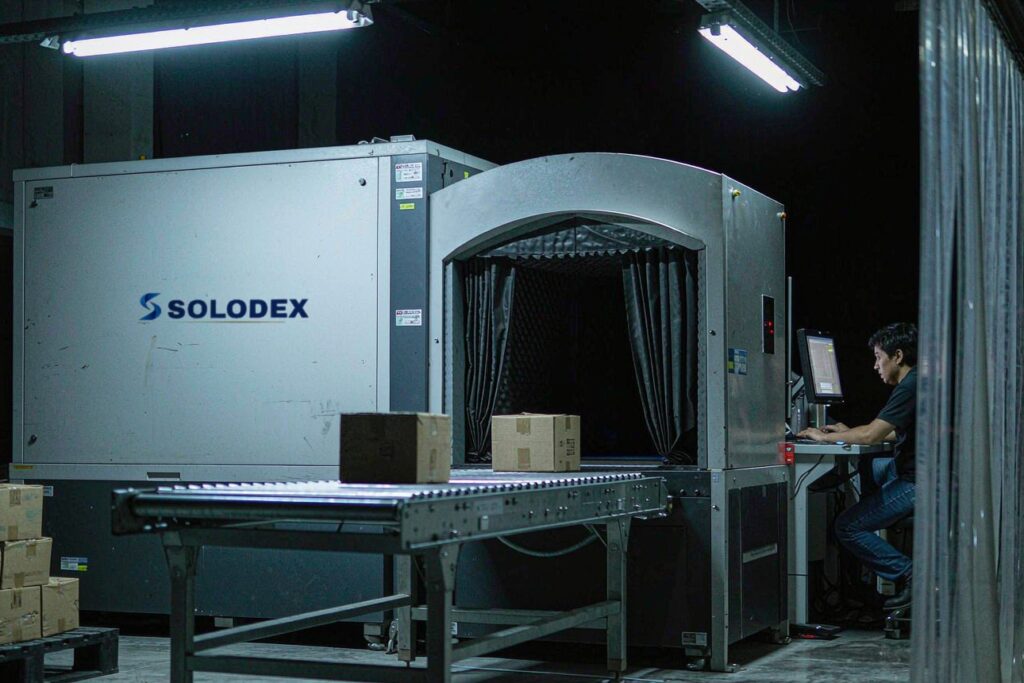
Nine of the ten cartons on the pallet were screened on Monday. The tenth was opened at the airport by a customs officer looking for something else, then closed again with fresh tape. Nothing was found, nothing was taken, and the pallet’s security status was gone.
It is now unknown cargo. Not suspicious — unknown, which is a category rather than an accusation. It cannot be loaded until it is screened again, and screening it again means taking the pallet apart, because the whole point of the earlier screening was that it happened before the pallet existed.
This is the part of air freight that surprises shippers most, and it is not really about terrorism. It is about a status that attaches to a consignment, travels on a document, is destroyed by a piece of tape, and decides which aircraft the goods are allowed to board.
The unit is the consignment, not the box
Security screening for air cargo is done at the level of a consignment, before it is consolidated. That ordering is not administrative convenience; it is the only point at which the work is possible. Once cartons are stacked on a pallet, netted to a contour and covered, there is nothing left to look through. The machine sees a pallet-shaped mass, and the only way to inspect what is inside is to take it down.
Which is why every serious air cargo regime pushes screening upstream, to warehouses and facilities away from the airport, operated by parties approved to do it. The airport screening line is the fallback, not the design. Cargo that reaches the terminal unscreened joins a queue, and the queue does not move at the speed of the aircraft.
Three words that decide which aircraft you board
The outcome of screening is not a pass. It is a status, and the status is a permission for a class of aircraft.
SPX means secure for passenger, all-cargo and all-mail aircraft. SCO means secure for all-cargo and all-mail aircraft only. SHR means secured to the higher standard applied to cargo assessed as high risk. Anything that has not been secured is not “pending” — it is unsecured, and it does not load.
The middle one is where schedules quietly break. A consignment at SCO is perfectly legitimate and completely unusable on a passenger aircraft. On a route where the only capacity that week is belly space on a passenger flight, an SCO piece is not delayed by a day; it is delayed until a freighter has room. Shippers who ask “is it cleared” get the wrong answer, because the useful question is “cleared for what”.
The status travels on a document with a name and a time
Every secured consignment is accompanied by a declaration — a consignment security declaration, either on the air waybill or as a separate record — and that document is auditable in a way most transport paperwork is not. It carries the identifier of the regulated party that issued the status, the consignment’s own identifier, a description of the contents, the status itself, and the reason it was issued.
The reason is a code, and it distinguishes two very different situations. Cargo received from a known consignor is marked as such. Cargo that was screened is marked with the method: hand search, X-ray, explosive detection system, trace detection, dogs, visual check, metal detection. The difference matters because one is a statement about the shipper’s premises and the other is a statement about this consignment.
And then two fields that most people never read: the name of the person who issued the status, and the date and time it was issued. Those two are the whole chain of custody in one line. If a pallet is challenged at the aircraft door, the answer is not “it was screened” — it is who said so, and when.
A pallet takes the status of its worst carton
Consolidation does not average. A pallet holding nine SPX consignments and one SCO consignment is an SCO pallet, because the aircraft does not care about proportions. The consolidating agent keeps the individual records, and the documentation that accompanies the built pallet carries the consolidator’s identifier, the pallet’s own identifier and one status — the lowest one inside it.
That single rule explains a category of delay that looks arbitrary from the outside. A shipment is booked, screened, delivered to the terminal on time, and still does not fly, because the forwarder consolidated it with a consignment that had a lower status. Nobody lied and nothing was damaged. The arithmetic of the pallet simply ran the wrong way.
It is the same structural problem as a single battery reclassifying a whole load: the unit that travels is not the unit that was described, and the strictest member sets the terms for all the others. It gets worse as soon as the pallet is built from several suppliers, which is the normal shape of a consolidated order — nine cartons from three factories, one of which was screened by a party nobody has heard of.
Being a known consignor is a status you earn, not a box you tick
A known consignor is a shipper that originates cargo for its own account and has been approved to apply the controls itself: controlled access to the packing area, screened staff, tamper-evident packing, documented seals, and an audit trail from the production line to the pallet.
The commercial value is straightforward. Cargo from a known consignor arrives at the forwarder already secure, so it does not join the screening queue, and it does not need to be opened. On a route with tight cut-offs, that is worth more than the freight rate difference between two forwarders.
The cost is that it is an organisational commitment rather than a certificate. The approval is granted after an assessment of the premises and the procedures, it can be withdrawn, and it has to survive staff turnover. Most small and mid-sized exporters never obtain it, which is why most cargo in the world is screened rather than exempt.
What voids the status
The status survives handling and it does not survive interference. A broken seal, tape that has been cut and replaced, a carton added after screening, a pallet left outside the controlled area overnight, or an inspection by another authority — each of these ends the chain of custody, and the consignment goes back to unsecured.
The customs inspection is the one that catches people, because it is nobody’s fault and it happens for good reasons. An officer opens a carton, looks inside, finds nothing and closes it. From a security point of view the carton has been out of control, and the pallet it belongs to has to be re-screened. On a built pallet that means breaking it down, screening the pieces again and rebuilding — a day at minimum, and a day that lands on the flight.
This is why experienced forwarders try to sequence customs examination before screening rather than after, and why a shipment that has been examined is worth flagging to whoever is building the pallet. The information exists; it just rarely travels with the goods. The same is true of a magnetic field reading, which is a different test with a different certificate, ordered at a different counter, and equally capable of stopping a consignment that nobody thought was unusual.
The packing list is a security document
Screening looks for what the image cannot explain. A machine does not know that a dense rectangular object is a heat sink, a motor lamination stack or a box of screws; it knows that it cannot see through it, and that the shape does not match anything on the paperwork.
So the ordinary, harmless, high-density cargo is the one that gets opened: machined parts, tooling, batteries, anything with a transformer in it. The genuinely dangerous item in a familiar shape tends to pass, because the image matches the description.
Which produces a rule that sounds backwards and is entirely practical: the more precisely the cargo is described, the less it gets opened. A packing list that names the article, its material and its arrangement inside the carton is doing security work, not just customs work — and it is the same document that has to match the invoice, the waybill and the entry. The version of that problem where two documents disagree is usually treated as a customs risk. At the screening point it is a delay risk, and the delay is measured in flights missed.
Why “urgent” is the most expensive word in the booking
Every screening method has a throughput measured in pieces per hour, and every approved facility has a queue. A consignment that arrives outside its booked slot waits for the next gap; a consignment that needs to be opened stops the line while somebody finds a knife.
The aircraft, meanwhile, is indifferent. It departs on schedule whether or not the pallet is loaded, and the cargo is rolled to the next flight — which on a thin route may be two days later, and on a heavy route may be tomorrow but at a rate nobody quoted.
This is the structural reason air freight cannot be accelerated at the end. You can pay for a faster flight, a direct routing or a priority handling label, and none of those create screening capacity at eight in the evening on the day of departure. The lever exists, but it is pulled a day earlier, by whoever decided when the cargo would arrive at the facility.
Five things to settle before the pallet is built
Which aircraft class does this consignment have to be acceptable for? If the routing includes a passenger aircraft anywhere, SCO is not enough, and the booking is wrong before the goods arrive.
Who holds the approval — the shipper as a known consignor, or the forwarder as a regulated agent? The answer decides who is responsible for the packing discipline and who gets called when it fails.
Is there a security declaration, and does it name a person and a time? A status without an issuer and a timestamp is not a status; it is a claim.
Will anything be opened between screening and loading? Customs examination, an airline’s own check, a re-palletisation at a transit point. Each one resets the clock.
Is the seal number recorded, and does the record travel with the pallet? This is the cheapest control in the whole chain and the one most often left to memory.
A permission, not a certificate
The word “security” makes this feel like a compliance topic, and compliance topics get filed under paperwork. It is not that. The status is a permission to board a particular class of aircraft, it is granted per consignment, it is carried by the same document that carries the contract, and it can be withdrawn by a piece of tape.
Which is why the two most useful fields on the declaration are not the status code but the name and the time. They tell you that a person, at a moment, decided this cargo was secure — and they tell you exactly how far back the clock has to be wound when something goes wrong.
The goods were never late. The pallet was rebuilt.
Screening happens before the pallet exists, and the build is the next step: once the net is on, nothing inside can be reached again without taking the load apart.
Screening is one of the queues that make up the ground time, and it is the one that behaves least like a rate: a facility’s opening hours decide more of the arrival date than the flight schedule does.
When time is bought back by switching to air, security screening still has its own minimum clock; the steps are in air cargo security screening.


