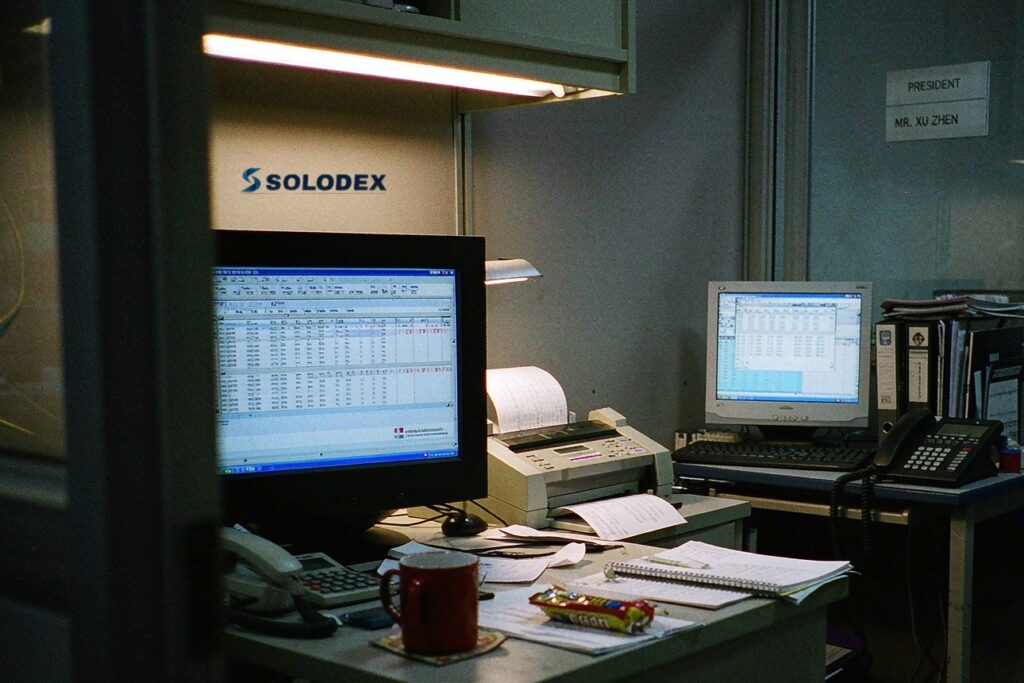
The interface that worked for eleven years
For eleven years, a factory in Zhejiang and a retailer in Rotterdam exchanged orders, shipping notices and invoices over the same EDI connection. Nobody touched it. It was, by every measure the IT department had, stable.
Then invoices started coming back rejected: price mismatch. The price had not changed. What had changed was the unit of measure — the retailer’s master data had moved a line from EA to CS, because someone in buying had decided to order by the case. The interface carried the same number it had always carried. The receiver read it as cases. The invoice was, in its own terms, wrong by a factor of twenty-four.
Nothing in the eleven years of stability had anything to do with the software being good. It had to do with nobody changing anything. The moment a master data field moved, the interface turned out to be a set of assumptions that had never been written down.
What EDI actually is
Electronic data interchange is narrower than the phrase suggests. It is a way of putting a commercial document — an order, a shipping notice, an invoice — into a structured, machine-readable message, according to a standard that both parties have agreed to use, and sending it from one system to another.
The standards are old and they work. X12 in North America, EDIFACT in most of the rest of the world, and a long tail of national and industry variants. The messages are terse, positional, and unfriendly to read, which is why they have survived: a fixed structure is easy to validate and hard to misinterpret, provided both sides are reading the same dictionary.
What EDI is not is an integration. It is a translation layer. It moves a document from one shape to another and hands it over. Everything that makes the two systems agree — the codes, the units, the rounding, the treatment of a missing field — sits outside the standard, in a document that somebody wrote once and nobody owns.
A format describes structure, not meaning
An EDI message is a sequence of segments with qualified values. The standard defines where the quantity goes. It does not define what the quantity means.
That meaning comes from two other places, and both of them are local. The first is the code list: unit of measure, package type, currency, port, incoterm. The second is the implementation guide — the companion document in which two companies agree which segments they will use, in what order, and what each value means between them.
Two companies can both be “EDI compliant” and still disagree about whether a quantity of 24 means twenty-four pieces or twenty-four cases. The standard permits both readings. Only the guide decides, and most guides are PDFs from a project that finished years ago.
The mapping table is the system
In every EDI connection there is a table that maps your fields to their fields: this internal item code becomes that GTIN, this warehouse code becomes that location code, this unit becomes that unit.
That table is the actual integration. The transport is a commodity; the mapping is the thing that knows your business. And in most companies it has three properties that make it fragile: it has no owner, it has no version history, and it has no test.
When a supplier changes a pack size, when a customer adds a new ship-to, when a port code is updated in an international list, the table has to change. If nobody is responsible for it, the change happens as a patch during an incident, and the next person to touch it has no idea why the exception exists. After a few years the table is a record of every incident the company has had, written in a language only two people understand, one of whom has left.
Acknowledgement proves arrival, not comprehension
EDI has acknowledgements, and they are widely misunderstood. A functional acknowledgement — 997 in X12, CONTRL in EDIFACT — says that a message was received and that its syntax was acceptable. It says nothing about whether the contents made sense.
So “the EDI is working” usually means “the acknowledgements are coming back”. A message can be acknowledged and still be wrong: the price is in the wrong currency, the quantity is in the wrong unit, the delivery date is a week out. Everything passed. Nobody noticed until the invoice was rejected or the goods arrived early.
The useful distinction is between transport health and business health. Transport health is uptime, acknowledgements and queue depth. Business health is whether the order that arrived in the ERP matches the order the customer thought they placed — which requires comparing values, not counting messages.
Three messages, three failure points
Most B2B flows are a small set of documents, and each one fails in its own place.
The order. The purchase order carries price, unit, quantity and requested date. It fails when price is quoted in a different currency, when the unit has changed, or when the requested date is earlier than any feasible production date and the system accepts it silently. The order is also where the customer’s item number and your item number have to be reconciled — and where a new item, ordered for the first time, arrives with a code nobody has mapped.
The shipping notice. The advance ship notice carries what is in the boxes: carton count, pallet structure, batch, serial or SSCC numbers. It fails when the packing changed at the last minute and the notice describes the plan rather than the load, or when a partial shipment is sent and the notice still describes the whole order. This is the message that quietly breaks receiving — the warehouse scans a pallet that the notice says should not exist.
The invoice. The invoice carries value: lines, quantities, prices, tax. It fails on matching — the buyer’s system tries to tie each line to a purchase order line and a receipt, and a line that cannot be matched is rejected, sometimes with a reason code that describes a symptom rather than a cause.
Silent drops
The failures that cost the most are the ones that do not raise an error.
A description longer than the field is truncated, and the truncated version no longer matches the customs description — which is one of the quiet ways a container ends up in an examination it did not need. A quantity with decimals is rounded to an integer, because the receiving field is an integer, and 1,250.5 becomes 1,250. A line with an unmapped item code is skipped rather than rejected, because the rule was written to “continue on error” during a go-live and never changed. A zero and an empty field are treated as the same thing, so a genuinely zero quantity and an unstated quantity become indistinguishable.
None of these produce a failed acknowledgement. All of them produce a document that is structurally valid and commercially wrong.
What breaks, and who notices first
The table is the practical version. The middle column matters most, because it tells you who finds out — and the answer is rarely the person who could fix it.
| Where it breaks | Who notices first | What prevents it |
|---|---|---|
| Unit of measure changed in master data | The customer’s accounts payable, weeks later | A unit field in the guide, and a check that compares quantity × unit, not quantity alone |
| New item code, never mapped | Nobody — the line is skipped | Reject unknown codes instead of skipping them |
| Description truncated to fit | Customs, at the port | Field length limits written into the guide |
| Partial shipment described as complete | The warehouse, on receipt | Generate the notice from the actual load, not from the order |
| Invoice line cannot be matched to a PO line | The buyer’s AP team, at month end | Carry the PO line number through every message |
The measure is not uptime
EDI projects are usually measured on transmission success, which is close to meaningless because it counts only the messages that arrived, not the ones that were understood.
The measure that matters is exception closure: how many messages failed a business check, how long they took to resolve, and whether each one had an owner. A connection with 99.9 per cent transport success and a three-week exception backlog is worse than a connection with 97 per cent success and a same-day queue, because the first one is hiding its failures in a mailbox.
The test is simple and most companies fail it: take one wrong order from last month and try to trace it. Who received it, what rule rejected it, who was told, what they changed, and when it closed. If the answer takes more than an hour to reconstruct, there is no exception process — there is a person who remembers.
The long pole is the implementation guide
Everything above is decided in the document that gets written before the first message is sent: which segments, which codes, which units, which field lengths, and what happens when a value is unknown.
That document is usually produced once, signed by two project managers, and then frozen while both businesses change around it. The version number stops moving; the assumptions do not. A guide that is not revised when a unit changes is not a specification, it is an archaeology site.
Which is why the useful discipline is small and unglamorous: one owner for the mapping table, a version on the guide, a change log, and a rule that unknown values are rejected rather than skipped. None of it is technology. All of it is what makes the technology survive the twelfth year — and the same discipline that keeps five documents describing one shipment from drifting apart, applied to the wire between two companies instead of the paper inside one.
The documents downstream have their own failure modes: what the invoice and packing list must say, which origin certificate applies, and what a transit record has to contain to remain valid. EDI does not fix any of them. It only makes the same mistake travel faster, and gives it a timestamp.
Between two companies, a message is only a document if the receiver accepts it. Inside a clearance country the rule is harder still: an invoice that fails validation was never issued, whatever the sender’s system says.
A working interface faithfully reproduces whatever the mapping table says, including the disagreements: the rules that decide which differences are allowed have to exist before the messages do.
Exchanging messages is not the same as two systems sharing a table; a version sent ashore does not rebuild a bay plan keyed by container number.


