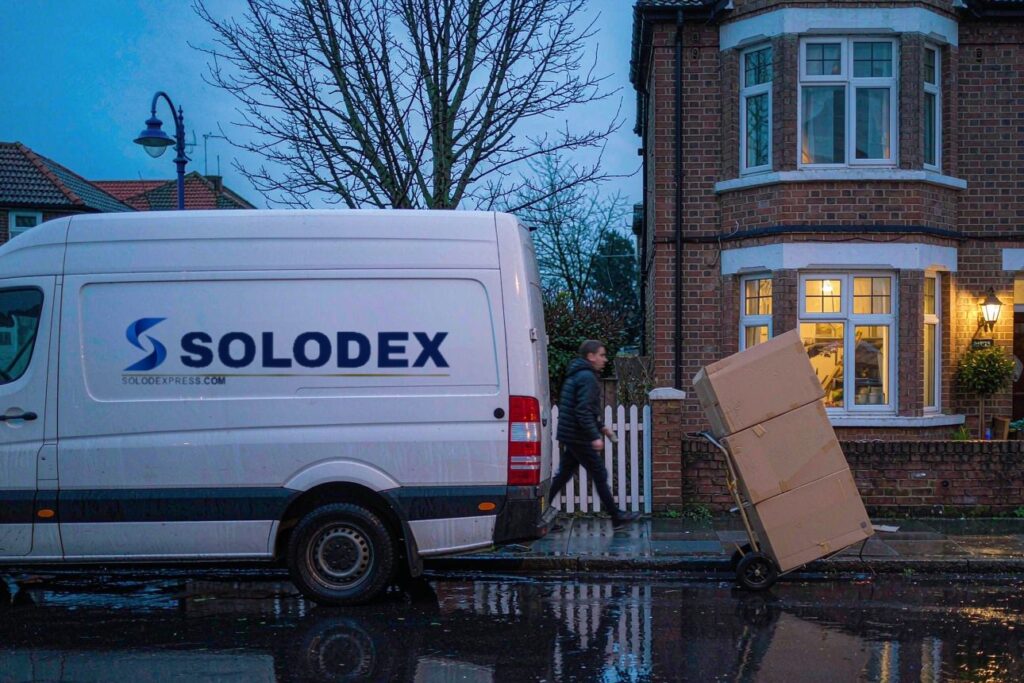
The parcel that came back
It arrives at a warehouse in Shenzhen sixty-one days after it left. Two labels on the box: the original outbound label, and a second one applied by a postal operator in another country, addressed to a returns address printed in small type on the original. The goods inside are undamaged. The customer wanted a different size.
The parcel has now been exported, imported, delivered, refused, re-exported and re-imported. Four customs events for a forty-dollar item, and nobody in the chain planned any of them, because the return address was a line of text on a label rather than a decision in an operating model.
That is the difference between direct mail and consolidation, and it is almost never discussed in those terms. The two models are usually compared on speed and price per parcel. The comparison that decides which one a business can live with is a different one: where the parcel crosses the border relative to the order, and who is answerable when it crosses back.
Two models, one structural difference
Direct mail sends each order across the border as its own consignment. The parcel is picked, packed and labelled at origin, handed to a postal or express network, and cleared at destination — individually, on its own declaration or its own line in a consolidated entry. The border is crossed after the order exists.
Consolidation sends stock across the border before the order exists. Goods move in bulk — by air or sea, in cartons or on pallets — clear once, and sit in a destination warehouse until an order picks them. The border is crossed before the sale, and the last mile is a domestic delivery.
That is the whole difference, and everything else follows from it: the customs identity, the working capital, the return path, the delivery promise, and the failure modes.
What does not follow is a quality ranking. Direct mail is not the cheap option and consolidation is not the professional one. They fail in different ways, and the right choice depends on a variable most operators never model explicitly — what happens when a customer sends something back.
Who clears, and when
In direct mail, the clearance happens per parcel, at the destination border, close to the moment of sale. The importer of record is usually the consignee or a consolidator acting for a batch of consignments. The tax is assessed on the retail value at the time of import. Nobody has any inventory at risk except the goods in transit.
In consolidation, the clearance happens once, in bulk, before any customer exists. The importer is the company that owns the stock — a local entity or an agent importing in its own name. Tax is paid on the landed value, at the moment of entry, on goods that may sit for months. From that point the goods are domestic, and the last mile is an ordinary local delivery.
The consequence for cash and for risk is significant, and it runs in opposite directions. Direct mail defers tax until sale and keeps no inventory abroad, but pays a higher unit cost per parcel and accepts the variability of per-parcel clearance. Consolidation pays tax early and ties up stock, but gets a much lower unit cost on the inbound leg and a domestic delivery that behaves like a domestic delivery.
There is also a third structure that confuses the comparison: bonded or marketplace stock, where goods are held under duty suspension and released as orders arrive. That model combines bulk inbound with deferred tax, and it moves the importer question to whoever holds the bond. The clearance model and the delivery model are two separate decisions, and businesses routinely make one without noticing the other.
The return address decides the model
Here is the test that separates the two models more sharply than any cost calculation.
Ask what happens to a parcel that comes back. If it must return to the origin country, then every return is an export, a freight movement, an import, and a re-stocking — four events, each with a cost, for goods that may be worth less than the movement. At some order value, the honest answer becomes “we do not take it back; we refund and write it off.”
If it can return to a local warehouse, the return is a domestic movement. It can be inspected, graded, re-labelled and re-sold, or consolidated and shipped back in bulk when the volume justifies it. The cost per return drops by an order of magnitude, and the customer experience — a local address, a short refund cycle — becomes a selling point rather than a cost centre.
So the real question is not “how fast do we want to deliver” but “where do we want returns to land.” A business selling low-value, low-return-rate goods can live with returns going back to origin: the arithmetic is ugly but rare. A business selling apparel, footwear, or anything with a size and a fit will drown in that arithmetic, because its return rate is not an exception, it is a feature of the category.
This is why apparel sellers consolidate and accessory sellers often do not, and why the decision should be made on return rate rather than on freight rate. It is also why the return address printed on a label is a strategic decision disguised as a formatting one.
Last mile is the only genuinely unpredictable part
Every other segment of an international parcel chain can be scheduled, tracked and predicted within a day. The last mile cannot, because it depends on things outside the chain’s control: whether someone is at the address, whether the address is complete, whether the building has a concierge, whether the local network treats a delivery attempt as an obligation or an attempt.
In direct mail, this unpredictability is inherited by the origin operation. A failed delivery abroad generates a return, a query, or a charge that arrives weeks later in a foreign language. The seller’s customer service team is asked to resolve something that happened in a street they have never seen.
In consolidation, the unpredictability is local and therefore manageable: a local carrier with a local phone number, redelivery rules the operator knows, and a returns address that is a van ride away rather than a flight. That is worth real money in categories with high delivery-attempt failure — which, in practice, means anywhere outside dense urban delivery zones.
It also changes what “free shipping” means. A direct-mail operation prices delivery into the product and hopes the parcel arrives; a consolidated operation prices a domestic delivery it can re-attempt, redirect and, if necessary, hold for collection.
Address quality deserves its own line. In an international network, an address that is merely unusual — a new building, a unit number in a format the local carrier does not recognise, a street name that exists in two districts — is enough to fail a delivery, and a failed delivery abroad produces a return that can cost more than the order’s margin. Local consolidation does not fix bad addresses, but it makes them cheap to fix: the operator can call, re-attempt, and hold the parcel at a depot that is a short drive away, rather than absorbing an international return for a data entry error.
Cost per delivered order, not per kilogram
| Model | Who clears | Typical transit | Where returns land | When it wins |
|---|---|---|---|---|
| Direct mail, per parcel | Consignee, or consolidator for a batch | 5–15 days, variable | Origin country | Low value, low return rate, long tail of SKUs |
| Consolidated stock | Local importer, once, in bulk | 2–5 days domestic after stock lands | Local warehouse | Higher value, high return rate, repeat demand |
| Bonded or marketplace stock | Bond holder, released per order | 2–5 days domestic | Local, with customs handling | Seasonal or launch volume, where duty timing matters |
| Hybrid: bulk + local partner | Local partner as importer | 3–7 days domestic | Partner’s facility | Testing a market before committing to a warehouse |
The column that matters is not transit. It is the fourth: where returns land. The second most important is the first, because it determines who carries the compliance risk when a line is wrong — and in a per-parcel model that risk is spread across thousands of small declarations, each of which is a record.
Cost per delivered order is the only metric that compares the models honestly. It includes the freight, the clearance, the failed-delivery rate, the return rate, the cost of processing a return, and the cost of the working capital tied up in stock that has not sold. Most comparisons stop at the first two items, which is why the answer so often looks wrong twelve months later. The way to build the number is to take a month of real orders and follow each one to its outcome: delivered, failed once, returned, written off. The average that falls out of that exercise is usually uncomfortable, and always more honest than a rate card.
Five checks before choosing
What is your return rate, by category? Not the average — the worst category. If any line has a return rate that would make a return-to-origin uneconomic, that line needs a local returns address, and therefore consolidation, whatever the freight arithmetic says.
What is the value density of the average order? Below a threshold, the fixed cost of the inbound clearance and the warehousing overwhelms the per-unit saving; above it, consolidation wins quickly. The threshold is not a number you can look up — it is where your own return and re-delivery costs cross the per-parcel premium.
Who is the importer in each model, and can you live with the answer? In direct mail it is likely the consignee or a consolidator; in consolidation it is you or your local agent. That difference is the difference between a compliance question arriving at a third party and arriving at your desk.
Where does a returned unit physically go? Write the address down. Then cost the journey from that address back to a sellable condition, and from there back to stock. If the answer is “we write it off,” make that a decision rather than a discovery.
What is the failure mode you can afford? Direct mail fails visibly and cheaply per incident, but at volume; consolidation fails rarely and expensively, in bulk. A small business can survive a hundred small failures; it may not survive one container of unsellable seasonal stock. The batch size question is the same question in a different costume.
Direct mail and consolidation are not two speeds of the same service. They are two different placements of the border relative to the sale — and the border is a fixed feature of the world, so the placement decides where the work, the money and the risk sit. Choosing well means choosing the placement deliberately, and knowing which side of it your returns will land on. The parcel that comes back sixty-one days later is not an unlucky exception. It is the model, arriving on schedule.
Consolidation is usually discussed as a cost question, but the scan hierarchy it creates is the reason a missing carton can disappear from the record.


