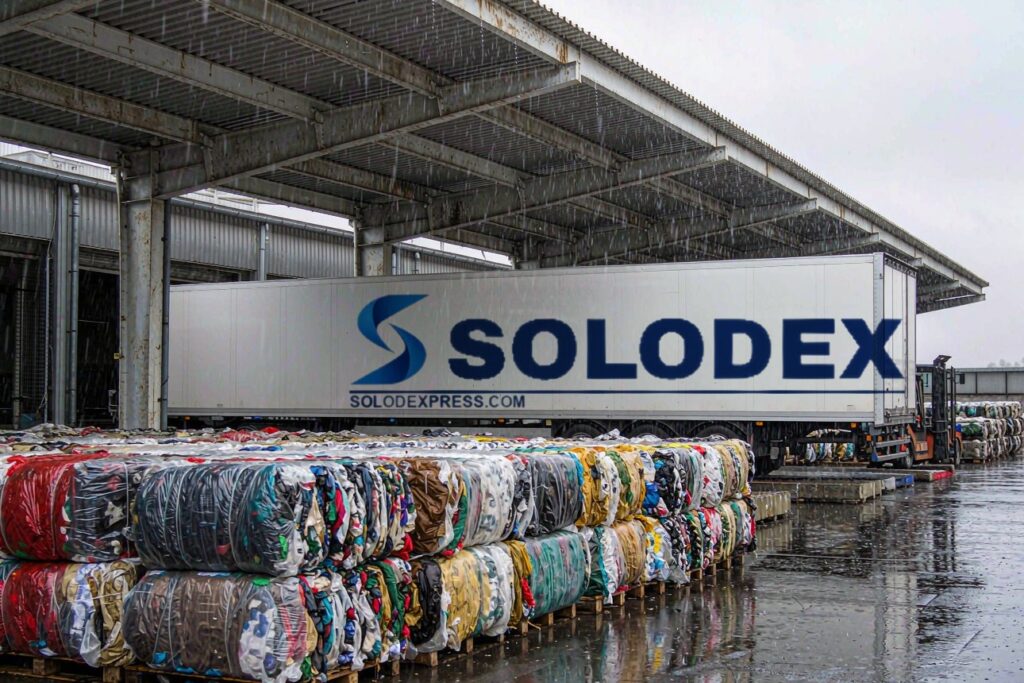
A 40-foot container loaded with duvets weighs about six tonnes and fills every cubic metre. The same container loaded with hardware weighs twenty-six tonnes and is also full. The freight bill is identical, and that one sentence explains most of what is strange about shipping textiles.
Cloth is the cheapest thing in the world to make heavy and the most expensive thing in the world to make small. Everything else about the category — the compression, the carton counts, the way a duvet eats a container — follows from that, and none of it is a freight-rate problem. The rate is fine. The product is just mostly air.
There is a second constraint that has nothing to do with volume, and it is where shipments actually stop: a piece of fabric has to pass a burn test and carry a label that names what it is made of. Both are cheap, both are mandatory, and both are checked before anything is loaded.
What the ship charges for
Sea freight does not care about weight until the container is over the limit, which for most textiles never happens. Air freight does care, and it charges the greater of actual weight and volumetric weight at a 1:167 ratio — one cubic metre is billed as 167 kilos.
Take a cotton T-shirt, folded and polybagged: 0.0035 cubic metres, 0.22 kilos. Its volumetric weight is 0.58 kilos, so air bills nearly three times what the shirt weighs — the arithmetic behind volumetric weight, applied to a product that loses to it badly. A duvet is worse. At 0.09 cubic metres and 2.1 kilos, the volumetric equivalent is 15 kilos — seven times the actual weight, and the reason nobody air-freights bedding.
| Cost element, one cotton T-shirt at $4.80 FOB | Amount | Share of landed cost |
|---|---|---|
| Factory price | $4.80 | 68% |
| Sea freight, 40HQ at $2,800 for about 2,900 shirts | $0.97 | 14% |
| Duty at 16.5% of customs value | $0.79 | 11% |
| Inland drayage and destination charges | $0.26 | 4% |
| Compliance testing and labels, amortised | $0.22 | 3% |
| Landed | $7.04 | 100% |
Fourteen per cent is not a number that should change strategy. But notice what happens when the shirt is packed badly: at 0.0045 cubic metres instead of 0.0035, the same container carries 2,250 shirts and freight per unit rises to $1.24 — a 28 per cent increase on the freight line for a difference nobody can see. Packing density is the only variable in this table that a buyer controls without negotiating.
The label is the customs document
Textiles are one of the few consumer categories where the information printed on the product is itself a regulated artefact, and a missing line is a reason to hold a shipment rather than a reason to discount it.
In the United States, the Textile Fiber Products Identification Act requires the generic fibre names with percentages, the country of origin, and the identity of the manufacturer or importer — on the product, not only on the carton. Care instructions fall under a separate rule and must be attached in a form that survives washing. In the European Union, the fibre composition regulation requires the same information in the language of the member state where it is sold, and “100% cotton” is a claim that has a tolerance attached to it rather than a description.
The failure mode is consistent: the label says 100 per cent cotton, the lab finds 3 per cent elastane, and the problem is no longer a labelling problem. It is a misdescription of goods, which is a customs matter. The fix costs eight cents a label. The consequence costs the shipment.
One practical note that saves money on every order: order the labels with the goods, not after. A factory that prints its own care labels will use its own fibre declaration, and the only way to control it is to supply the artwork and the specification with the purchase order. The EU import rules treat a wrong declaration as the importer’s liability regardless of who printed it.
Burning a strip of fabric
US law requires clothing fabric to pass a flammability test, and the test is exactly as literal as it sounds: a strip is held at 45 degrees, a flame is applied for one second, and the time it takes to travel a marked distance is recorded.
Fabric falls into three classes. Class 1 is normal and passes; Class 2 is intermediate and needs a caution; Class 3 burns fast enough that it cannot be sold as clothing. The fabrics that fail are predictable — brushed fleece, cheap chiffon, anything with a raised pile and a loose structure — and they fail because the nap carries flame across the surface faster than a flat weave does.
Two things about this test catch importers out. The first is that it is run per fabric, per colour, not per style: eight colourways of the same fleece is eight tests, at $300–800 each and five to ten working days. The second is that a fabric that passed last year can fail this year, because the mill changed the yarn source or the brushing depth.
The remedy is not exotic. Increasing weight per square metre, tightening the weave, or blending in a modacrylic or a flame-retardant polyester all move a fabric from Class 3 to Class 1, and each of them changes the hand of the cloth. That is a decision the buyer makes at sampling, not at the port.
Dyes, and the amines behind them
European law restricts twenty-two aromatic amines that can be released from azo dyes, at a limit of 30 milligrams per kilo. The list is short, the test is cheap — $80–200 per colour — and the failure is total: goods that exceed the limit cannot be placed on the market, cannot be reworked, and cannot be sold elsewhere in the bloc.
Most Chinese mills already hold a test report, which is exactly why this goes wrong. The report is usually for a dye lot from a previous season, and a report for a different lot is not evidence about this one. Ask for the report with the production date and the colour code on it, and test one colour per fabric family yourself on the first order.
Children’s garments add a second layer — APEO, formaldehyde and, in some markets, a nickel-release test on metal trims — and the tests multiply with the colour count. This is the point where colour becomes an expense rather than a merchandising decision, and where a range of twelve colours turns a manageable compliance budget into a large one.
Compression is the only real lever
Since the ship charges for space, the only lever with real leverage is how much product fits in a cubic metre. Nothing else in this category moves the number by double digits.
Bedding compresses best. A duvet at 0.09 cubic metres rolled and vacuum-packed becomes roughly 0.045 — a 50 per cent reduction, and a container that carried 690 units now carries 1,378. Apparel compresses less dramatically and with a cost: rolling a shirt into a polybag takes it from 0.0035 to 0.0028 cubic metres, and the fold creases that arrive with it produce returns that the flat-packed version did not.
| Packing method, duvet at 0.09 m³ flat | Units per 40HQ | Freight per unit | Added cost per unit | Return rate effect |
|---|---|---|---|---|
| Flat in a carton | 690 | $4.06 | — | Baseline |
| Rolled, polybag | 980 | $2.86 | $0.18 | +0.5 point |
| Rolled and vacuum-compressed | 1,378 | $2.03 | $0.42 | +1.2 points |
| Vacuum-compressed, low-loft fibre | 1,520 | $1.84 | $0.55 | +2.0 points |
Read the last column against the third and the decision becomes arithmetic rather than preference. Vacuum compression saves $2.03 a unit and costs $0.42 in bags and labour, netting $1.61. The two extra points of returns cost, at $14 a return, about $0.28. The net gain is $1.33 a unit — and at 1,378 units a container that is $1,833 per shipment for a change made in the packing specification.
The row below it is where the arithmetic turns. Low-loft fibre compresses further and saves another nineteen cents, but loses loft permanently, and a duvet that arrives flat does not recover. The returns do not stop at the two points; they become reviews about the product rather than the packaging, which is a different and much more expensive problem. The optimum is the third row, not the fourth — and it is the third row for a reason that has nothing to do with freight, which is the pattern across this whole category.
Sizes that multiply SKUs
Apparel is the category where a simple product becomes an inventory problem, and the multiplication is always underestimated before the first order.
Four sizes and four colours is sixteen variants. Add a second fabric and it is thirty-two. At a minimum of 300 units per variant — the usual floor once a mill has to dye a specific colour — the opening order is 9,600 units to cover a range that will sell unevenly. In practice two sizes and two colours carry 70 per cent of the volume, and the remaining twenty-eight variants sit in a warehouse for a season.
The rule that comes out of this is blunt and worth applying before every range review: if variants multiplied by minimum order quantity exceeds what you can sell through in one season, cut colours before cutting sizes. A customer who cannot find her size leaves; a customer who cannot find her preferred colour often buys the second choice. Size is the constraint that converts directly into lost sales, and colour is the one that converts into a slightly different sale.
Footwear and bags multiply on a different axis: shoes by size and width, bags by colour and hardware. The opening-order arithmetic therefore changes with the category, as the shoes and bags guide sets out.
A packing list that pays for itself
There is a shipping decision in this category that costs nothing and is skipped constantly: whether cartons are packed solid or assorted.
Solid packing means one carton holds one size in one colour. Assorted means a carton holds a ratio — two small, three medium, three large — which uses space more efficiently and is cheaper to pack at the factory. It is also, at a fulfilment centre, a disaster: a picker needing a medium in navy has to break a carton that contains eight garments of which seven are the wrong thing, and the fee structure of most warehouses charges per pick, not per carton opened.
Solid packing usually adds five to eight per cent to carton volume and removes a per-unit handling fee that runs from $0.30 to $0.60 for apparel. On a 2,900-unit container the trade is roughly $0.40 a unit of freight against $0.45 a unit of picking — close to neutral at the dock and decisively in favour of solid packing once the returns from mis-ships are counted.
The carton marking matters as much as the packing. Size and colour have to be readable on the outside, in a format the warehouse scans rather than deciphers, and the same code has to appear on the packing list. A carton marked “ASSORTED” is a carton that will be opened twice.
Order the samples before the labels
The sequence in this category is unusual: the label artwork depends on a test that depends on a fabric that depends on a sample. Doing it out of order means reprinting and re-testing, which is where the avoidable cost lives.
- Settle the fabric and the weight first. Composition, grams per square metre, and finish. Every later document references these, and a change after testing invalidates the test.
- Run the burn test on the final fabric, per colour. Not per style, and not on the mill’s previous report. A Class 3 result at this stage costs $800; the same result at the port costs the container.
- Test the dye lot, not the dye. One azo screen per fabric family on the first production run, with the colour code and date on the report.
- Then print the labels. Fibre content, origin, care instructions, in the language of the market. Eight cents each, and they go on the garment rather than the bag.
- Then specify the carton. Solid or assorted, with the size and colour code visible, and a packing list that matches. This is also the moment to fix the cubic metres per unit, which is the number that sets the landed cost of everything after it.
- Compress only as far as the product survives. The table above has an optimum, and it is not the cheapest freight number — it is the row where the returns curve is still flat.
None of this makes textiles difficult, and it is the same discipline that decides whether an appliance can carry its certification in a market. It makes textiles unforgiving in a particular way: the freight is what it is, the duty is what it is, and the two variables that a buyer actually controls are packing density and the number of variants. One of them is arithmetic and one of them is merchandising, and the sellers who do this well treat both as the same kind of decision — which is why the same discipline that keeps a duvet from eating a container is what keeps a twelve-colour range from eating a year of cash.
The label decides cubic metres here. In the destination market the same label is a legal statement about fibre, care and origin, and that side of the file is set out in the fourth category in this series.
None of that applies once the goods have been worn: used clothing is graded and baled, and the documents are about origin and admission rather than labels.
Soft goods compress well, which makes the carton choice unusually powerful: the same garments in a smaller outer carton can bill at a different weight without any change to the order.


