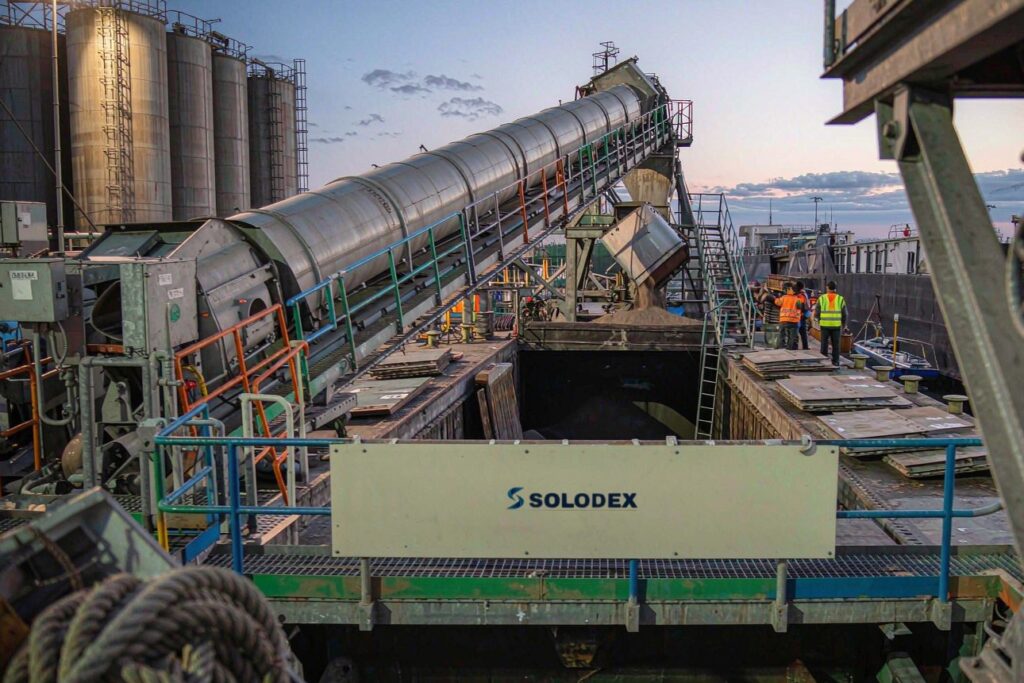
Thirty-seven thousand tonnes nobody lifted
A bulk carrier finished loading wheat at a grain berth and the bill of lading was issued for 37,710 metric tonnes, in bulk. Nothing in that sentence describes a weighing. No crane lifted 37,710 tonnes and put it on a scale. No clerk watched 37,710 units pass and made a mark for each one. There was one continuous stream of grain coming down a spout into an open hatch for about thirty-one hours, and when it stopped, a number appeared on a document. The number was produced by reading the ship twice, before loading and after loading, and subtracting everything else that had changed on board in between.
Ask the people at the berth who weighed the cargo and the honest answer is that nobody did. The terminal has a belt scale on the conveyor from the silos, and it produces a running total for the terminal’s own purposes. The ship has a set of marks painted on its hull, a table in its drawings, and a surveyor with a clipboard and a small boat. Those are two different instruments measuring two different things. The figure that goes onto the bill of lading comes from the second one. It is a statement about how much deeper the vessel sat in the water, converted into tonnes through the ship’s own hydrostatic particulars, with the cargo left as the only line nobody could measure directly.
That is the part of bulk shipping that the rest of this site’s cargo never has to think about. Boxes, crates, drums, IBCs, tanks and bladders all arrive with something that can be counted, lifted, marked or handed over. Even the awkward ones supply a physical outline that a tally clerk can point at. A hold full of grain supplies none of those. There is no outer package, no shipping mark, no piece number and no hand-over of a container-shaped object. The hold is part of the ship. It does not travel with the goods, it is not delivered at the other end, and it never becomes a unit in anyone’s count.
So the quantity has to be manufactured by an observation rather than read off an object. This article is about that observation, about the surprising number of things that have to be known before it means anything, and about the three fields that can be compared on paper before the figure is printed. The practice described here is as of 2026-11; the way a survey is recorded varies by trade and by port, and none of that variation changes the shape of the argument.
Six numbers painted on the hull
Start with what the surveyor actually does. On arrival, before the first tonne goes aboard, the vessel’s draft marks are read on both sides at the bow, amidships and at the stern. Six readings, each to the nearest centimetre, taken from a boat or from the quay with the water as calm as the berth allows. On the wheat shipment the arrival sheet read 4.82 and 4.84 metres forward, 5.12 and 5.16 amidships, 5.44 and 5.48 aft. After loading, the same six marks were read again: 8.92 and 8.94 forward, 9.12 and 9.14 amidships, 9.28 and 9.32 aft. Two columns of six small numbers, written several hours apart, are the physical evidence on which 37,710 tonnes rests.
Six readings rather than one exist because a ship is not a rectangular tank. She is trimmed by the stern, she may have a slight list, and her hull bends along its length as cargo goes in. A single mark at one end would describe the shape of the loading operation as much as the amount of cargo. The surveyor reduces the six to a mean draft corrected for trim and for hog or sag, and that corrected mean is the value taken to the ship’s table. On this occasion the corrected mean moved from 5.14 metres to 9.12, a difference of 3.98 metres. That is the whole observation. Everything after it is arithmetic done with documents that belong to the vessel rather than to the wheat.
It is worth noticing what is being read. The marks are painted on the outside of the hull, and what the water touches is the ship, not the cargo. There is no point in the operation at which the grain is touched by a measuring instrument that produces the bill of lading figure. Even the water is not a constant: the density of the harbour water has to be sampled, because a vessel floats higher in dense salt water than in the brackish water of a river berth after rain. On this berth the arrival sample was 1.021 tonnes per cubic metre and the completion sample 1.018, against the 1.025 on which the ship’s tables were drawn up. A correction, small but real, belongs in the calculation before any tonne of wheat can be named.
A table that belongs to the ship
The next document is not a scale certificate or a packing list. It is the vessel’s displacement table, supplied by the yard when the ship was built and kept on board. It says how many tonnes of the ship and everything in her are being supported by the water at any given corrected draft. Read 5.14 metres into it and you get 12,860 tonnes. Read 9.12 metres into it and you get 47,530 tonnes. Both figures are totals for the whole floating object: steel, machinery, fuel, water in the ballast tanks, stores, crew effects, the constant nobody can weigh, and whatever is in the holds. The difference between them, 34,670 tonnes, is how much more the water was supporting at the end of loading than at the beginning.
That difference is not the cargo. It is not even approximately the cargo until a second set of books has been consulted, because a ship is a busy place during thirty-one hours of loading. Ballast water is pumped out to make room in the holds. Fuel is burned by the generators running the deck gear. Fresh water is used, stores are consumed, and the surveyor carries forward a figure called the constant, which is the accumulated estimate of everything on board that has never been measured item by item. Every one of those lines changed while the grain was going in, and every one of them pushes the displacement difference away from the answer.
This is where the direction of the reasoning becomes easy to miss. An ordinary cargo is weighed, and the resulting weight is then used to work out what it will do to the ship. Here the reasoning runs backwards. The ship is observed in two states, the observation is converted into tonnes through a table drawn up years earlier, and the cargo is inferred from the gap. A break bulk manifest keeps gross tonnes and cubic metres side by side, measured on each piece with a weighbridge and a tape; a bulk manifest has one line and no instrument that ever touched the goods. The quantity on the document is a reconstruction, not a measurement.
What else changed during those thirty-one hours
The surveyor’s worksheet is where the cargo finally appears, and it does so as the last line of a subtraction. Read the table below down the right-hand column. The displacement went up by 34,670 tonnes. Ballast water went down by 2,860, fuel and lubricants by 142, fresh water and stores by 38. Since the ship was lighter by all of those non-cargo items at the end than at the beginning, the grain must account for the displacement increase plus every tonne that left the ship: 34,670 plus 2,860 plus 142 plus 38 gives 37,710 tonnes. The constant, an estimate of 310 tonnes carried unchanged from the previous survey, contributes nothing to the difference and everything to the uncertainty.
| Line on the survey worksheet | On arrival | On completion | Change |
|---|---|---|---|
| Corrected mean draft | 5.14 m | 9.12 m | +3.98 m |
| Displacement from the ship’s table | 12,860 t | 47,530 t | +34,670 t |
| Ballast water | 4,910 t | 2,050 t | -2,860 t |
| Fuel, diesel and lubricants | 1,180 t | 1,038 t | -142 t |
| Fresh water and consumable stores | 296 t | 258 t | -38 t |
| Constant carried forward | 310 t | 310 t | 0 t |
| Cargo, by difference | – | – | 37,710 t |
Read across the rows instead and a different fact becomes visible. The cargo is the only line with no reading in either state. Every other line is either observed on the hull, looked up in a table carried on board, or taken from the vessel’s own tank soundings and logs. The wheat is the residual term: the amount required to make the books balance after everything measurable has been accounted for. That is an unusual status for the single most important number on the transport document. It is derived from evidence about the ship, and the goods themselves appear in the calculation only as the difference.
The consequences are practical rather than philosophical. A mistaken ballast sounding, a fuel log that was written up at the end of the watch, a density sample taken from the wrong side of the berth, or a constant inherited unquestioned from a survey done six months earlier all move the cargo figure without a single grain of wheat being different. This is why the survey is signed by people who read tanks and marks, and why the calculation has to be written down line by line. A number produced as a residual is only as good as the completeness of the list of everything that was subtracted.
Cargo is the residual
It helps to say plainly what is not happening here. Nobody is estimating the wheat. Nobody is agreeing a tolerance so that a small difference can be ignored. The figure is a determinate result of a particular set of readings and a particular set of ship’s records, and a second surveyor working from the same worksheet should reach the same tonnes. What is unusual is the direction of dependence: the cargo quantity is a function of the vessel’s condition, so the vessel’s own paperwork becomes cargo documentation. The ballast log, the fuel log and the constant are not housekeeping. On this shipment they are part of the evidence for what was loaded.
That dependence also explains why the same commodity, loaded into the same holds on a different voyage, can produce a different bill of lading figure without anything being wrong. A ship that arrives with more ballast to discharge, or that burns more fuel while alongside, or that is trimmed differently at completion, gives a different displacement difference for the same stream of grain. The figure is local to a vessel, a berth, a tide and a thirty-one-hour window. It is not a property of the wheat, and it cannot be reproduced later from the goods.
There is a useful contrast with the other unpackaged cargoes on this site. A flexitank makes the condition of a borrowed dry box a physical condition of the oil inside it, and the fitment report therefore travels with the consignment. An ISO tank carries its own history forward in a cleaning certificate and an equipment number. Both of those are containers that can be pointed at, counted and checked. A hold cannot be pointed at as an object of the shipment; it stays bolted to the ship. The only thing that travels is the record of the ship’s two states, which is why the survey sheet, rather than a package, is the physical artefact of this cargo.
A hold is never handed over
Now look at the rest of the bill of lading. The packages column on a bulk shipment is usually filled with a phrase such as “in bulk” or “one lot”, or it is left to the description of the goods; there is no integer to enter. This is not a clerk taking a shortcut. It is the accurate answer to a question that has no countable subject. A break bulk piece is defined by what the hook lifts once, and a stream of grain offers the hook nothing to lift as a unit. A clean on board handover depends on somebody standing at the rail and writing a remark or not writing one; here there is no moment at which a discrete object passes the rail, so the whole apparatus of tallying, marking and remarking has nothing to attach to.
The same absence shows up in the identity of the goods. A shipment without a container number has to paint a shipping mark and a piece number on the cargo itself, because otherwise twelve identical beams cannot be told apart from the lot beside them. Grain cannot be stencilled. It has a grade, a moisture content, an origin and a silo of provenance, and those travel as text on a certificate rather than as marks on the goods. The physical lot is homogeneous, and its identity is a matter of documentation and sampling, not of anything written on a surface. Bulk cargo is the one case where the site’s usual advice to make the cargo carry its own name is literally impossible.
The hold itself is the reason. It is a space inside the vessel, bounded by steel that belongs to the carrier and stays with the ship at discharge. At the receiving end the wheat is pumped or grabbed out, and no empty hold is returned, signed for or counted. There is no equipment number to reconcile, no seal to break, no outer package to inspect for damage. The title of this article is therefore a deliberate provocation: the hold does the work a package normally does, keeping the goods together and giving them a boundary for the voyage, but it never becomes a package in the documentary sense. It cannot be counted, delivered or invoiced as a unit, and it never passes into the receiver’s hands.
The previous article in this series ended at exactly this edge. An IBC shipment can be one tank, eighteen cages or thirty packages because the integer comes from the container rather than the juice. Bulk cargo removes the container from the transaction altogether, and with it the integer. What remains is a continuous quantity that has to be reported in tonnes, and a ship that can be read to supply the number. The column does not fail to be filled in; it is replaced by an observation of the vessel.
The shore number measures something else
The terminal’s belt scale on this shipment totalled 37,548 tonnes over the thirty-one hours of loading. The survey produced 37,710. The two figures differ by 162 tonnes, about 0.43 per cent. It is tempting to treat that as an error in one of them, and it is the wrong first reaction. The two instruments are not two readings of the same quantity. One totals what passed along a conveyor into the loading spout. The other infers what the ship gained after every other change on board has been removed. Between the belt and the hold there is dust, moisture, spillage, grain retained in the spout and in the conveyor, and the whole family of estimates sitting inside the constant.
This is a different situation from a document check where an invoice and a bill of lading carry two different gross weights for the same box and a machine flags the disagreement. In that case both figures are claims about one measured object, and one of them can usually be traced to a pallet that was included or left out. Here both figures are internally complete answers to different questions, made by different instruments, at different points in the handling chain. Writing the smaller number into the bill of lading would not correct the survey; it would replace a statement about the ship with a statement about the conveyor.
What makes the pair worth keeping is that they are the only independent evidence available. The survey sheet cannot check itself: a ballast figure entered wrongly simply produces a different cargo figure. The shore total is the one thing in the file that was produced without reading the ship at all. Reading the two together does not decide which is right, but it does show whether the worksheet has been honestly kept. A gap that is stable across voyages on the same berth is a property of the handling chain. A gap that appears once, on one hold, is a question about that loading. Conventions for recording and comparing these totals vary by trade and by terminal, and the shape of the comparison does not vary.
The reading cannot be taken twice
There is one property of this measurement that distinguishes it from almost every other quantity in a shipping file. It cannot be repeated. Once the vessel sails, the arrival state is gone: ballast has been moved again, fuel has been burned, fresh water has been made, the trim has changed, and the tide and the water density at the berth are no longer what they were. No amount of inspection of the wheat at discharge can reconstruct the six readings made before loading. The bill of lading figure is therefore a one-time observation with a short window in which it can be checked, and the only records of that window are the survey sheet and the vessel’s logs.
That makes the survey a strangely fragile document for something with the legal weight of a bill of lading quantity. It is created at a berth, by people reading marks from a boat, in weather, in a few hours around the start and finish of loading. It depends on a table printed for that hull, on tank soundings taken by the crew, on a density sample, and on a constant that is an estimate carried from survey to survey rather than a measurement. All of it is written down once. A cargo packed into drums can be recounted in a warehouse a month later; a tank’s previous cargo can still be traced through certificates after fourteen months. The draft survey has no afterlife as an object that can be revisited.
This is also why the surveyor’s worksheet lists its corrections rather than hiding them behind a single number. A residual figure is only defensible if the list of what was subtracted is visible. Trim correction, density correction, hull deflection, ballast, bunkers, fresh water, stores and constant each have a line, and each line can be compared with a log kept for another purpose. The number on the bill of lading is not stronger than the weakest of those lines. Shippers who treat it as a weight that somebody took, and who keep only the final tonnage, have discarded most of the evidence that the figure ever meant anything.
What to compare before the figure is printed
The practical check reduces to three fields, and it can be done at the berth before the document is issued. Take the six arrival and six completion draft readings with their corrections, and the line-by-line list of ballast, bunkers, fresh water, stores and constant from the survey worksheet. Take the quantity and the description on the draft bill of lading, with its unit and its “in bulk” wording. Take the terminal’s own total from the belt scale or the silo withdrawal record. Put the three side by side and read across.
Three problems are visible without any specialist judgement. The bill of lading quantity does not equal the cargo line derived on the worksheet, which usually means a correction or a tank sounding was left out of the subtraction. The packages column contains a number where the description says in bulk, or a piece count has been inherited from a booking that was originally made for bagged goods. The shore total and the survey total differ by a gap that cannot be accounted for by the terminal’s usual handling loss for this commodity on this berth. Each is a comparison of written figures, and each can be made while the ship is still alongside and the marks can still be read.
The order matters, as it does elsewhere in this series. The observation comes first, the worksheet second, the bill of lading third, and the shore total is an independent check rather than an input. Once the vessel has sailed, only the third and fourth of those survive, and the first cannot be reconstructed from them. That is the real difference between a quantity that was weighed and a quantity that was inferred: a weighing can be argued about later, while an inference has to be examined at the moment it is made.
So the hold is a package only in the physical sense. It holds the wheat together, gives it an outline for the voyage and keeps it out of the sea, and then it stays with the ship while the wheat leaves. It is never counted, never marked, never delivered and never returned. The number on the bill of lading is not the weight of the goods; it is the difference between two states of the vessel, with everything that changed on board crossed out and the cargo written in as the remainder. Read the marks, keep the worksheet, and keep the shore total beside it, because the ship will not be in that state again.
A cargo with no package has no quantity of its own. The figure is borrowed from two readings of the ship, and when the ship’s state changes, the paper has to be written again.
A draft survey turns the difference between two states of the ship into the bill of lading tonnage; a returning tank turns the difference between two weighbridge tickets into a quantity that no document will print.
Ballast, fuel and fresh water are corrections when the ship’s own draught is used to infer cargo weight; on a container vessel that same ballast water is instead a line the planner can still adjust to pull the centre of gravity down.


