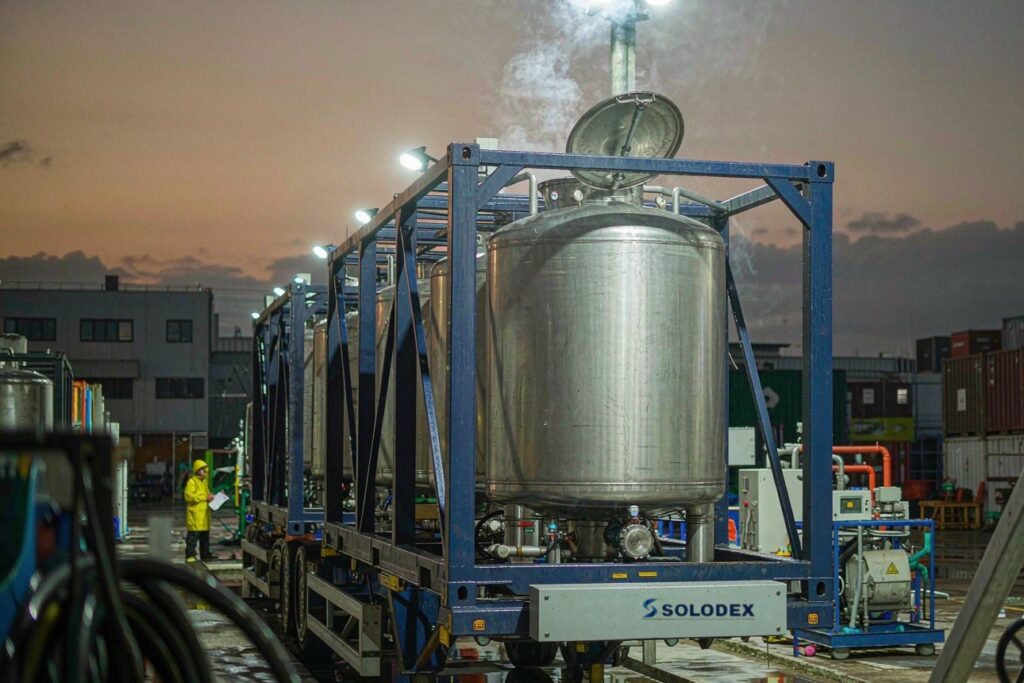
Fourteen months, one stencilled number
A tank operator keeps a file for a 24,000 litre ISO tank stencilled SXDU 481207-3. Over fourteen months that one number appears on four bills of lading. In March of the first year the tank carried glucose syrup for a food plant. In August it carried industrial glycerine. In January of the second year it carried a detergent base. In June it was offered for 24,000 litres of refined sunflower oil, food grade, for the same manufacturer that had taken the syrup.
Nothing about the equipment changed. The tare stayed at 3,720 kg, the shell capacity stayed at 24,000 litres, the frame stayed twenty feet long, and every one of the four bills said one piece. Net weight moved with density and ullage rather than with the tank: a dense syrup is not filled to the brim, while a light oil can be. What changed four times was the product name, and what changed with it was whether the tank was allowed to be used at all.
The June consignment was refused. Not at customs, not by the carrier, and not because the oil was wrong. The buyer’s specification required a documented food-grade history. The operator could produce a cleaning certificate showing that the tank had been washed after the detergent base, with a date, a method and a signature. What the operator could not produce was an account of the cargo before that one that satisfied the buyer. The file had a gap in it, and the gap was fourteen months old.
Three weeks later the same 24,000 litres of oil, same purchase order, same HS code, same consignee and same discharge pump, was loaded into a different tank whose previous cargo had been the same refined sunflower oil. One page of history replaced four. The oil had not moved an inch in the meantime.
This is the part of bulk liquid shipping that a rate quotation never shows. A general purpose container is empty once its doors are opened. A flexitank bladder is new on every voyage. An ISO tank is neither. It is a piece of equipment with a memory, and the memory is not in the steel. It is in a chain of documents that outlives any single consignment.
| Voyage | Month | Cargo named on the bill of lading | Tank number | Previous cargo on the cleaning certificate | Outcome |
|---|---|---|---|---|---|
| 1 | Mar, year 1 | Glucose syrup, food grade | SXDU 481207-3 | First fill, no predecessor | Accepted; the file begins |
| 2 | Aug, year 1 | Industrial glycerine | SXDU 481207-3 | Glucose syrup, food grade | Accepted; grade not relevant to this buyer |
| 3 | Jan, year 2 | Detergent base | SXDU 481207-3 | Industrial glycerine | Accepted after a standard wash and inspection |
| 4 | Jun, year 2 | Refined sunflower oil, food grade | SXDU 481207-3 | Detergent base | Refused; the cargo before that one could not be documented |
| 4 again | Jul, year 2 | Refined sunflower oil, food grade | A different tank number | Refined sunflower oil, food grade | Accepted; the same 24,000 litres, one page of history |
Read down the fourth column rather than across the rows. The number holds steady for four voyages and changes once, and that single change is what turns a refused consignment into an accepted one without the goods changing at all.
The number arrives before the product name
On an ordinary booking, the goods come first. Someone decides what is being shipped, then somebody else finds a box, a pallet position or a slot to put it in. The description travels down the chain and the equipment reference is attached near the end, usually by the carrier or the depot.
With a tank the order is reversed. The operator allocates a unit by number from a fleet; that unit has a certificate file, a last cargo, an inspection date and a heating or lining specification before anybody has written a word about this consignment. The shipper then asks whether that particular number is acceptable for the product. A booking confirmation for a tank is therefore not a reservation of space. It is a request to join a history that already exists.
That reversal is easy to miss because the document looks identical to every other transport document. There is a number in the equipment column, a description in the goods column, and dates at the top. The earlier article on loose cargo argued that a container number is the identity of a shipment that has no identity of its own. Here the number is something stronger and stranger: it is an index into a sequence of shipments that have nothing to do with one another except that they used the same shell. The tank number is not the identity of this cargo. It is the key that retrieves this cargo’s predecessors.
Which is why the first question at booking time is not “do you have a 24,000 litre tank available”. That question has an answer on any given morning, and the answer is nearly always yes. The question with consequences is which number would be allocated, what it last carried, and whether anybody downstream will accept that answer.
A certificate about the cargo that already left
Open the cleaning certificate and read the fields literally. It names the tank number. It names the previous cargo. It gives the date the tank was emptied, the cleaning method, the date of the wash, the result of an internal inspection, sometimes an odour or visual check, and the name of the depot or station that issued it. Every substantive field on that sheet describes a consignment that is finished.
The current cargo appears on the packing list, on the bill of lading and on the invoice. Those sheets describe a consignment that is about to start. So the two halves of this shipment’s identity sit on two different pieces of paper, issued by two different parties, weeks apart, and neither of them was written to be read next to the other. The certificate is a record of an ending. The packing list is a record of a beginning.
There is a useful comparison with product files. In food contact compliance, a test report is bound to a specific article made from a specific formulation at a specific plant, and the whole argument is about which object the report describes. That is an identity that points forward from a product to the evidence about it. The tank file is an identity that points backwards from a piece of equipment to the cargoes it has held. Both are called identity, and a shipping clerk who treats them as the same kind of fact will look in the wrong place when a buyer asks a hard question.
It also explains why a certificate cannot be “wrong” in the usual sense and still be useless. It may be perfectly accurate, properly signed and issued by a competent station, and still say a previous cargo that this particular buyer will not accept. The document is not a pass or a fail. It is a statement of fact about a voyage that is over.
Nobody signs the sentence in between
Between the certificate and the packing list there is a sentence that no form contains: “given what this tank last carried, and how it was cleaned, this cargo may be loaded into it.” That sentence is the actual decision. It is taken somewhere, by somebody, on almost every tank booking, and it is usually taken by inference.
The operator knows the wash was done to a standard procedure. The shipper knows the product is a food-grade oil. The buyer knows its own specification, which may say “dedicated tank”, “previous cargo must be a food-grade product”, or “previous three cargoes to be declared”. The carrier knows the equipment number and the seal. Each party holds one clause. Nobody holds the whole sentence, and no document is issued whose sole purpose is to record that the clauses were compared and found compatible.
That gap is where the June refusal came from. The operator had done nothing incorrectly. The wash was real, the certificate was real, the oil was real, and the booking was real. The rejection happened because the buyer’s clause and the operator’s clause had never been put on the same page before the truck was ordered. By the time anyone compared them, a full tank of oil was standing at a loading point with a number on its frame that the receiving plant would not accept.
The practical consequence is that compatibility is a property of the buyer’s specification, not of the tank. The same certificate clears one consignment and blocks another. Ask whether the tank is clean enough and you will get a confident answer that settles nothing; ask what the destination’s specification says about the previous cargo and you will get the answer that decides the shipment.
Clean is not the same word twice
The word needs separating, because it appears twice in this trade and the two uses are routinely confused. A clean on board bill of lading is a statement about a pen: the person receiving the goods at the ship’s rail wrote no remark, so the paper says nothing about visible condition. It is a silence, recorded at a handover, about the outside of something that was handed over.
A cleaning certificate is the opposite. It is a positive statement about work that was carried out on the inside of a piece of equipment, by a named party, on a named date. It does not say the goods were in good order. It does not say anything about the goods at all. It says the shell was treated after a previous use, and it says what that previous use was.
So a shipment can have a clean bill of lading and a previous cargo that makes the product unsaleable at the receiving end. The carrier’s note and the buyer’s specification are answering different questions, on different days, about different surfaces. Treating one as evidence for the other is a category mistake, and it is a common one because both are short words on documents that travel together.
None of the four cargoes in the opening example was a regulated substance. Glucose syrup, industrial glycerine, detergent base and refined food oil are ordinary bulk liquids. Classification by flash point and properties is a separate exercise with separate paperwork, and this article is not about it. The point is that an entirely unremarkable commodity acquires a documentary past the moment it is put into a reusable vessel.
Five readers, one missing reader
A packing list is read by five different parties, each taking the rows that concern them and ignoring the rest, which is why a document can be locally correct five times and still fail as a whole. A tank booking has the same structure and one fewer reader.
The carrier reads the equipment number, the gross weight and the seal. Customs reads the product description and the value. The loading terminal reads the tank number, the valve status and the fill quantity. The cleaning station reads the previous cargo and writes the wash result. The buyer reads its own specification and, if it is careful, the certificate. Five parties, five partial readings.
What nobody is assigned to read is the relationship between two fields on two sheets: the previous cargo on the certificate and the product description on the packing list. The carrier has no reason to compare them. The cleaning station finished its job before the new booking existed. Customs compares descriptions across documents, not a commodity against a past commodity. The buyer may compare them, but often sees the certificate only after the tank has been positioned.
This is not a missing form. Adding a sixth sheet would not fix it, because the missing act is a comparison, and comparisons need an owner and a moment. The moment is before the tank is released to the shipper. The owner, in practice, has to be whoever is in a position to see both documents, which is usually the forwarder coordinating the booking rather than any of the five specialists.
One number, four bills of lading
There is a spatial version of this problem and a temporal one. When two shippers share a container, one container number appears on two packing lists on the same sailing, and the question is which piece of paper describes the whole box. That is one number spread across two consignments at one moment in time.
A tank is the same pattern turned ninety degrees. One equipment number appears on four bills of lading across fourteen months, and the question is not which document describes the whole tank. All four do, each for its own voyage. The question is whether anyone can reconstruct the order of those four documents from the tank number alone. Usually the carrier can reconstruct one voyage, the operator can reconstruct three or four, and the shipper can see only the one it booked.
That difference matters when a buyer asks for the previous three cargoes. The request sounds like a document request, and it is answered as though a filing cabinet were being searched. In fact it is a request to join four independent consignment files, held by different parties, each of which was closed when its bill of lading was issued. No single document in international trade has a field for “the cargo before the last one” as a standing attribute of an equipment number. The history has to be assembled, and assembling it takes longer than the loading window.
The container number in a dry-box shipment behaves differently. It is assigned, it appears on a handful of papers for one sailing, and then it is released. A tank number persists as an index across many sailings. That persistence is the whole reason a certificate about an earlier voyage can decide a later one. It is also the reason the tank cannot be treated as neutral space, which is the point the flexitank article made from the opposite direction: there, a dry box was asked to be a pressure boundary it was never designed to be. In both cases the equipment is not a container the cargo happens to sit in. It is a condition the cargo has to satisfy.
Why the fourth voyage was refused in the second
The rejection in June looked like a problem with the June shipment. The oil, the booking and the buyer were all in order. But the fact that decided the case was created in August of the previous year, when a food-grade tank was released for an industrial cargo without anybody recording what that would mean for a later food-grade booking.
Chains like this are hard to argue about because every individual step was reasonable. An operator cannot keep a fleet of tanks idle on the chance that a food plant will call again in ten months. The glycerine consignment was legal, declared and properly washed afterwards. The detergent base was likewise. The buyer’s specification was written for its own production line and was not unreasonable either. Nothing failed. The sequence simply accumulated.
This is different from a claim about damaged goods. There is no damaged cargo here, no survey and no carrier liability to establish. It is also different from the questions about bracing, floor loading, rated gross weight or condensation inside a box: those are all about what a single voyage does to a single load. The tank question is about what a series of voyages does to the eligibility of the next one. A shipper who only checks the current paperwork is checking one frame of a longer film.
There is a modest defensive habit that follows. When a buyer specifies a previous-cargo condition, ask for the tank number at booking, not at loading, and ask for the certificate that belongs to that number, then the one before it. If the operator cannot produce the second one, that is not a reason to panic; it is a reason to change tanks while changing tanks is still cheap. A tank swap at the booking stage costs a phone call. The same swap after 24,000 litres have been filled costs a pump, a hose, a receiving vessel and a week.
The tank never starts empty
At the end of every one of those four voyages the tank was emptied, washed and closed. Physically it was as close to empty as a vessel gets. Administratively it had just acquired another line. Its file now contained a fifth product name, a fifth date and a fifth signature, and those lines do not expire when the valves are shut.
That is the contrast with the other two ways of moving this oil. Drums and IBCs are manufactured, used once and disposed of; each consignment begins with a fresh boundary and no past. A flexitank bladder is likewise new, which is why the documentary burden in that case falls on the fitment report and the condition of a borrowed dry box. An ISO tank is a permanent object, and a permanent object cannot have a first voyage more than once. Every voyage after the first starts with a predecessor.
So “empty” is a statement about valves and pumps, not about status. An empty tank returning to a depot still carries a last cargo, a cleaning requirement, a certificate and an equipment number that a future booking will inherit. Some operators will not release a unit until the wash certificate is in the file, and some destinations ask to see it before accepting the return. The return leg is a movement with its own documents, not a piece of equipment quietly going home.
That is also why the cleaning certificate is best read as a bridge rather than as a clearance. It closes one consignment and opens the next one’s eligibility. A tank with no certificate is not dirty in any proved sense; it is simply unusable for the next booking, because the one fact the next booking needs is the name of the cargo that just left.
What to ask before you book the shell
The whole problem reduces to three fields on two or three sheets, and they can be checked in a few minutes before a tank is released. Take the tank number from the booking confirmation. Take the previous cargo, the wash date and the issuing station from the cleaning certificate for that number. Take the product description and the destination’s specification from the packing list and the purchase order. Put them next to each other and read across.
If the previous cargo field is blank, or belongs to a different tank number, or the certificate is dated before the discharge of the voyage it is supposed to close, the mismatch is visible immediately. If the specification asks for the previous three cargoes and the file shows only one, that is visible too. These are not judgements about chemistry. They are comparisons of strings, dates and numbers, and they can be made by the person who coordinates the booking without asking anybody to interpret a regulation.
What cannot be checked at the last minute is the history itself. Once a tank has been filled, the previous cargo is a matter of record rather than choice, and the only remaining remedy is to transfer the liquid into another vessel. So the useful order is: number first, certificate second, specification third, booking last. It inverts the normal sequence, in which the description is settled early and the equipment is a detail filled in by someone else at the end.
The four bills of lading in the opening example were four separate shipments with four separate buyers, four separate invoices and four separate sets of instructions. They were connected by one stencilled number on a steel frame. A shipping document describes a consignment; a tank number describes a history. The cargo that arrives in June is therefore not fully described by anything written in June.
The tank does not start empty. It starts with a name that is not yours.
The boundary is not a property of the cargo. It is borrowed, and when the container changes, the paperwork has to be written again.
A tank number is an index into the cargoes that used the same shell before this one, and every one of those voyages was booked as one piece; an IBC shipment can change its package count three times without a drop of the liquid changing.
A tank number holds a fourteen-month chain of certificates that can still be read after the fact; a draft survey cannot be taken twice, because the arrival state of the ship is gone once she sails.
A tank number holds a fourteen-month chain of certificates that decides whether the next cargo may be loaded; the return movement asks a different question, because four weighbridge readings show the 172 kg that the word empty declined to describe.
An ISO tank carries its own frame and its own history; on deck its corner castings still join a stack whose accelerations come from the ship, not from the tank.


