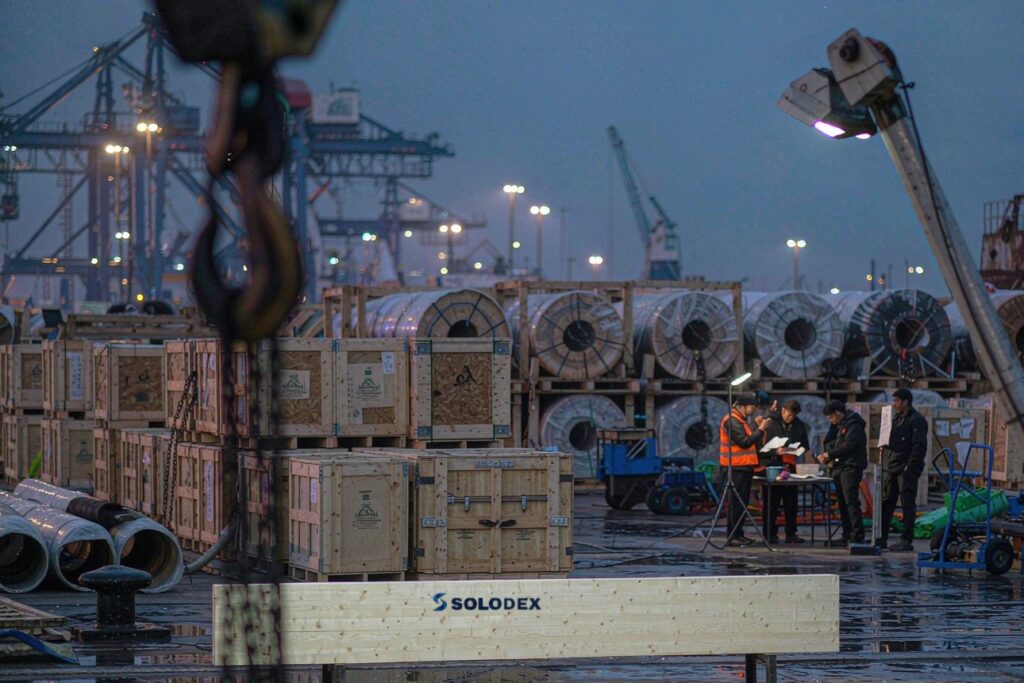
Two bills of lading can carry exactly the same line: shipped on board in apparent good order and condition. One covers a sealed container. The other covers twenty-six wooden cases of printing press rollers that went over the rail one at a time. The words are identical. What they record is almost the opposite.
On the first bill, the line means the carrier never saw the goods. The doors were closed before the box reached the quay, and the carrier accepted an item of equipment against a seal number. On the second, it means somebody standing at the ship’s rail watched every case pass, had a pencil in hand, and did not write anything down. One is a statement about not looking. The other is a statement about looking and finding nothing worth a remark.
That difference is the fifth thing a container decides on the cargo’s behalf. It decides when the hand-over happens, who is present for it, and how much of the goods have to be described at that moment. Remove the box and the hand-over does not move to another office. It moves to the hook, into the open, while the cargo is still swinging.
A Line That Means Two Opposite Things
Clean on board is usually read as a verdict. It sounds like a conclusion somebody reached: the goods were inspected, found sound, and certified. On a container shipment it is nothing of the kind. It is closer to a boundary drawn around the carrier’s knowledge. The carrier received a sealed box, could not see inside it without breaking a seal that belongs to somebody else, and is not making a representation about the contents. The familiar phrase one container said to contain makes that explicit. The document is useful precisely because it does not claim to have counted.
For break bulk cargo the same phrase has to earn its meaning. The carrier’s people were at the rail. There was no closed door between them and the goods. Cases, crates, bundles and bare machine frames were visible one by one, in daylight, for as long as it took to sling them. A remarks column existed on the tally sheet and could have been used on every line. If it stayed empty, that emptiness is a record of an observation, not an absence of one.
So the same ten words describe two different allocations of responsibility. In one case the ship is saying: I did not look, and the paper says so. In the other: I looked, and there was nothing to report. A reader who treats both as a clean bill of health has missed the only part of the sentence that matters, which is who was standing where when it was written.
What the Box Hands Over
A container hand-over is a remarkably small event. A gate reads a number, a seal is checked, a weight is recorded, and the box becomes the carrier’s responsibility. Everything that might be said about the condition of the goods inside is postponed. It is not cancelled; it is deferred to the day somebody opens the doors at the other end, in a warehouse, with no crane waiting and no ship to sail.
That deferral is a design feature, not an oversight. It is what makes a container shipment fast. One acceptance event replaces several hundred. It also means the carrier’s document has almost nowhere to put a comment about the goods. The surface the carrier can see is the surface of the box, and a scuff on a steel wall is a matter about equipment, not about the cartons behind it. A broken seal is a separate question with its own paperwork, and it is a question about who had access, not about whether a machine housing is dented.
This is why the count of pieces inside a box is the shipper’s business. The carrier accepts one unit and answers for one unit. What counts as one piece is settled by the sling, not by the invoice, and for a sealed box the sling lifts one thing regardless of what the packing list says. The number of cartons will be established later, by a person who was not at the gate, in a room the carrier never entered.
What the Hook Hands Over
At a break bulk berth the hand-over is spread across the whole loading operation. A case arrives on a trailer or from the shed, is slung, crosses the rail, is lowered into a hold, and is unhooked. Somebody at the rail marks a line. That mark is made while the piece is still identifiable, still lit, still close enough to read a stencil, and still in the presence of the people who will have to answer for it later.
Nothing is deferred. There is no later moment at which the condition of each case can be established calmly, because after the hatch is closed the cases are a stack in a dark shared space, and after three weeks at sea the rain stains have dried and the crushed corner has been repacked or swept up. If a description of the goods at the moment of hand-over is going to exist, it has to be produced in the few seconds while the piece is in the air.
This is also where the marks and piece numbers painted on the cargo stop being an abstract identification problem. The clerk is not merely counting. He is reading a painted line on a moving object and deciding, at the same time, whether anything about that object needs a sentence. Identity and condition arrive in the same glance, from the same face of the same case, at the same instant.
One Pass, and the Window Closes
The awkward part is that the opportunity to write is attached to a physical event. It opens when the sling comes off and closes when the piece is out of reach. There is no queue of pending remarks to be filled in after sailing. A photograph taken at discharge can be sharper and better lit than anything the clerk saw, but it cannot add a line to a document that was signed at the loading berth three weeks earlier.
At the delivery end, a signature is a sentence that later gets quoted, and much of that article is about how hard it is to contradict. The loading end has the mirror image of the same problem. There, the difficulty is not contradicting a sentence but supplying one that was never written. Both are about a short window in which a person with a pen stands next to goods; the difference is that at delivery the pen is usually used, and at the rail the useful sentence is the one that is missing.
So a clean document is best understood as an unused opportunity. It does not say the goods were sound. It says that at the only moment when somebody was qualified to describe them, nobody chose to write a description. That is a much narrower claim, and it is the only claim the paper can actually support.
| In a container shipment | In break bulk |
|---|---|
| What is received: one item of equipment, identified by a number and a seal. | What is received: twenty-six cases, each seen as its sling comes off. |
| Who could see the goods: nobody on the carrier’s side, until the doors are opened at destination. | Who could see the goods: the tally clerk, the ship’s officer, the stevedores, in daylight at the rail. |
| What a clean line records: that the box and its seal were accepted, not that the contents were examined. | What a clean line records: that the remarks column stayed empty while the pieces passed. |
| When condition is settled: later, in a warehouse, by the party receiving the goods. | When condition is settled: now, in the seconds while each piece is over the quay. |
| What can still be added: a note about the seal, or a survey after unloading. | What can still be added: nothing about loading condition; the pieces are in the hold and the ship has sailed. |
| Where the risk sits: in a gap between the box and its contents. | Where the risk sits: in a sentence that was available and never written down. |
The Same Pencil Writes Two Columns
A tally sheet is usually imagined as a counting device, a column of ticks. In practice the counting column and the remarks column sit side by side and are filled by the same person, in the same pass, with the same pencil. The number and the sentence are products of one observation. Separating them into a quantity problem and a quality problem is something that happens later, in offices, when the sheet has been copied into other documents.
That is why tallying appears on a port tariff as one line among many charges, and why it is easy to file it under clerical work. For loose cargo the line pays for the moment when both columns are created. There is no earlier number for the clerk to copy and no earlier description of condition to reproduce. If the clerk is not there, neither column exists.
It also explains why a short remark is so much more consequential than it looks. Three cases wet-stained is five words. It changes what every subsequent document has to say about those three cases, and it changes who has to explain the stains when the cases are opened. A tick in the counting column cannot do that. The tick is satisfied by the piece arriving; the remark follows the piece.
What the Line Could Not Say
There is a hard limit on what the clerk can write, and it is worth being precise about it. He can describe a face: rain stains, a crushed corner, a broken steel strap, a case that looks second-hand, a stencil that is illegible, a lid that has been opened and nailed shut again. He cannot say anything about the machined surface inside, because the case is closed and will stay closed. His sentence is about the outside of the goods at that moment, nothing more.
This is where the container version and the break bulk version converge in a slightly unexpected way. Neither document is a statement about internal condition. The difference is that the container’s outer surface belongs to the carrier’s equipment, while the case’s outer surface belongs to the cargo. So the break bulk remark is the only visible-surface statement the transport documents will ever contain about the goods themselves.
The case is not a wrapper around the product; it is a structure that replaces the walls and the lifting points of a box. A crushed corner is therefore not cosmetic. It is damage to a load-bearing member that was specified to take a sling and a stack. When the clerk writes those words, he is describing the failure of something the shipper was obliged to supply in place of the container.
Four Sheets, One Sentence
A remark written at the rail does not stay on the tally sheet. It is supposed to travel. The route is short, entirely on paper, and has four stops:
- The tally sheet. Written at the rail, line by line, while the pieces pass. It holds both the count and the remarks in their original form, including the awkward wording and the crossings-out.
- The mate’s receipt. Issued when the goods are received on board. The remarks are copied here, usually shortened, and this is the paper the shipper’s documents are checked against.
- The bill of lading. The transport document that travels to the buyer and to the bank. A remark that survives this step becomes a clause or an endorsement on a document that will be read thousands of miles away.
- The discharge tally. Produced at the other end when the pieces come out. It is the only later record made in the presence of the same physical goods.
Four sheets, one sentence. At each step the sentence can be copied faithfully, abbreviated, reworded, or dropped. Nothing in the process guarantees that it arrives. Nor is there a rule about who owns it: the tally clerk writes it, the ship’s officer signs the receipt, a documentation clerk prepares the bill, and a receiving clerk at discharge writes an independent record of what he sees. Four people, four moments, four different reasons to be brief.
A Sentence That Goes Missing Makes No Difference
Here is the part that makes this worth writing about. If a remark is lost between the second and third sheet, the resulting documents do not disagree. They look more consistent than before. A clean bill of lading next to a tally sheet with no remark is a tidy pair of papers. The omission produces no mismatch for anybody to notice, no field left blank, no figure that fails to reconcile.
The usual document problem on this site is five descriptions of one shipment that do not agree, and the work there is to establish that they refer to the same goods. This is the opposite failure. The papers can agree perfectly, the piece count can be twenty-six on all four sheets, and the whole set can still be missing a single adjective that somebody saw and wrote down at nine in the morning. Agreement is a property of what remains on the page. It says nothing about what was left off.
The same is true of the count itself, but for a different reason. A number can be correct on every document and still go stale because the unit it described was rebuilt mid-voyage. Here the unit never changes: twenty-six cases remain twenty-six cases. What goes stale is the description of three of them. One failure is about a noun being reorganised; this one is about an adjective being dropped. Both hide inside papers that reconcile cleanly.
Consider the actual morning. Twenty-six cases of printing press rollers are delivered alongside. Three have fresh water stains from a night of rain in the yard. One has a corner crushed by a forklift before loading, and its steel strap has been replaced. The tally clerk writes the count as twenty-six and the remarks as 3 cases wet-stained, 1 corner crushed, strap renewed. The mate’s receipt, copied after a shift change, carries 3 cases wet-stained. The bill of lading is issued clean with a piece count of twenty-six. Three weeks later the discharge tally notes one case with a damaged corner.
Every number on those four sheets is identical. No two sheets contain the same sentence. At discharge, the crushed corner is a fact about a case and a surprise on paper, and the people who have to discuss it are the people who were not at the rail. The wood dried; the sentence did not travel.
Who Wrote the First Sentence
It is worth asking who was qualified to write the first description of this cargo’s condition. Not the shipper, who packed the cases days earlier in a factory and was not at the berth. Not the buyer, who will see the goods three weeks later. Not the bank, which will read the bill of lading without ever seeing a case. The first sentence about the state of the goods comes from a tally clerk and a ship’s officer, two parties who neither made nor bought nor own them.
That arrangement is not a mistake. Those are the only people who can see the goods at the moment when responsibility changes hands. But it has a consequence that is easy to overlook: the earliest and most physical description in the whole document chain is authored by the party whose interest lies in keeping it short. Everything downstream, including the buyer’s understanding of what was shipped, depends on that brevity being accurate and being copied.
This is a different question from who signs a declaration. A signature identifies the legal person making a statement to an authority, and that subject is often an office that never opened a carton. Here the subject is not in dispute at all. The clerk was plainly there. What is in doubt is whether the one sentence he wrote was carried forward by three other people who were not.
What to Reconcile on the Quay
The check is small, and it can be done with the documents in hand before the ship sails. It does not involve opening a case or arguing about who caused a stain.
Take the remarks column of the tally sheet, the remarks on the mate’s receipt, any clause or endorsement on the bill of lading, and the exception column of the discharge tally. Ask whether the same sentence appears on all four, and whether the piece count beside it is the same number on all four. Both halves matter. A matching count with a missing remark is exactly the tidy failure described above; a matching remark with a different count is a different problem about what was lifted.
In some trades the names of these sheets differ, and in some ports the remarks are kept on a separate exception list rather than on the face of the document. The shape of the reconciliation does not change. Somebody wrote something while the goods were visible. Find out what the next three sheets did with it.
Nor is this a claim about who pays for damage, which is a separate conversation with its own timelines and evidence. It is a claim about visibility. A sentence that exists at the rail and nowhere else is a sentence that was written for nobody, and the goods will arrive with a history that their documents do not contain.
Five Decisions, Back on the Goods
This is the fifth and last of the decisions a container makes silently. The first was identity: a box number names the equipment, so loose cargo has to carry its own name on a painted face. The second was the count: a box separates lifts from things, so loose cargo has to be settled as one piece at the hook. The third was measurement: a box is booked as equipment, so loose cargo has to be weighed and cubed into two manifest columns. The fourth was protection: a box supplies the roof, walls, corners and lifting points, so the packing specification has to replace each one.
The fifth is the hand-over. A box is accepted closed, which lets the description of the goods wait until somebody opens it at the other end. Loose cargo is accepted in the open, one piece at a time, with a person watching and a pencil available. There is no waiting, and there is no second chance to say what that person saw.
None of these five are services the container advertises. They are consequences of the fact that a sealed, numbered, structurally rated box sits between the goods and everybody who has to handle them. Take the box away and each one returns to the cargo, to the people standing beside it, and to a line on a sheet of paper that has to be written while the sling is still in the air.
A container lets a shipment arrive before anybody has described it. Cargo that does not travel in one has to be described as it leaves.
Clean on board says nobody wrote a remark when the goods changed hands; a cleaning certificate says what the tank carried before, which is a different use of the word clean.
Clean on board records that nobody wrote a remark when a piece passed the rail; for cargo poured through a spout there is no passing object to remark on, only two sets of draft marks.
One lift of the hook defines one piece; one stack of four boxes defines one securing calculation, with three lines that cannot be traded against each other.


