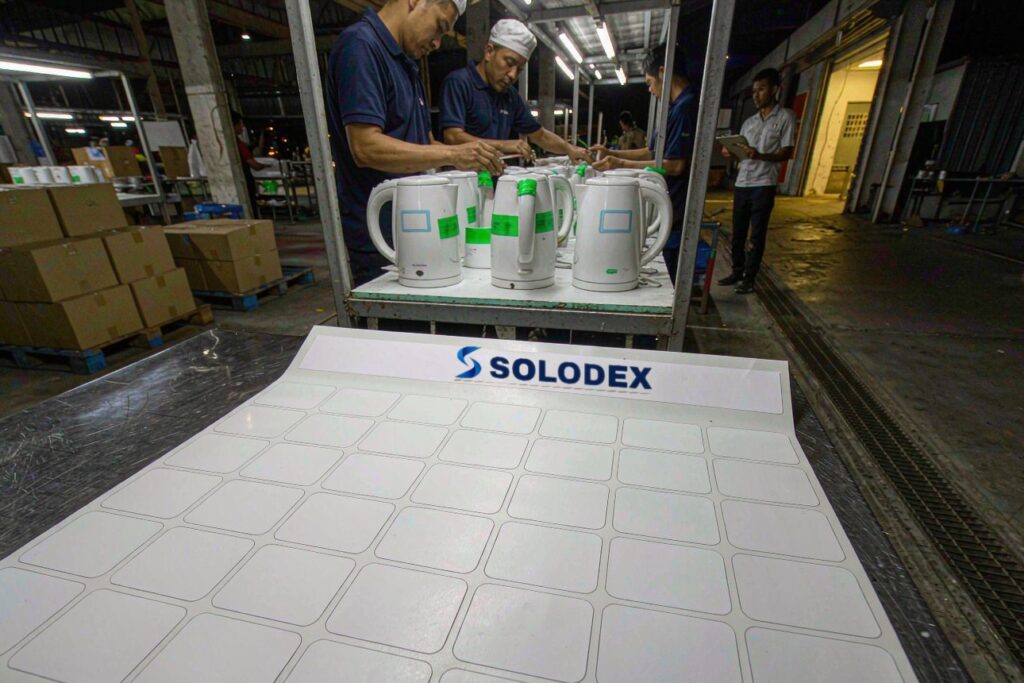
The box was right and the printing was wrong
The kettles were the ones in the certificate photograph. The carton carried the model number, the origin mark and the net quantity. The Arabic panel was there, printed, with the warnings and the instructions. The container was still held, because the only name on that panel as importer was the manufacturer’s — the local distributor, whose registration the entry was filed under, appeared nowhere on the retail box.
Nothing was counterfeit and nobody had lied. A label had been designed for a product, and the shipment had been built for a market; between those two things sat a name that had changed after the printing plates were made.
This is the part of Gulf market entry that looks like design work and behaves like compliance. The standard is the same text in six countries, as the previous article set out; what differs, market by market, is what has to be printed on the box, in what language, naming whom. And unlike a certificate, printing cannot be corrected by an email.
A label is a controlled document
Read a retail label as a list of claims rather than as packaging. It asserts the identity of the product, the identity of the party responsible for it in this market, the country of origin, the quantity, the warnings, the conformity mark where one applies, and often a registration or certificate reference. Every one of those assertions is checkable against a document that exists somewhere else, held by somebody else.
That is the whole difference between a label and artwork. Artwork is judged on how it looks; a label is judged on whether its claims survive being compared with a certificate, an invoice and a physical sample. A beautiful panel with an obsolete importer name is a failed document, and the fact that it is beautiful is not a mitigating circumstance.
Which is why the label has to be versioned like any other controlled document: a number, a date, a record of what changed, and a rule about who approves a change. Suppliers who manage labels this way can answer the only question that matters at the counter — which revision is on this carton — in about ten seconds.
The importer’s name is the load-bearing element
Of all the fields, one carries the most weight and changes the most often: the name and address of the importer or authorised representative in the destination market.
It is not decorative. When something goes wrong with the product, that is the party the authority contacts, the party a recall is addressed to, and the party whose reputation is on the box. The name on the label is the regulatory anchor for everything that happens after the sale, which is precisely why the regulation insists it be there rather than in a manual.
The commercial consequence follows directly: change distributor, reprint the label. Not amend a file, not issue a letter — reprint, because the pack in the market carries a name that is no longer the responsible one. Buyers who negotiate a distributor change as a commercial matter discover, usually a week before the first shipment under the new arrangement, that it is also a printing project with a lead time of its own.
There is a second, quieter version of the same trap: the label names a group entity that is not the entity on the import declaration. Both names are real, both belong to the same company, and the entry still fails, because the regulation is asking about the party on the entry, not about the family tree.
Translation produces a legal text
The Arabic panel is not a courtesy translation of the English one. It is the text the market reads and the authority enforces, and it has to be produced as a controlled document with fixed terminology.
Two failures recur. The first is literal translation, which loses the regulated term: a warning rendered faithfully word for word but without the phrase the regulation uses for that hazard, so a compliant product reads as a non-compliant one. The second is the opposite — a translation written to sell, which adds a claim the product never made. That second failure is worse than a mistranslation, because a mistranslation is an error and an added claim is a mislabelling, and mislabelling is treated as a product defect rather than a language problem.
The practical rule is that the Arabic text should be written or verified by someone who reads the regulation rather than the brochure, and then locked. If the same phrase appears on the label, in the instructions and on the certificate, it should be the same phrase in all three.
What the officer actually compares
At the counter the comparison is narrow. Three fields stop most containers, and none of them is the one suppliers worry about.
The responsible party. The name on the retail unit has to be the importer on the entry, spelled the way the registration spells it.
The model designation. The string on the label, on the certificate and on the invoice has to be identical — not equivalent, identical. A suffix added for the local market is a different model until somebody amends the certificate to say otherwise.
The origin. Marked, and consistent with the origin claimed on the entry. A product assembled in one country from components made in another has one correct answer, and the label has to carry that answer rather than the one the marketing department prefers.
Everything else — the font, the layout, the position of the mark, whether the Arabic sits above or beside the English — matters to the authority that approved the artwork and much less to the officer with a container in front of him. The order of risk is the reverse of the order of attention in most design reviews.
Where a sticker works, and where it does not
Stickers exist because labels go wrong, and they are legitimate instruments in most Gulf markets, within limits that are worth knowing before a container is loaded rather than after.
| Defect | Sticker as a remedy | Where it must go | What remains at risk |
|---|---|---|---|
| Missing Arabic panel | Usually accepted if applied before release | The retail unit, not the shipper | Whether the application is accepted at the port or must be done in an approved facility |
| Wrong importer name | Accepted, and the most common use | Over the old name, on every retail unit | A sticker over a sticker is refused in most markets |
| Missing net quantity or unit | Accepted on a supplementary panel | A panel that does not obscure required information | Durability: a label that lifts in a warehouse is a defect found later |
| Missing conformity mark | Not a labelling fix | — | The mark follows the certificate, not the printer |
| Wrong model designation | Not a labelling fix | — | The certificate has to name the model first |
| Origins that contradict the entry | Never | — | Treated as a false declaration rather than a printing error |
Read the second column as a boundary rather than a list of permissions. A sticker can correct what the market reads. It cannot correct what the file says, and the two rows that cannot be stickered are the two that go to the certificate.
The third column is where most of the cost hides. A sticker applied to the shipper is invisible to the shopper and, in markets where the retail unit is the regulated object, does not satisfy the requirement at all. That distinction — carton versus retail unit — is the single most expensive misunderstanding in this article, because discovering it means opening cases.
The mistakes decided by the print run
Four errors are cheap to make and expensive to undo, and all four are decided at the moment the labels are ordered.
Printing before the distributor is final. Printing the registration number before the certificate has been issued, so the number on the box is the one from the application rather than the one that was granted. Printing net quantity in units the market does not use, which is a labelling defect that no translation fixes. And printing the shipper only, on the assumption that the retail pack can be stickered later — which is true in some markets, in some categories, at some ports, and is not a plan.
The reason these are expensive is arithmetic. A print run is tens of thousands of units; a label change is not an amendment, it is a reprint plus a repack. For a retail unit in a sealed case, repacking means opening cartons, relabelling, resealing and re-palletising — work that costs more than the labels and takes longer than the voyage.
The long pole is the reprint
Everything else in this series can be fixed with a document. A certificate can be amended, a registration can be transferred, a container can be re-routed. A label that is already on forty thousand units cannot be fixed by any of those, and that is the asymmetry worth planning around.
Which produces a simple sequencing rule that prevents most of it. The label is the last thing to be printed and the first thing to be checked. Last, because it depends on the importer, the registration and the model designation, all of which are settled late. First, because it is the only element in the file that cannot be corrected by correspondence.
Suppliers who print early do so to protect a production schedule, and the trade is usually bad: a fortnight saved at the printer against a month lost at the port, with a repacking bill in between. The version of the label is worth as much attention as the version of the certificate, and it is checked in the same five minutes — name, model, origin, quantity, language — before the cartons are sealed.
The goods are identical in every market. What the regulation approves is the text printed on them, which is why the same kettle can be compliant in one country and mislabelled in the next without a single component changing. The certificate chain, the national registration and the categories where claims are regulated most tightly all end at the same object: a printed panel that has to be true, and a file that has to agree with it.
The zone is also the cheapest place to fix a label, precisely because the goods have not been imported yet.
One house bill in a consolidated box can be delayed by a label that the others never needed; the requirement is set out in Arabic label requirements.


