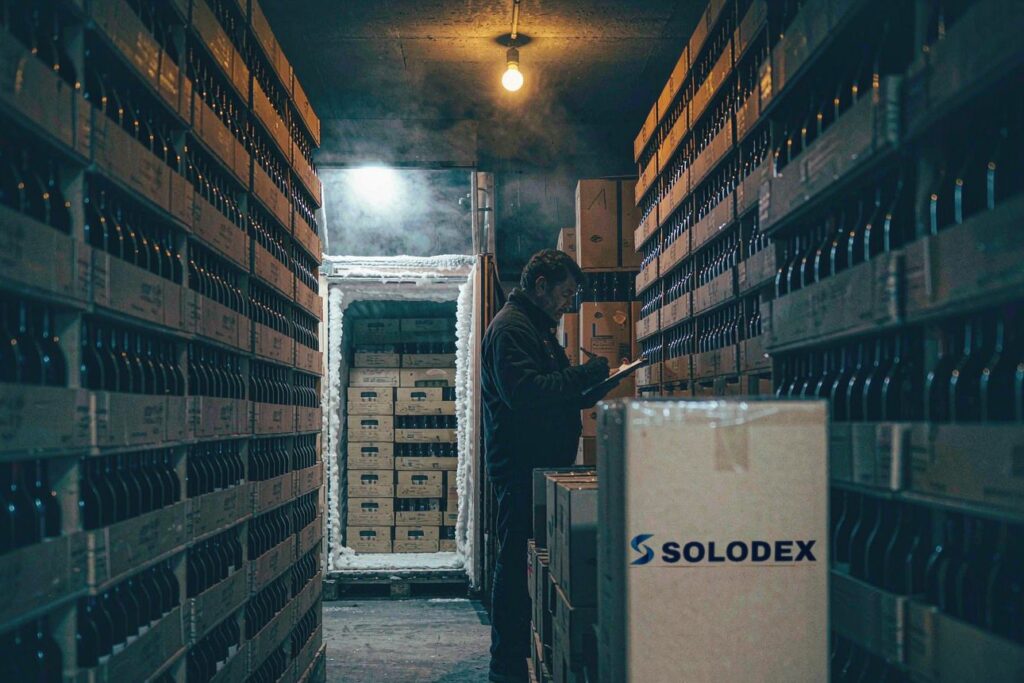
The wine was bottled in March, shipped in April, and arrived in June. It sat in a bonded shed for five weeks because the importer’s excise registration had lapsed in February and nobody had noticed until the entry was lodged.
Nothing was wrong with the wine, the label, the temperature or the freight. What was missing was a number that belongs to the buyer, held by a tax authority the seller has never spoken to, and required before a single bottle can leave the shed.
This is the defining feature of the category. For most goods, the question at the border is whether the cargo may enter. For alcohol, the question is whether the importer may hold it — and that question is answered weeks before the vessel sails, in a different country, by a different party.
Two taxes and a permission
Alcohol attracts customs duty, and it also attracts excise — a specific tax, charged per litre of pure alcohol or per bottle, and set by the destination for each category of product. In most markets a value-added tax sits on top of both, calculated on a base that already includes them.
Those are the arithmetic. The permission is the part that stops shipments. To clear alcohol, the importer must be registered with the tax authority, hold whatever licence the market requires for the trade, and often be able to show an approved premises or a bonded warehouse arrangement. A forwarder cannot supply any of this, and an exporter cannot verify it.
Which means the practical test for a first order is not “can we ship it” but “can the buyer legally receive it”. Those are different questions, answered by different people, and only one of them is on the shipper’s side of the water.
Excise is charged on alcohol, not on value
Because excise is specific rather than proportional, the tax base is physical: the alcohol content and the volume. A bottle at 13.5 per cent and a bottle at 14 per cent are different tax objects even when they sell for the same price, and a magnum is not two bottles for tax purposes in every market.
That makes the label data part of the customs data. The declared alcoholic strength, the declared net contents and the number of bottles have to agree across the invoice, the packing list, the label and the analysis certificate — and they have to agree exactly, because a mismatch changes the tax due.
It also explains why the tax can exceed the freight by a wide margin on premium products, and why the same bottle can retail at three different prices in three neighbouring countries without anybody being robbed.
The label is a permission too
In most markets the back label has to carry specified information: the importer’s name and address, the alcoholic strength, the net content, the allergen declaration for sulphites, and in some cases a health warning or a recycling note. Some markets require the label to be registered or approved before the goods arrive; a few require the importer’s details to be overprinted in the destination country rather than printed at source.
There is a practical consequence that catches first-time exporters. The label that was approved for the domestic market is not the label that can be sold abroad, and the difference is not cosmetic — it is the difference between a product that clears and one that has to be relabelled in a bonded warehouse at the importer’s expense.
And in a number of markets there is a physical permission on top of the printed one: a tax stamp or seal applied to the closure, issued to the licensed importer, controlled like currency. A bottler who ships a thousand cases without knowing whether the destination stamps them has created a problem that no amount of paperwork solves at the quay.
Duty is paid before the goods move
| What has to exist | Who holds it | When it must exist | If it does not |
|---|---|---|---|
| Importer’s registration and trade licence | The buyer | Before the entry is lodged, ideally before the order | The goods sit in bond while an application is processed |
| Approved label and, where required, tax stamps | The importer, sometimes the bottler under supervision | Before the goods are offered for sale; often before import | Relabelling in bond, at the importer’s cost, or refusal |
| Entry, duty, excise and VAT | The importer, through a broker | Before release — the taxes are paid, not promised | Storage accrues and the container cannot be devanned |
| Temperature-controlled carriage | The forwarder, on the shipper’s instruction | From the winery door to the importer’s warehouse | A wine that arrived and is no longer the wine that was sold |
Read the third column. Three of the four must exist before the goods are even loaded, and the fourth — payment — falls due before anything moves out of the shed. There is no version of this category in which the paperwork catches up afterwards.
Bonded storage buys time, not permission
A bonded warehouse lets the importer store duty-suspended goods, and in most markets it is the standard way to hold stock without financing the tax. What it does not do is make an unlicensed importer licensed, or a non-compliant label compliant.
It also creates a second clock. The goods are in a controlled premises, the tax is deferred, and the storage is charged — and every week the wine sits there is a week of storage cost against a product whose value does not increase in a shed. The bond is a cash-flow instrument, and like every cash-flow instrument it is only free if the goods move.
Glass, weight, and why wine goes by sea
A 750 millilitre bottle weighs about four hundred grams empty and around 1.2 kilograms full. A case of twelve is close to fifteen kilograms, of which the wine is a little over nine. The product is, in freight terms, mostly packaging and water.
That has two effects. The first is that a container of wine reaches its payload limit before it runs out of space — the mirror image of a container of tyres, and the same arithmetic that makes dense fragile goods expensive per kilo. The second is that air freight is only rational for very high-value bottles, where the freight is a rounding error against the price of the wine and the cost of being late.
Which is why the loading plan matters more than the rate: the difference between a well-filled container and a half-filled one is the difference between a competitive landed cost and a conversation with the buyer.
Temperature is part of the product
Wine is not a durable good. Heat exposure over a few days changes it permanently, and the change is not visible in a photograph or detectable in a document — it is discovered when the bottle is opened, months later, by a customer who will not order again.
So the carriage instruction is not a preference. A reefer, or an insulated container with a temperature recorder, and a record that survives the voyage, is the only way to answer the question a buyer will eventually ask. Without the recorder, the argument about a cooked shipment is unwinnable in both directions: the forwarder cannot prove the temperature was held, and the shipper cannot prove it was not.
This is the one part of the category where the freight decision is genuinely a product decision. Everything else is tax and permission.
What alcohol is not
Worth separating, because the two topics get mixed: whether a bottle may fly is a dangerous goods question, and it is answered by its own rules — the strength, the packaging, the quantity per inner packaging. That is a different article with a different arithmetic, and it applies to samples and to air freight rather than to a container of cases.
The container is not dangerous goods in any practical sense. It is a tax event with a transport leg attached, which is why the expertise it needs is a broker’s rather than a dangerous goods officer’s.
Five things to settle before the order is confirmed
Is the buyer licensed to import this category, and is the registration current? Ask for the number and the expiry, not for a reassurance.
What is the total tax per bottle at the destination? Duty, excise on the declared strength, and VAT on the total. If nobody has computed it, nobody knows the landed cost.
Does the label meet the destination’s requirements, including who is named as importer? And is any of it required to be applied locally?
Are tax stamps required, and who applies them? If the answer is the importer, the goods cannot be sold until the stamps exist.
What is the temperature instruction, and is there a recorder? A promise without a record is not evidence.
None of these is a freight question, and every one of them is the reason a container of wine sits in a shed for five weeks — the same structure as a machine that is inadmissible or a seed that is alive. The gate is different in each category; the pattern is that the gate is never the one the shipper is looking at.
Paid before it moves
Most cargo can be described, shipped, and argued about afterwards. Alcohol cannot, because the tax is assessed on physical facts that must be declared exactly, and the permission to hold the goods belongs to a party who is not in the shipping conversation until quite late.
Which is why the useful conversation at the start of a wine programme is not about rates or transit times. It is about a licence number and an expiry date, and about who is legally the importer when the container is cleared — because in this category, that party is the one who pays before the bottle moves, and the one who owns the problem if it does not.
The wine was never late. It was waiting for a registration that expired before it was bottled.
A carriage instruction and a recorder that survives the voyage are what make a wine shipment answerable later; during the crossing that recorder is only one of three records, because the machine logs supply and return air while the cargo keeps its own slower curve.


