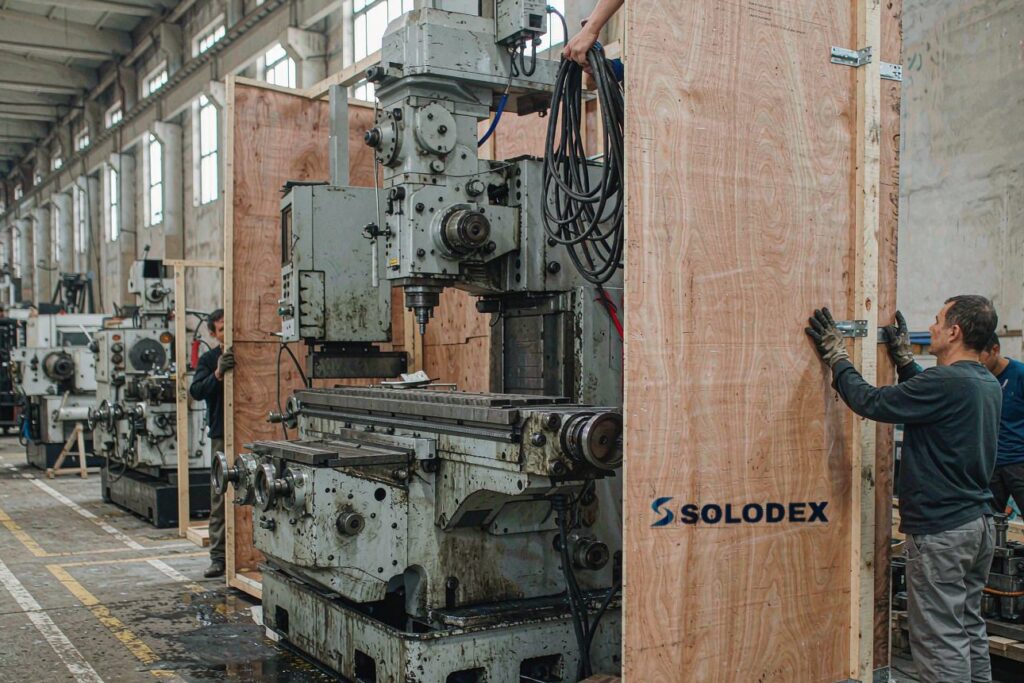
The machine was a 2016 machining centre, in production until March, maintained on schedule, with a spindle that had done less than half its rated hours. The buyer paid a third of the new price and considered it a good week’s work.
It never left the port of destination. Not because it was damaged, and not because anybody doubted the condition — the entry was stopped because the import approval the buyer held had been issued for new machinery, and the nameplate on the machine said 2016.
This is the thing that used-equipment buyers learn once: “used” is not a description of condition. It is a regulatory category, and in a number of markets it is a restricted one.
The tariff line is the same; the regime is not
A used machining centre and a new one usually sit under the same tariff heading, attract the same duty rate, and are described in the same six digits. That similarity is what makes people assume the treatment is identical.
It is not, because duty is only one of the things a border decides. Separate from the tariff, most markets operate an import regime for goods, and within that regime used industrial equipment is frequently carved out: subject to prior approval, limited by age, restricted to certain end uses, or banned outright for particular classes of machine.
The reasons are policy rather than trade. Used equipment can import a safety standard that the destination has already retired, displace a local refurbishment industry, or arrive as a disposal route for something that no longer meets any current rule. Whether those reasons are good is not the point; the point is that the file at the border is read against them.
Three gates that read the word “used”
Prior approval. Some markets require an import permit or licence for used capital goods, issued before shipment and often tied to the specific machine, its year, its capacity and the factory that will use it. A permit for new equipment does not cover a used one, and a permit for one machine does not cover its twin.
Pre-shipment inspection. A number of importing countries require used machinery to be examined at origin by a nominated agency before it is loaded, with a certificate that the destination customs will ask for on arrival. This is a government programme, not the buyer’s quality inspection, although the two are often combined in one visit.
Cleanliness. Used machinery carries the place it came from. Soil, crop residue, straw, dried process material and standing water are plant-health and bio-security matters, and used agricultural, food-processing and earth-moving equipment is examined for exactly that. A machine can be mechanically perfect and still be refused for the soil in its chassis.
| The gate | What it asks | Who answers it | Without it |
|---|---|---|---|
| Prior approval | Is this class of used machine admissible at all, and does the approval name this unit? | The import authority at destination | The entry cannot be lodged; storage and demurrage begin while nothing moves |
| Pre-shipment inspection | Is the machine complete, safe and identifiable before it is loaded? | A nominated agency at origin | The entry is held at destination until a certificate that should have been issued weeks earlier is produced |
| Cleanliness | Is there soil, residue or organic material on or in the machine? | Port health or plant protection | Treatment, return or refusal, at the shipper’s cost, after the freight has already been paid |
The order matters, and it is not the order of the list. Approval comes first because it is the only one that can end the transaction. Inspection comes second because it has to happen at origin and takes time to book. Cleanliness comes third because it is the cheapest to fix and the most expensive to discover late — a machine that has been crated and is waiting for a vessel is a difficult thing to steam clean.
Three different ages
Every form that asks for the age of a machine is asking a specific question, and the three possible answers are rarely the same number.
Year of manufacture is what the nameplate says, and it is what most approvals and most inspection reports are keyed to. Year first commissioned is when it entered service, which can be a year or two later and is the number the maintenance records show. The year the model left production is the one that matters when a market restricts equipment by technology generation rather than by calendar age.
A buyer who answers “it’s about five years old” has answered none of them. The number that decides whether the file moves is the one stamped on the plate, photographed legibly, with the serial number beside it.
What the inspection actually looks at
Pre-shipment inspection for used equipment is not a valuation exercise, although a value is usually recorded. It is a condition and identification exercise, and the report is structured around a handful of questions.
Does the machine match the documents — make, model, serial, year, capacity? Is it complete, or are guards, control panels and safety devices missing? Is the wiring intact and the insulation sound? Are there leaks, and of what? Is anything obviously unsafe to load, or unsafe to run once installed? And is there a maintenance history that supports the hour count?
The report is issued at origin and consumed at destination, which is why the photographs matter more than the prose. A plate that has been painted over, a serial number that cannot be read, or a set of guards removed for transport will each generate a question that costs days.
The nameplate is the document
Of everything on a used machine, the nameplate is the item most often damaged, repainted or replaced, and the item a customs officer will ask to see first. It carries the manufacturer, the model, the serial, the year and usually the electrical rating.
Three photographs taken before packing solve most of this: the plate itself, the plate in context on the machine, and the serial number stamped on the frame if it differs. If the plate is unreadable, the manufacturer’s letter confirming the serial and year is the substitute — and getting it takes longer than taking the photograph.
Clean is a customs word
Used machinery is inspected for what it is carrying as well as what it is. Agricultural equipment, food-processing lines, mining and construction machines and anything that has handled organic material are the categories where this is enforced hardest, because the risk being managed is biological rather than commercial.
The practical requirement is unglamorous: the machine arrives at the port of loading clean, dry and free of soil and residue, with the cleaning recorded. Steam cleaning before packing is normal for this class of cargo, and the record of it belongs with the shipping documents rather than in an email.
The packaging has its own rule. Where timber is used — crates, skids, dunnage — the wood needs the ISPM 15 treatment and mark, and the mark has to be on the wood, not on a certificate filed somewhere else. Plywood is exempt; solid wood is not; a crate built from both is a conversation at the border.
Big, heavy and awkward, on top of everything else
Used machines are frequently the shipment that does not fit. A machining centre in a crate can be three metres tall, several tonnes, and impossible to lift without the lifting points the manufacturer designed and the rigger removed.
That is a separate problem with its own ceilings — road height, crane capacity, container door dimensions — and it interacts badly with the regulatory ones, because a machine that has to be partially dismantled for transport is a machine whose identification and completeness are now harder to demonstrate.
Value is a negotiation, not a discount
A used machine is legitimately worth less than a new one, and the invoice will reflect that. What customs will not accept is a number that cannot be explained. The contrast is instructive: with new parts and new machines, the invoice and the catalogue settle the argument; with a used machine, the invoice is the beginning of one.
The defensible version has three parts: the transaction price, the basis for it (age, hours, condition, comparable sales), and the depreciation that connects the two. An appraisal or the seller’s asset register helps. A price that is simply a third of the list price, with no working, invites a valuation query — and a valuation query stops the container while somebody decides what the machine is worth.
The trap is the opposite of fraud and just as expensive: an invoice written low “because it is used”, by a seller who has never had to defend a customs value. An inspection report that records condition is the cheapest support for a low number, because it explains why the number is low.
Five things to settle before the machine is crated
Does the destination restrict used machinery of this type? Not the tariff line — the import regime. This is answered by the importer or its broker, in writing, before the purchase order. And it is worth checking the other end as well: some machines also need an export permit or a dual-use check at origin before they can be shipped at all, which is a separate file at a separate counter.
Is a prior approval needed, and does it name this machine? Model, serial and year, not “a machining centre”.
Is a pre-shipment inspection required at origin, and by whom? If yes, the booking has to leave room for it, because the inspection date is not the shipping date.
Is the machine clean, and is the cleaning recorded? Especially if it has ever touched soil, crops or food.
What is the value based on? Three numbers and a document, not one number and an assumption.
Two questions, two departments
Whether a used machine is worth buying is an engineering and commercial question, answered by people who know the model, the hours and the market. Whether it may enter a country is a legal question, answered by a regime that has never seen the machine and does not care how well it runs.
The failure in the story at the top of this page was not a bad machine or a bad price. It was a buyer who asked the first question carefully and assumed the second one would take care of itself — which it does, in most markets, for most goods, until the goods are second-hand.
One rule, if only one is remembered: find out whether the country takes used equipment of this class before finding out what it is worth. The answer to the first question decides whether the second one is ever asked.
The same logic runs in the opposite direction for second-hand goods: one property of the article decides which regime applies, long before anybody discusses price or packing.
The same question, one product further on: a tyre carries its production date in the mould, so “new” is a number on the goods rather than a line in the contract.
The permission belongs to the buyer, not the shipper, and it expires: an alcohol import licence is the clearest case of a document that can stop a container without anything being wrong with it.
There is a second version of the same problem, and it is harsher: some used goods are prohibited rather than restricted, so there is no approval to wait for.
For used units there is one more step before crating: the refrigerant has to be recovered, because a machine with a live charge is a dangerous goods shipment with a worse paper trail.
For returned equipment the same question appears in reverse: an empty cylinder is still the class of its last contents until it is cleaned and documented.
For equipment with a working life the question becomes sharper still: “refurbished” is a process, not a legal status, and the border asks for a condition.
A machine can also be excluded because of one component: the mercury in a switch is still a switch, whatever enclosure it is bolted into.
Which is why the bill of materials matters more than the machine: a charged component inside it carries its own entry.
Second-hand cargo often attracts an inspection before the strip can be scheduled; the category is explained in why second-hand is a customs category.


