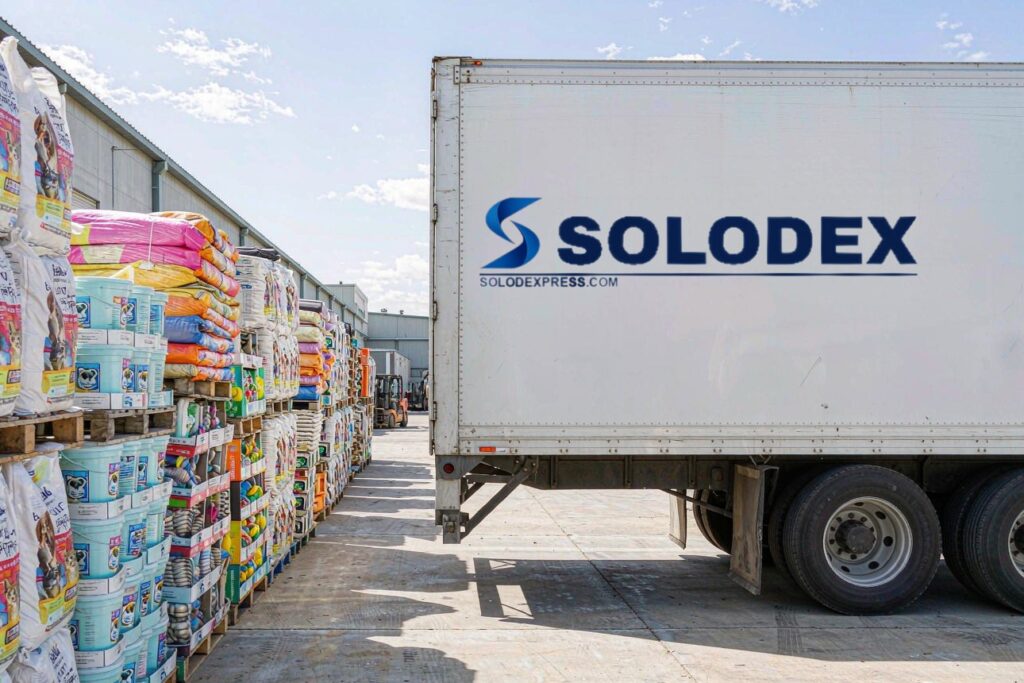
A box leaving a pet brand’s warehouse usually contains two products regulated as if they came from different industries: a bag of treats, which is food, and a chew toy, which is a consumer product. They travel together. They are declared separately, tested separately, and in most markets inspected by different agencies.
That split is the defining feature of this category, and it is invisible in the catalogue, where a treat and a toy sit side by side with similar margins. It becomes visible at the border, where one needs a health certificate and an establishment number, and the other needs a warning label and a plasticiser declaration.
The second feature is physics, and it is more extreme here than anywhere else in this series: the category spans cat litter at 900 kilos per cubic metre and a pet bed at 15. Nothing about freight carries over between them.
Food and furniture in the same box
Pet food is feed. Not “food-like”, not a grey area — in the European Union it is regulated as feed, which sits inside the same entry machinery as any other consignment into the bloc, and means the manufacturing establishment has to be approved and listed, the consignment has to travel with an animal health certificate through a specific system, and the product has to be traceable to a batch.
Pet toys are consumer products. They are not covered by children’s product rules in the United States, which surprises sellers who assume anything chewed needs a certificate, and they are not covered by feed rules either. They sit under general product safety, state-level chemical warning laws, and the platform’s own requirements, which in practice are stricter than the statutes.
| Aspect | Treats and chews that are edible | Toys, beds, bowls, accessories |
|---|---|---|
| Framework | Feed law — FDA/CVM in the US, feed hygiene rules in the EU | General product safety, plus state chemical warning laws |
| Factory approval | Establishment must be listed or approved, and the number appears on the certificate | No registration; supplier audit is commercial, not legal |
| Documents per shipment | Health certificate, batch traceability, sometimes a veterinary attestation | Commercial invoice, and a test report if the platform asks |
| Testing | Microbiological — salmonella, enterobacteriaceae | Chemical — lead, phthalates, azo dyes, sometimes formaldehyde |
| If it fails | Destroyed or re-exported; food cannot be reworked | Usually reworked, relabelled or sold elsewhere |
The last row is the one that should shape the sourcing plan. A toy that fails a phthalate screen can be reformulated and the next batch corrected. A consignment of treats that arrives without a valid establishment listing is destroyed, and the freight, the duty and the product all go with it.
Treats are feed, and feed has a register
The mechanism that stops most first shipments of pet treats is not a test. It is a list, and the factory is either on it or it is not.
For the European Union, animal by-products and derived products used in pet food must come from establishments that the exporting country has listed, and the consignment must be accompanied by the appropriate health certificate. A factory can produce excellent product for years and still be ineligible, because eligibility is a regulatory status rather than a quality grade. Before quoting a treat programme into Europe, the first question is not the price — it is whether the plant appears on the approved list for that commodity.
The United States runs a different structure with a similar effect. Pet food facilities must register with the FDA, and products containing certain animal-derived materials may require an import permit from the animal health authority. The details depend on the species and the material, which is why this is a question for an import specialist rather than a search engine — the same reason a bag of jerky and a bag of coffee follow different paths through the same border, as the food shipping rules make clear.
There is a commercial consequence that most sellers miss. Because the plant is the regulated object, changing factories is not a sourcing swap — it is a new regulatory pathway, with its own listing timeline. A buyer who has qualified one plant has an asset, and it is the kind of asset that should be written into the supplier agreement rather than assumed.
Chews fail differently
Move from edible to chewable and the regime changes completely, but the failure modes do not disappear — they change character.
The first is the plasticiser question. A soft, grippy toy made from plasticised PVC carries the same phthalate exposure as a child’s teether, and while pet products are not subject to the children’s limits, the state-level warning laws and the platforms are converging on similar numbers. A TPR or natural rubber compound avoids the issue entirely and costs a few cents more per unit.
The second is the declaration. California’s chemical warning law requires a clear label for products containing listed substances above defined thresholds, and pet products are not exempt. A seller who ships an untreated nylon chew with a plasticiser or a dye on the list and no warning is exposed to penalties that dwarf the margin — and the same product sold in forty-nine other states is compliant, which is exactly why the risk is easy to overlook.
The third is structural rather than chemical. Long ropes, cords and anything with a loop create an entanglement and ingestion hazard that no statute in this category specifically prohibits, but which generates returns, reviews and, occasionally, litigation. Design standards here are commercial rather than legal, which means the market enforces them through returns rather than through customs.
A bag that weighs nothing and costs the most
Freeze-dried treats are the extreme case of value density in this category: a 100-gram bag occupies 0.0012 cubic metres, weighs almost nothing, and retails at $14. The freight per unit is trivial. Everything else about it is expensive.
The product is animal-derived, which brings the establishment listing described above. It is microbiologically sensitive, which means testing per batch rather than per year. And it has a shelf life that makes the difference between sea and air a commercial decision rather than a cost one — a 9 to 12 month shelf life and a 34-day sea transit leave less room for a slow sell-through than the freight saving is worth.
That combination produces a rule that runs counter to the rest of the series: in this sub-category, air freight is often correct despite the volumetric penalty, because the inventory is cheap to move and expensive to age. A pallet of freeze-dried treats in a warehouse for two extra months costs more in shelf life than the air premium costs in cash.
Litter is a freight problem, not a product one
At the other end sits cat litter, which is a rock with a brand on it. At 900 kilos per cubic metre it is the densest product in this series, and density is what makes it unshippable rather than what makes it cheap to ship.
A 40-foot container carries 20 to 22 tonnes of litter before the weight limit stops it, and the cubic capacity is barely half used. At a $2,800 ocean freight, the cost is $0.13–0.14 per kilo, against a factory price of roughly $0.35 per kilo — so freight is about 40 per cent of the product cost before duty, before the warehouse, and before the last mile that actually determines whether the business works.
That is why litter is a local business with imported branding rather than an imported product. It is also why the category supports premium formats — clumping clay, tofu, pine, silica — that sell at three to five times the commodity price: the only way to make the freight share acceptable is to raise the price per kilo, not to negotiate the rate.
| Density band | What dominates | Example in this category | Transport that works |
|---|---|---|---|
| Under 50 kg/m³ | Volume, absolutely | Pet beds, large plush | Sea container, compressed; air is impossible |
| 50–167 kg/m³ | Volumetric weight | Toys, accessories, small beds | Sea by default; air only for urgent replenishment |
| 167–600 kg/m³ | Actual weight | Freeze-dried treats, canned food | Air viable at high value; sea for volume |
| Above 600 kg/m³ | Freight as a share of cost | Cat litter, clay, gravel | Local production; import only premium formats |
Read the table as a sourcing map rather than a shipping guide. It says which products can be imported at all, and the answer is narrower than most catalogues assume.
A crate is a volume decision
Pet crates and carriers are the one product in this category where the shipping decision is made by the mould rather than by the freight rate.
A crate that assembles from flat panels ships at perhaps 0.06 cubic metres; the same crate welded as a rigid box ships at 0.35. The flat version needs clips, instructions and a customer willing to spend ten minutes with a screwdriver; the rigid version needs nothing but a large carton. At 0.35 cubic metres a container holds 177 units, and at 0.06 it holds over 1,000 — which is the difference between a viable import and a rounding error.
The trade is not free. Flat-pack crates generate assembly complaints, missing-clip tickets and a return rate two to three points higher than rigid ones, and the returns land in a category where the item is bulky and the resale value is low. The calculation is the same shape as the compression decision in textiles: pick the packing that maximises units per container subject to the returns rate staying flat, not the one with the lowest freight number.
Returns when the customer is the animal
Return rates in this category are lower than apparel and higher than appliances, and the composition is unusual because the buyer and the user are different parties.
Beds and crates come back for size — the dog grew, or the measurement on the listing was taken from the outer frame rather than the inner floor. Collars and harnesses come back for fit, which is a measurement problem with the same fix as the crate: publish the dimension that matters, not the one that is easy to measure. Toys come back rarely, and when they do it is almost always a durability complaint, which is a product issue rather than a logistics one.
Treats are the exception, and the exception is absolute: food cannot be resold, most platforms will not accept a food return, and a palatability complaint is handled with a refund and a disposal rather than a round trip. The cost of a treat refund is the full landed cost plus the disposal, which is why the sampling protocol for a new flavour deserves more attention than the freight negotiation for it.
Splitting the catalogue before the order
The category is manageable once it is divided, and the division happens at the catalogue level rather than the shipment level.
- Separate edible from inedible before sourcing. Two regulatory regimes, two document sets, two failure modes. A supplier who makes both is convenient and should still be qualified twice.
- Check the establishment listing before the price. For any animal-derived product entering the EU, the plant must be on the approved list. No price compensates for a factory that cannot be declared.
- Place each product on the density table. It determines whether the item is importable, air-eligible or a local business — and it is computable from the carton dimensions before the first order.
- Publish the dimension the customer measures. Inner floor for crates, neck circumference for collars, actual weight range for beds. It is the cheapest return reduction available and it costs a line on the listing.
- Keep edible inventory young. Shelf life, not freight, is the binding constraint on freeze-dried and canned goods — the volumetric weight penalty is real but smaller than the cost of ageing stock.
- Treat the warning label as a product feature. California’s list applies to pet goods, and a compliant label designed in at the packaging stage costs nothing, while one retrofitted after a complaint costs the shipment.
The through-line is the same one that has run through every category in this series, expressed here in its purest form: the freight quote describes the least important variable. What decides whether a pet product works is whether the factory can be declared, whether the density puts it on the right side of the table, and whether the label was designed before the carton was printed. The rest is a rate — and rates are the one thing every seller already negotiates.
Shelf-life conditions are written into the specification of many pet products; when such a condition becomes a carriage instruction, the machine it is given will report air at its own sensors rather than the temperature of the goods.


