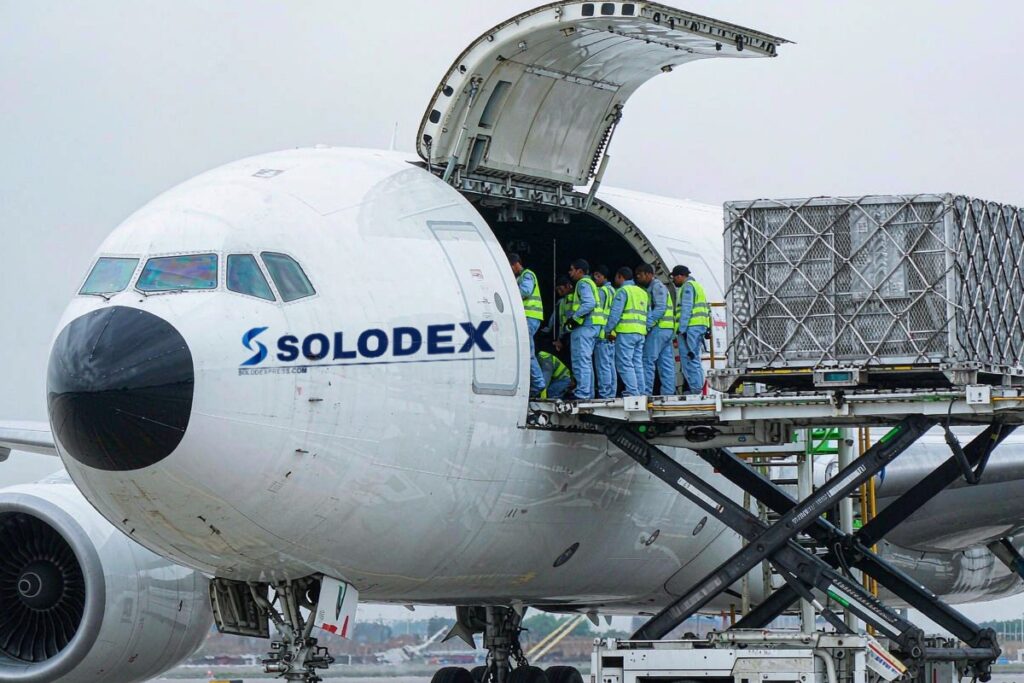
“Can I ship a power bank?” is the wrong question, and it is why the answers online contradict each other. Nothing in the rulebook asks what the product is called. Three parameters decide it: the watt-hour rating, the UN number the pack is classified under, and — since January 2026 — how much charge is left in it. Answer those three and the route is determined; skip them and the parcel is whatever the person at the counter says it is.
The short version: a power bank is a standalone lithium-ion battery, UN3480, class 9 dangerous goods. It can be shipped internationally, but almost never as an ordinary parcel, and on air it is cargo-aircraft freight rather than passenger baggage. Everything below is the detail behind that sentence.
Based on IATA DGR 67th edition (effective 1 January 2026), IMDG and EU Regulation 2023/1542 as at October 2026. Carrier acceptance is narrower than the regulation and changes; confirm with the line before booking. Last reviewed: October 2026.
The number that decides it
Watt-hours, not milliamp-hours. The label on the box usually gives mAh because it sounds bigger; customs, airlines and carriers work in Wh. The conversion is one line:
Wh = mAh ÷ 1000 × nominal voltage — and for the lithium-ion cells inside a power bank the nominal voltage is 3.7 V.
So the thresholds translate into the numbers people actually own:
| Printed rating | Watt-hours (3.7 V) | Air | Sea |
|---|---|---|---|
| 10,000 mAh | 37 Wh | Cargo aircraft only, as UN3480 | Allowed under IMDG conditions |
| 20,000 mAh | 74 Wh | Cargo aircraft only, as UN3480 | Allowed under IMDG conditions |
| 27,000 mAh | ≈100 Wh | Top of the no-approval band | Allowed |
| 30,000 mAh | 111 Wh | Airline approval required | Allowed |
| 45,000 mAh | 167 Wh | Over 160 Wh — no | Allowed, with DG paperwork |
Two traps sit inside that table. The first is that a 20,000 mAh pack is comfortably under 100 Wh — and still cannot fly as ordinary cargo, because the limit that stops it is not watt-hours, it is the UN number. The second is the state of charge: under the 2026 rules, standalone lithium-ion batteries must be at or below 30% charge when handed over, and the figure has to be on the dangerous goods declaration. A fully charged, well-packaged, correctly invoiced power bank is still a refusal.
There is also a separate set of numbers for what a passenger may carry, and it is not the same rule. Hand luggage allows batteries up to 100 Wh without asking, 100 to 160 Wh with the airline’s approval, and refuses anything above. That is a baggage rule. It tells you nothing about whether a courier will accept a carton of them.
Which UN number the parcel gets
| Configuration | UN number | Packing instruction | Passenger aircraft |
|---|---|---|---|
| Power bank on its own | UN3480 | PI965 | Not permitted |
| Battery packed with equipment | UN3481 | PI966 | Permitted, charge ≤30% above 2.7 Wh |
| Battery installed in equipment | UN3481 | PI967 | Permitted up to 100 Wh per battery |
| Lithium metal cells, on their own | UN3090 | PI968 | Not permitted |
This is where sellers accidentally create a problem: a power bank that ships inside a device it powers is a different UN number, a different packing instruction and a different set of documents from the same power bank in its own retail box. Mixing both configurations in one carton is not a shortcut — it is a misdeclaration, and the pack will be pulled.
What the paperwork actually is
For a carton of standalone power banks going by air, the file is bigger than the shipment:
- UN38.3 test report from an accredited laboratory — eight tests including altitude simulation, thermal cycling, vibration, shock and short circuit. It is tied to the cell model, so a new supplier means a new report.
- Safety data sheet in GHS format, bilingual, with the transport section carrying the UN number and packing instruction.
- Air transport condition certificate from a recognised body, stating the UN number, the packing instruction and which aircraft types may carry it. Usually valid for a calendar year.
- UN-specification packaging with its performance certificate, terminals insulated, cells immobilised — plus a 1.2 m drop test where a carton holds more than 24 cells or 12 batteries.
- Dangerous goods declaration signed by a trained shipper, stating the state of charge, plus the class 9 label, the lithium battery mark and, for UN3480, the cargo-aircraft-only label.
That file is per shipment, not per parcel, and it is what makes the difference between a forwarder quoting a power bank lane and a courier quietly refusing the carton at the counter.
Where they can actually travel
Air is possible but narrow: standalone batteries go as cargo-aircraft freight through a dangerous goods channel, which is why the transit time looks like air freight rather than express. Sea is the volume route — under IMDG, small cells and batteries can move under the conditions of special provision 188, and a container of power banks is a normal booking rather than an exception.
What is closed: international postal mail, which does not accept lithium batteries; the express carriers’ ordinary (non-DG) services, which exclude standalone batteries by tariff; and any shipment containing a swollen, damaged or recalled pack, which is refused by every mode without discussion. A power bank that has been dropped, or one from a batch under recall, cannot be shipped at all — not by air, not by sea, not with paperwork.
The second border: European product rules
Shipping rules get the parcel onto a plane. Product rules decide whether it may be sold at the other end, and for the EU they have tightened on a schedule that catches sellers mid-stock:
- CE marking for the finished device — LVD, EMC, RoHS, plus radio equipment rules where the pack has wireless functions — has applied since August 2024.
- Producer responsibility (EPR) has applied since August 2025, and it is registered country by country. There is no single EU registration.
- From 18 August 2026 the battery itself carries a standardised label: manufacturer, category and identification, chemistry, capacity, weight, place and month of manufacture, hazardous substances, and critical raw materials above 0.1%, alongside the crossed-out bin.
- From 18 February 2027 a QR code links to the product information, and portable batteries built into devices must be removable and replaceable by the end user.
One classification detail worth knowing: a battery over 5 kg that is not an e-bike or vehicle battery is treated as industrial under that regulation, power stations included. The same product sold in a smaller casing follows the portable regime with lighter obligations. National regimes sit on top of this — the EU guide covers the customs side of the same shipments.
Why power banks get refused
In practice, rejections cluster into five causes, and only the last is about the product itself:
- Shipped as ordinary cargo without a dangerous goods declaration, because it was booked as “electronics”.
- State of charge above 30%, or no record proving it — the 2026 requirement, and the newest reason for a refusal.
- UN3480 and UN3481 mixed in one carton, or a mixed carton declared under one number.
- Missing or expired paperwork: an air transport certificate from last year, a UN38.3 report for a different cell model, no drop test where the quantity requires one.
- Visible swelling, a damaged casing, or a model under recall.
Questions this page usually raises
- Can I send one power bank to a friend abroad? Realistically no, by post or ordinary courier. It is a dangerous goods shipment regardless of quantity, and the paperwork does not scale down to a single unit.
- Does a power bank inside a phone change anything? Yes — UN3481 under PI967, which can travel on passenger aircraft up to 100 Wh. That is why phones ship easily and loose power banks do not.
- Is a label like “no battery” or “battery removed” acceptable? Only if it is true. A false declaration on a class 9 item is treated far more seriously than a wrong invoice field — the penalty framework is in what happens if you underdeclare a parcel.
- What about the watt-hour figure — do I calculate it or use the printed one? Use the rated value marked on the device. If the pack does not state Wh, calculate from mAh and nominal voltage, and be ready to show the working.
- Where does this sit against the rest of the process? Batteries are step 2 of the six-step sequence — the compliance check that happens before the parcel is packed, not after it is quoted.
Solodex books battery cargo on DG channels with the UN number, state of charge and paperwork settled before pickup, and tells you plainly when a power bank cannot fly. If you want a lane costed with that in view, send us the details.


