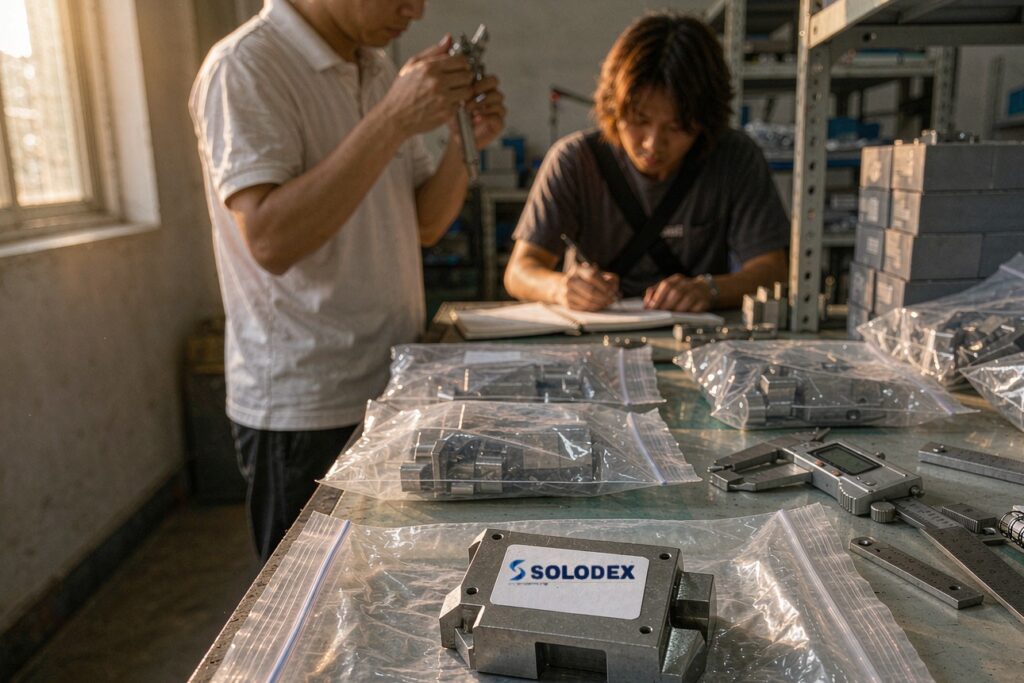
The sample was perfect. The mould was not.
The sample arrived in a foam-lined box, wrapped in tissue, with a printed label. It was flawless: no sink marks, no flash on the parting line, the texture even across the whole face. The buyer approved it, placed a tooling order and a first production run, and five weeks later received ten thousand units with a visible shrink mark on one corner and a parting line you could feel with a fingernail.
Nothing was fraudulent. The sample had been made on a CNC machine and hand-finished by a technician who had spent two days on it. The production units came out of a steel mould running on a forty-second cycle. They were never the same object, and no document in the file said so.
That is the gap this article is about. A sample is evidence of a capability — someone can make one — and buyers read it as evidence of a process, which is a different claim entirely. The factory audit has the same shape: it documents a moment, not a run.
Three kinds of sample, and only one is evidence
The word covers three different objects, and suppliers rarely volunteer which one they are sending.
A prototype is made without production tooling: machined, printed, cast in silicone, assembled by hand. It is the right instrument for checking a design decision — does the lid fit, is the grip the right size, does the colour read correctly. It is worthless as evidence of manufacturing, because none of the manufacturing has happened yet.
A trial sample comes from the production tool but not from the production process. The mould exists, it has been run enough to produce parts, and the parts are usually set aside from the first shots — before the cooling, pressure and cycle settings have been optimised. Trial samples show what the tool can do on a good day, which is more than a prototype shows and less than a production run needs.
A production sample is taken from a run made with production tooling, production parameters and production operators, at the cycle time the factory intends to quote. It is the only one of the three that can be signed as a reference, because it is the only one produced by the process you are buying.
The practical question to ask is not “can I see a sample” but “which tool and which settings produced this”. A supplier who answers precisely is a supplier who understands the difference. A supplier who answers “same as production” without being able to name the tool has told you which of the three you are holding.
The golden sample is a contract, not a keepsake
Signing a sample turns it into a reference: the physical definition of what “correct” means for the life of the order. That makes the signing ceremony more important than it looks, and it is usually conducted in a hurry.
Three things have to be recorded alongside the object. The date, because materials and tools change. The parameters, because a sample produced at a fifty-second cycle is not reproducible at forty. And the identity of the tool, because a sample from cavity two of a four-cavity mould says nothing about cavities one, three and four.
Then there is custody. One signed sample goes to the buyer, one stays at the factory on the line, and — where the order value justifies it — one goes to the inspection body or a third party. A single sample held only by the buyer is a sample nobody can compare against at the point of production, which is the only place the comparison is useful.
The signed sample also expires, in a way nobody writes down. Change the resin supplier, retool a worn insert, move the line to another building, and the reference still exists while the thing it referenced does not. The drift that precedes most supplier failures is visible first as a product that no longer matches a sample nobody re-signed.
What a test report on a sample actually covers
The second common misreading is the test report. A laboratory tests what it is given. If what it was given was a hand-built prototype, the report describes a hand-built prototype, however official the letterhead.
This matters most in categories where the test is a market-access condition rather than a quality check. A certificate issued on a prototype can open a customs file and close a compliance folder while saying nothing about the units in the container — the same distinction that runs through every market’s file requirements. Where the scheme requires the certifier to draw the sample itself, the problem disappears; where the applicant supplies the sample, it does not.
Two habits reduce the exposure. Ask the laboratory what was submitted and who submitted it, and keep that answer in the file next to the report. And where the category allows it, re-test from a production sample before the first bulk shipment — the cost is a fraction of the certificate and it converts a document about an object into a document about a process.
The cost of a sample is not the sample fee
Suppliers and buyers argue about a two-hundred-dollar sample fee and ignore the number that actually matters, which is the time.
A sample shipped by express costs more per kilogram than any commercial cargo will ever cost, and rightly so: it is buying days, not tonnes. What it does not buy is the thing that most delays a launch — the round trips. Sample out, comment back, revision, sample out again. Each cycle is two to three weeks, and three cycles is a season.
Which is why the sample stage deserves more engineering attention than it usually gets and less negotiation. Paying the fee without arguing is cheaper than losing a week to a discussion about who should bear it, and specifying three things in the first request — the tool, the parameters, the intended market — removes one round trip on its own.
There is a customs version of the same carelessness. A sample declared as “no commercial value” is not free of duty by virtue of the phrase — it is a consignment that the destination has to value itself, which usually means a delay and sometimes means a valuation above the invoice. The workable form is the dull one: declare the real cost of the sample, mark the invoice “sample, not for resale”, and keep the value consistent with what the same item would be declared at in a commercial shipment. What the declaration actually means is a separate subject, and it is the one that decides whether the sample arrives in four days or fourteen.
The same arithmetic applies to the cost of skipping. A first run rejected for a defect that a production sample would have caught costs the rework, the freight, the storage and the season. Against that, the entire sample programme is a rounding error, which is exactly why it is treated carelessly.
Six sample situations, and what each one can support
The table is about what a sample can be used for, because the same object can be legitimate for one purpose and misleading for another.
| What you have | Valid use | Not valid for | When it stops being true |
|---|---|---|---|
| Machined prototype | Design and ergonomics review | Any statement about production | As soon as tooling starts |
| First-shot trial sample | Tool sign-off, fit check | Cosmetic and dimensional limits at cycle time | When parameters are optimised |
| Production sample, signed | The reference for inspection | Nothing beyond the tool and parameters named | Material, tool or site change |
| Sample with a lab report | The tested object against the standard | The units in the container | Any change of material or process |
| Salesman sample from stock | Colour and packaging impression | Anything about your specification | Immediately; it is somebody else’s run |
| Sample bought from a marketplace | Benchmarking a competitor | Evidence that your supplier can make it | Before it is even unwrapped |
Read the second and third columns together and the pattern is a mismatch of scope: every sample is valid for a narrow claim and routinely used for a wide one. The signed production sample is the only row that can carry an inspection reference, and even that one carries only what was written next to it.
The long pole is round trips, not money
Everything in this article costs little and takes long. That combination is why the sample stage is where schedules are lost, and why it is managed by the least senior person on the buying side.
The lever is not a bigger sample budget. It is fewer cycles: specify the tool and the parameters in the first request, send reference photographs of the defect limits rather than adjectives, decide who signs before the sample arrives, and treat the signed sample as a document that has to be re-issued when anything underneath it changes. None of that requires authority, and all of it requires somebody to own the sequence.
One more thing goes wrong quietly: three people sign a sample for three different reasons. The engineer signs the design, the quality manager signs the appearance, and the buyer signs the commercial terms — and none of them signs the same list of characteristics. When the first production run is argued about, each party defends the sample they remember approving. A single signature block with the characteristics written on it prevents most of that argument, and it costs one sheet of paper.
A sample is a single unit made under conditions that will never be repeated exactly. A production run is a process held inside limits for weeks. The buyer’s job is not to approve the unit — it is to decide, before the unit arrives, which of those two things the supplier is being asked to demonstrate. The first order is the only honest test, and the sample’s real function is to make that test cheap enough to run twice.
The sample decides what the goods are; the payment term decides who is carrying the risk while that is being settled.
A sample proves a unit for customs; it does not prove who stands at the door, where the receiver is identified by a code on a phone rather than by an import registration.


